

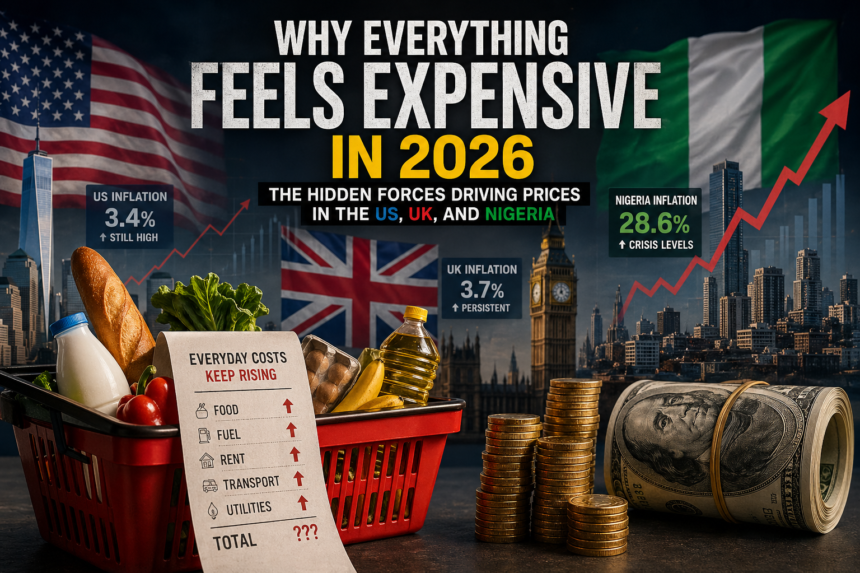

The Illusion of “High Prices”
Your groceries, rent, and transport are rising—but not for the reasons you think. What consumers interpret as “everything getting expensive” is not a single phenomenon—it is the convergence of three structural shifts happening at once: currency realignment, margin reconstruction, and a repricing of risk across supply chains. Prices are not simply rising; they are being reset after a decade of artificially suppressed costs.
In 2026, inflation is no longer just a macroeconomic statistic. It has become embedded in corporate strategy, pricing architecture, and consumer psychology. The result is a persistent sense that prices are detached from reality—even when headline inflation appears to be moderating in the US and UK.
Nigeria, by contrast, is experiencing the same forces in a more visible and accelerated form. What appears as crisis there is often just a more transparent version of what is unfolding more quietly in developed markets.
Inflation Didn’t End—It Evolved
Central banks in the US and UK succeeded in slowing rate of change in inflation, but not the level of prices. That distinction is critical. Prices have plateaued at a higher base, and companies have reorganized their cost structures around that new baseline.
This creates a structural ratchet effect:
- Input costs rise → companies increase prices
- Input costs stabilize → prices stay elevated
- Margins expand → pricing becomes sticky
The assumption that prices will revert downward has proven incorrect. Businesses learned during 2021–2023 that consumers tolerate higher prices longer than expected—especially when increases are gradual and framed as industry-wide.
In Nigeria, this dynamic is amplified by currency depreciation and import dependence, making the “new normal” far more volatile. But the underlying mechanism is identical: once prices move up, they rarely come back down.
The Currency Factor: The Dollar’s Silent Tax
One of the least understood drivers of global price pressure is the persistent strength of the US dollar.
For the US, a strong dollar dampens imported inflation. For the UK, it complicates trade balances. For Nigeria, it acts as a direct inflationary shock.
The transmission mechanism is straightforward:
- Commodities are priced in dollars
- A stronger dollar raises import costs in local currency terms
- Businesses pass those costs to consumers
In Nigeria, where a significant portion of consumption is import-linked—fuel, machinery, pharmaceuticals, processed goods—the exchange rate becomes the primary inflation channel. Even domestically produced goods are indirectly affected through logistics, energy, and raw material inputs.
In the UK, sterling volatility post-Brexit continues to feed into pricing through imported food and energy. Meanwhile, US consumers experience this dynamic less directly—but benefit from lower relative import costs, reinforcing global imbalances.
The net effect: price pressure is unevenly distributed, but structurally connected.
Corporate Pricing Power: From Defensive to Strategic
The most important shift since the pandemic era is not inflation itself—it is how companies respond to it.
Pricing is no longer reactive. It has become a core strategic lever.
Across sectors—from consumer goods to airlines to software—companies have adopted a more aggressive stance:
- Dynamic pricing models adjust in real time
- Shrinkflation preserves margins without headline increases
- Tiered pricing extracts more from higher-income consumers
In the US and UK, large corporations have used their scale and brand equity to push through price increases while maintaining demand. Earnings reports across consumer staples and retail sectors show a consistent pattern: revenues rising faster than volumes.
This is not inflation pass-through. It is margin expansion disguised as cost recovery.
Nigeria presents a different picture. Here, companies often lack the same pricing flexibility due to fragile consumer demand. However, they compensate through:
- Smaller product sizes
- Lower-quality substitutions
- Increased frequency of price adjustments
In both contexts, the outcome is the same: consumers pay more for less real value.
Supply Chains: Efficiency Replaced by Resilience
For decades, global supply chains were optimized for cost. That era is over.
Geopolitical tension, trade fragmentation, and pandemic aftershocks have forced companies to prioritize resilience over efficiency. This shift has structural cost implications:
- Diversified sourcing is more expensive than single-source procurement
- Inventory buffers tie up capital
- Regionalization increases duplication of infrastructure
These costs are not temporary. They represent a permanent repricing of global production.
In the US, reshoring initiatives—particularly in semiconductors and manufacturing—have introduced higher labor and compliance costs. In the UK, supply chain friction linked to post-EU trade arrangements continues to add complexity and cost.
Nigeria faces a dual burden: dependence on imports and weak domestic industrial capacity. Attempts to localize production often run into infrastructure deficits, making locally produced goods paradoxically more expensive.
The result is a global system where cheap goods are structurally harder to produce.
Energy Costs: The Invisible Multiplier
Energy is not just another input—it is the multiplier of all costs.
Even where fuel prices have stabilized, the volatility of recent years has forced companies to reprice energy risk into long-term contracts. Logistics, manufacturing, and distribution all carry embedded energy premiums.
Nigeria’s removal of fuel subsidies exposed this dynamic in its purest form. Transportation costs surged, feeding directly into food and retail prices. What was previously hidden through fiscal policy became immediately visible to consumers.
In the UK, energy price shocks have eased but not reversed. Businesses continue to price in uncertainty. In the US, relative energy independence provides some insulation, but not immunity—particularly in transport-heavy sectors.
The key point: energy costs have been financialized into pricing models, ensuring their impact persists even when spot prices decline.
Consumer Behavior: The Quiet Reset
Consumers are not just reacting to higher prices—they are rewriting their spending logic.
Three behavioral shifts are now visible across all three markets:
1. Trading Down Without Reducing Spend
Consumers shift to cheaper brands or smaller pack sizes but maintain overall expenditure levels. This creates the illusion of resilience while masking declining purchasing power.
2. Selective Premiumization
Even under pressure, consumers continue to spend disproportionately on categories that deliver perceived emotional or social value—tech, beauty, dining experiences.
3. Reduced Price Sensitivity at the Margin
Repeated exposure to price increases has desensitized consumers. The threshold for what feels “expensive” has shifted upward.
In Nigeria, this manifests as frequency reduction—fewer purchases rather than smaller ones. In the US and UK, it appears as substitution within categories.
For companies, this behavioral reset is critical. It allows continued revenue growth even in a constrained environment.
The Margin Story Markets Don’t Fully Price In
Equity markets have largely interpreted recent corporate performance as resilience. A more precise reading would describe it as margin recovery enabled by structural repricing.
Many companies experienced margin compression during the initial inflation spike. The subsequent period has been one of rebuilding margins through pricing discipline rather than cost reduction.
This has two implications:
- Current profit levels may be less sustainable than they appear, especially if demand weakens further.
- Markets may be underestimating consumer fatigue, particularly in lower-income segments.
In Nigeria, listed consumer goods companies show a more volatile pattern—revenues rising nominally, but real profitability under pressure due to FX losses and input cost volatility.
The divergence highlights a broader truth: inflation rewards scale and punishes fragility.
Strategic Execution: Who Is Actually Winning?
Not all companies are navigating this environment equally.
Winners share three characteristics:
- Pricing credibility (strong brands or essential products)
- Supply chain control (integration or diversified sourcing)
- Balance sheet flexibility (ability to absorb shocks without forced pricing)
In the US, large-cap consumer and technology firms continue to outperform due to these advantages. In the UK, multinationals with global revenue streams are better positioned than domestically exposed firms.
In Nigeria, the winners are often those with:
- Access to foreign currency
- Local production capacity
- Strong distribution networks
Execution quality matters more than macro conditions. Two companies facing identical cost pressures can produce radically different outcomes depending on pricing strategy and operational discipline.
The Risks Beneath the Surface
The current pricing environment is not stable. It is balanced on several fragile assumptions:
Demand Elasticity May Snap
Consumers have absorbed repeated price increases—but not indefinitely. A tipping point could trigger abrupt volume declines.
Policy Intervention Risk
Governments under political pressure may intervene—through price controls, subsidies, or taxation—distorting market signals.
Currency Volatility
Particularly in emerging markets, further depreciation could trigger another inflation cycle.
Margin Compression Cycle
If competition intensifies or demand weakens, companies may be forced to reverse pricing gains, compressing margins quickly.
The risk is not a return to low inflation. It is a more volatile pricing environment with sharper cycles.
What This Means
For Investors
Headline revenue growth is no longer a reliable indicator of strength. The key question is how that growth is generated—through pricing, volume, or mix. Companies relying purely on price increases are more exposed to demand shocks.
For CEOs and Operators
Pricing discipline must be matched with cost transparency and operational efficiency. Overreliance on pricing power risks long-term brand erosion.
For Policymakers
Inflation is no longer purely monetary. It is structural—linked to supply chains, energy, and global capital flows. Policy responses focused only on interest rates will have limited impact.
For Marketers
The era of passive demand is over. Value perception must be actively constructed. Consumers are more analytical, even when they continue to spend.
What to Watch Next
Several signals will determine whether current price levels persist or reset:
- Wage growth vs inflation: If wages lag, demand compression becomes inevitable
- Currency stability in emerging markets: Particularly Nigeria’s FX trajectory
- Corporate margin trends: Early signs of compression would indicate pricing limits
- Energy market volatility: Renewed shocks would cascade quickly
The most likely scenario is not a sharp reversal, but a prolonged period of elevated prices with intermittent volatility.
The Real Conclusion
Everything feels expensive not because prices are temporarily high, but because the global pricing system has been structurally repriced.
Cheap money masked inefficiencies. Stable geopolitics enabled low-cost production. Predictable energy prices anchored logistics. Those conditions no longer exist.
What consumers experience today is not inflation in the traditional sense. It is the cost of a more fragmented, risk-aware, and margin-conscious global economy.
The discomfort is real. But it is not temporary.