

By using this site, you agree to the Privacy Policy and Terms of Use.
Accept
BrandiQBrandiQBrandiQ
  • Brand & Marketing
  • Industry News
  • Market Intelligence
  • Business & Economy
  • Technology & Digital
Reading: Nigeria’s Growth Paradox: Falling Inflation, Rising Financial Stress – PiggyVest Report
Share
0

No products in the cart.

Notification Show More
Font ResizerAa
BrandiQBrandiQ
0
Font ResizerAa
Search
  • Brand & Marketing
  • Industry News
  • Market Intelligence
Have an existing account? Sign In
Follow US
© 2026 Brand IQ. All Rights Reserved.
Business & Economy

Nigeria’s Growth Paradox: Falling Inflation, Rising Financial Stress – PiggyVest Report

By BrandiQ Analyst

BrandiQ Analyst
Last updated: March 27, 2026 10:59 am
BrandiQ Analyst
March 27, 2026
Share
3 Min Read
piggyvest
SHARE

A new report by PiggyVest has exposed a deepening contradiction at the heart of Nigeria’s economy: improving macroeconomic indicators are not translating into financial wellbeing for citizens.

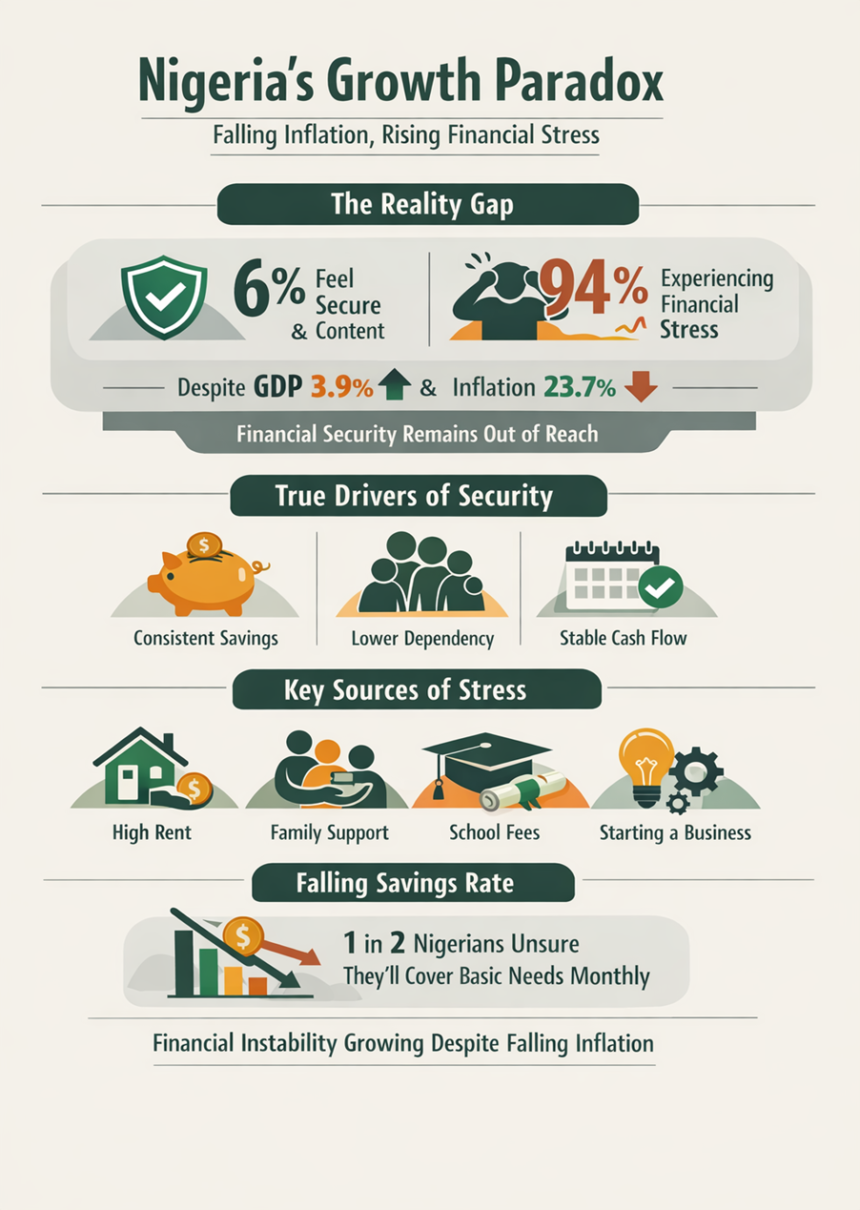
The PiggyVest Savings Report 2025, based on responses from over 26,000 Nigerians, reveals that while inflation is easing and GDP growth remains positive, 94% of Nigerians still experience financial stress, with only 6% reporting a sense of stability and contentment.

Economic Analysis: The Illusion of Macroeconomic Progress

On paper, Nigeria’s economy appears to be stabilising:

  • Inflation moderating to ~23.7%
  • GDP growth approaching 3.9%
  • Relative currency strengthening

Yet, beneath these indicators lies a more complex reality:

Economic recovery is notyet a lived experience – it is a statistical one.

This disconnect highlights a structural issue:
macroeconomic gains are not cascading into household-level resilience.

The Real Drivers of Financial Security (Hint: It’s Not Income)

One of the report’s most striking insights challenges conventional thinking:

Higher income does not guarantee financial security.

Instead, financial stability is driven by:

  • Consistent saving habits (54% of secure individuals save monthly)
  • Lower dependency burdens
  • Predictable cash flow

Surprisingly, some individuals with no stable monthly income still report financial security – underscoring that behaviour and structure matter more than earnings alone.

Structural Pressures Defining Nigerian Households

For the majority, financial stress is not driven by lifestyle choices – but by systemic obligations:

  • Rent and housing costs
  • Family and social support (“black tax”)
  • School fees
  • Capital required to start or sustain a business

These recurring pressures create a cycle where:

 Income is consumed immediately
Savings become impossible
Financial buffers never form

A Dangerous Trend: Declining Savings Culture

The report also highlights a worrying shift:

  • Monthly savers have declined for three consecutive years
  • Over 50% of Nigerians are unsure if their income can cover basic expenses each month

This signals a transition from financial strain to financial instability – a more dangerous long-term condition.

Strategic Implication: Rethinking Economic Success Metrics

The findings raise critical questions for policymakers, financial institutions, and brands:

  • Should GDP and inflation remain the primary indicators of success?
  • How can financial systems enable predictability and resilience, not just income growth?
  • What role can fintechs play in embedding behavioural financial discipline at scale?

What This Means for Brands & the Digital Economy

For brands operating in Nigeria:

  • Financial anxiety is now a dominant consumer reality
  • Products and messaging must reflect value, stability, and trust
  • Fintech and savings platforms have a major opportunity to own the “financial peace of mind” narrative

Bottom Line

Nigeria is not just facing an income problem – it is facing a structural stability crisis.

Until households gain predictable cash flow, reduced obligations, and saving discipline, macroeconomic progress will continue to feel distant


You Might Also Like

New Africa Hospitality Investors Council (AHIC) Launches to Mobilize Global Capital into Africa’s Tourism Economy
Champion Breweries Opens N15.91bn Rights Issue
Nigeria Emerges Among Fastest-Rising Economies in Global Trade Integration – DHL Connectedness Report 2026
Africa’s $360bn Infrastructure Pipeline Faces 57% Talent Gap, PMI Warns
Nigeria’s Nigerian Content Development and Monitoring Board (NCDMB) Secures Key Local Content Role at African Energy Week (AEW) 2026
Share This Article
Facebook Whatsapp Whatsapp LinkedIn Telegram Email Copy Link Print
What do you think?
Love0
Sad0
Happy0
Sleepy0
Angry0
Dead0
Surprise0
Wink0
Previous Article Alternative Bank Alternative Bank & IWG: Building Nigeria’s SME Work Ecosystem
Next Article afreximbank Afreximbank Moves to Build Africa’s Digital Trade Infrastructure with Accelerator Launch
Leave a Comment

Leave a Reply Cancel reply

Your email address will not be published. Required fields are marked *

Africa Launches the First Pan-African Pact for Insurance Inclusion
Business & Economy
Wema Bank, EIB Global Sign €50 Million Facility to Boost Women- and Youth-Led Enterprises 
Brand & Marketing
Maltina’s Nourishment Tour: See What Happens Inside  
Brand & Marketing
Why Brands Should Build Agency Partnerships, Not Supplier Lists, says Penquin Executive
Industry News
- Advertisement -

You Might Also Like

NBC Awards N2m Grants to Women Entrepreneurs

November 11, 2025
Hisell

HiSell Unveils Platform to Simplify Sales for SMEs

December 17, 2025

Lasaco Assurance Introduces Safe Start to Aid Mothers

November 5, 2025

AFCAC Sec-Gen Urges Implementation of Single African Air Transport Market

November 25, 2025
esi africa

ESI Africa Report Maps $4.2 Trillion Opportunity in Energy and Infrastructure

March 27, 2026
Dimension Data

Dimension Data Nigeria Completes $15m Bond Programme to Boost Digital Infrastructure

March 6, 2026

Heirs Energies Recommits to Unlocking Value in Oil Sector

September 26, 2025
Nigeria and Germany national flag

Germany’s €365m Bet on Nigeria Signals New Economic Realignment

May 15, 2026

Subscribe to BrandiQ Newsletter

Subscribe to our newsletter to get our latest articles instantly! Don't worry, we don't spam.
Brand IQ

BrandiQ is Africa’s leading digital platform for brand strategy, business innovation, marketing insights, and data-backed intelligence shaping African markets.

  • About Us
  • Contact Us
  • Privacy Policy
  • Terms & Conditions

Copyright 2013 – 2026 BrandiQ. All Rights Reserved

Welcome Back!

Sign in to your account

Username or Email Address
Password

Lost your password?