


By using this site, you agree to the Privacy Policy and Terms of Use.
Accept
BrandiQBrandiQBrandiQ
  • Brand & Marketing
  • Industry News
  • Market Intelligence
  • Business & Economy
  • Technology & Digital
Reading: Global Brand Pitches Intensify as Consumer Giants Reshape Agency Alliances
Share
0

No products in the cart.

Notification Show More
Font ResizerAa
BrandiQBrandiQ
0
Font ResizerAa
Search
  • Brand & Marketing
  • Industry News
  • Market Intelligence
Have an existing account? Sign In
Follow US
© 2026 Brand IQ. All Rights Reserved.
Market Intelligence

Global Brand Pitches Intensify as Consumer Giants Reshape Agency Alliances

Dr. Desmond Ekeh
Last updated: May 12, 2026 1:50 pm
Dr. Desmond Ekeh
May 12, 2026
Share
8 Min Read
SHARE

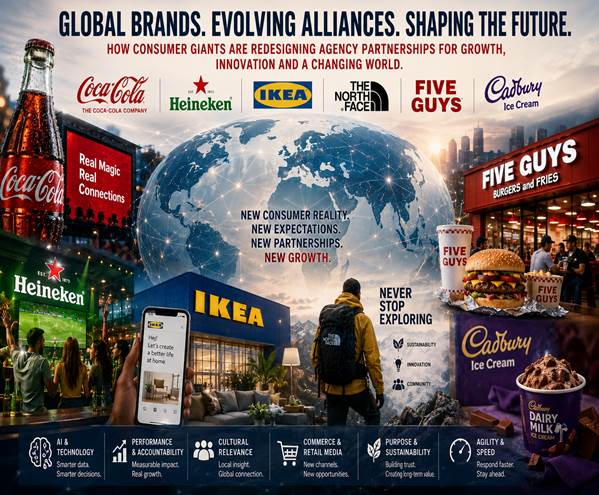
The global marketing and communications industry is entering another cycle of strategic realignment as some of the world’s biggest consumer brands including The Coca-Cola Company, Heineken, IKEA, The North Face, Five Guys and Cadbury Ice Cream review creative, media and integrated communications mandates amid mounting pressure for growth, digital transformation and cultural relevance.

Industry executives familiar with ongoing global pitch movements say the current wave of reviews reflects deeper structural changes within international marketing rather than routine agency reshuffling. The shift is increasingly being driven by artificial intelligence, fragmented consumer attention, retail media expansion, performance accountability and rising geopolitical uncertainty affecting supply chains and consumer spending patterns.

For BrandiQ’s core audience of brand owners, investors, marketing executives and communications professionals, the emerging pitch landscape signals how global corporations are redesigning their agency ecosystems for a more volatile and data driven marketplace.

Coca-Cola’s Expanding Multi-Agency Model

The Coca-Cola Company continues to evolve its global marketing architecture beyond the traditional “one holding company dominance” model that previously characterised large multinational accounts.

Industry analysts note that the beverage giant’s increasing use of specialist agencies, regional creative partnerships and project-based assignments demonstrates a broader trend among multinational advertisers seeking flexibility, speed and cultural localisation.

The company’s recent campaign reallocations suggest a deliberate strategy of balancing global consistency with market specific creativity. This follows growing concerns among multinational brands that oversized agency structures sometimes struggle to respond quickly to rapidly changing consumer behaviour across digital platforms.

For investors, the implication is significant.

Global advertisers are no longer evaluating agencies purely on creative excellence. Increasingly, agencies are being judged on:

  • AI integration capabilities
  • First party data management
  • Commerce and retail media expertise
  • Social influence strategy
  • Cultural intelligence
  • Speed to market
  • Measurement and attribution systems

This explains why independent agencies and agile creative boutiques are increasingly winning assignments traditionally dominated by global holding groups.

Heineken and the Battle for Premium Consumer Attention

Heineken is also understood to be reassessing parts of its communications and experiential marketing ecosystem as global beer and lifestyle brands compete aggressively for younger consumers whose media consumption habits continue to shift toward creator led platforms and immersive digital experiences.

The global beer market is undergoing structural repositioning as brands attempt to maintain premium identity while adapting to health-conscious trends, moderation culture and Gen Z consumption patterns.

Communications experts say alcohol and beverage brands now require agencies capable of combining entertainment, sports partnerships, influencer ecosystems and data analytics into integrated growth engines.

The implication for agencies is profound: traditional advertising alone is no longer sufficient for retaining global beverage accounts.

IKEA’s Marketing Evolution and Retail Reinvention

IKEA remains one of the most closely watched global advertisers because its agency decisions often mirror wider retail transformation trends.

As retail media networks grow globally, furniture and lifestyle brands are increasingly prioritising customer experience design, digital commerce storytelling and sustainability communication.

Industry observers believe IKEA’s evolving agency relationships reflect the need for integrated partners capable of blending:

  • E-commerce marketing
  • Sustainability storytelling
  • AI powered customer personalisation
  • Community engagement
  • Physical and digital retail integration

The company’s marketing evolution also reflects how global retailers are repositioning stores from transactional spaces into experiential brand ecosystems.

Five Guys and Fast Casual Globalisation

Five Guys represents another important trend in global brand communications: the international expansion of premium fast casual dining brands.

As restaurant competition intensifies worldwide, brands are increasingly seeking agency partners capable of localising global narratives without diluting brand consistency.

Marketing consultants say fast growing restaurant chains now prioritise agencies with expertise in:

  • Hyperlocal digital targeting
  • Delivery platform integration
  • Youth culture marketing
  • Community based engagement
  • Social commerce storytelling

This reflects the growing convergence between hospitality, entertainment and digital lifestyle branding.

North Face and the Future of Purpose Driven Branding

The North Face operates in a category where sustainability, environmental ethics and lifestyle identity increasingly shape brand value.

Global apparel and outdoor brands are facing mounting pressure to align commercial messaging with climate responsibility, ethical sourcing and social credibility.

Industry insiders suggest that agencies competing for outdoor and lifestyle accounts must now demonstrate competence in sustainability communication and purpose branding alongside traditional creative execution.

This represents a major shift in the economics of global advertising.

Today, reputation management and ESG storytelling are becoming central revenue drivers for communications firms serving multinational clients.

Why Global Pitch Activity Is Accelerating

Several structural forces are driving the current surge in global pitch reviews.

AI Disruption in Advertising

Artificial intelligence is transforming media planning, creative production, audience targeting and consumer analytics. Global brands are reviewing agency partnerships to ensure technological competitiveness.

Economic Pressure

Slower consumer spending in several advanced economies is forcing multinational brands to demand measurable returns on marketing investment.

Retail Media Growth

Retail platforms are increasingly becoming advertising ecosystems, fundamentally reshaping how brands allocate budgets.

Fragmented Consumer Attention

Younger audiences consume content differently from previous generations, forcing brands to diversify communications strategies across multiple platforms and creators.

Geopolitical and Supply Chain Uncertainty

Global instability is increasing the importance of reputation management, localisation and agile market communication.

Implications for Global Agencies

The latest pitch movements suggest that the traditional dominance of large holding companies may continue facing pressure from specialist firms, AI enabled consultancies and culturally agile independents.

However, holding groups still retain major advantages in:

  • Global infrastructure
  • Data scale
  • Cross market coordination
  • Integrated media buying
  • Enterprise level technology investment

The likely future is not the disappearance of holding companies, but the emergence of hybrid agency ecosystems where brands combine large global networks with specialist independent partners.

What African Agencies Should Learn

For African agencies and communications firms, the global pitch environment offers important lessons.

International clients increasingly seek partners capable of delivering:

  • Cultural intelligence
  • Regional consumer insight
  • Data driven strategy
  • Digital storytelling
  • Sustainability communication
  • Youth engagement
  • AI enabled creativity

African agencies that invest early in technology, analytics and cross border capabilities may become more competitive within the global communications value chain.

The evolving pitch landscape also reinforces a broader reality: in the new global economy, marketing is no longer simply about advertising products. It is increasingly about managing ecosystems of culture, technology, trust and consumer identity.


You Might Also Like

Best Savings Apps in Nigeria With Interest (2026 Tested & Ranked): The Quiet Financial Infrastructure War
Is Africa the Next Silicon Valley?
From Idea to Empire: A Simple but Powerful Framework to Evaluate Any Business
Culture Intelligence Emerges as the New Competitive Advantage as Studio 545 Launches Across Africa and Emerging Markets
African Cloud Economy: Nigerian Brands Risk Consequences of Over-reliance on Foreign Infrastructure
Share This Article
Facebook Whatsapp Whatsapp LinkedIn Telegram Email Copy Link Print
What do you think?
Love0
Sad0
Happy0
Sleepy0
Angry0
Dead0
Surprise0
Wink0
ByDr. Desmond Ekeh
Follow:
Dr. Desmond Ekeh, a PR consultant, journalist, and brand communicator, researches at the intersection of philosophy, politics and communication.
Previous Article Kenya’s $2.1m Agricultural Finance Breakthrough Signals New Era for Africa’s Rural Investment Markets
Next Article Mastercard, Letshego Deepen Africa’s Digital Finance Expansion
Leave a Comment

Leave a Reply Cancel reply

Your email address will not be published. Required fields are marked *

Africa Launches the First Pan-African Pact for Insurance Inclusion
Business & Economy
Wema Bank, EIB Global Sign €50 Million Facility to Boost Women- and Youth-Led Enterprises 
Brand & Marketing
Maltina’s Nourishment Tour: See What Happens Inside  
Brand & Marketing
Why Brands Should Build Agency Partnerships, Not Supplier Lists, says Penquin Executive
Industry News
- Advertisement -

You Might Also Like

lg electronics

LG Electronics Expands Smart Home Portfolio in Nigeria with Climate-Focused Innovation

March 25, 2026
AI Advertising Shake-Up: Meta Surges, YouTube Lags as Data Power Reshapes Global Ad Economy By Desmond Ekeh The first quarter of 2026 delivers a clear verdict on the future of digital advertising: scale alone is no longer enough. In a data-driven economy increasingly shaped by artificial intelligence, performance-not presence-is now the defining currency. Fresh analysis from WARC shows a widening divergence among Big Tech platforms, with Meta Platforms outperforming expectations, Amazon holding steady, and YouTube struggling to convert attention into revenue. At stake is more than quarterly earnings. These shifts are redefining how data, AI, and platform economics interact across Nigeria, Africa, and the global marketplace. The Data Behind the Divergence Below is a simplified analytical snapshot of Q1 2026 performance relative to projections: Platform Actual Ad Revenue Forecast Variance Strategic Signal Meta $55.0bn $54.1bn +2.3pp AI translating directly into monetisation Google Search $60.4bn +13.7% growth expected +5.4pp Search remains dominant, AI enhances usage Amazon Ads $17.2bn $17.3bn est. -0.4pp Stable, full-funnel dominance YouTube $9.98bn $10.05bn -1.9pp Engagement not converting to revenue Google Display Network Decline Decline expected -1.6pp worse Structural weakness in open web Meta and the Economics of Intelligent Attention Meta’s outperformance is not accidental; it reflects a deeper structural advantage. By embedding AI into content ranking, ad targeting, and optimisation, the company has effectively closed the loop between attention and monetisation. The implication is profound: AI is no longer a support tool - it is now the core infrastructure of revenue generation. For emerging markets like Nigeria, where platforms such as Instagram and Facebook dominate digital consumption, this signals a future where: • Advertising efficiency improves dramatically • Smaller businesses gain access to precision targeting • Platform dependency deepens Amazon and the Rise of Transactional Advertising Amazon continues to redefine advertising by collapsing the distance between exposure and purchase. Its retail media model - built on first-party data and purchase intent - remains one of the most powerful propositions in modern marketing. For the global economy, this signals a shift toward closed-loop ecosystems, where: • Every ad impression is measurable • Attribution becomes near-perfect • Marketing budgets increasingly migrate to platforms closest to transaction This has direct implications for African e-commerce ecosystems such as Jumia and Konga, which must now evolve beyond marketplace models into data-driven advertising platforms. YouTube and the Monetisation Paradox Despite massive engagement, YouTube continues to underperform expectations. The challenge is structural: short-form video (driven by platforms like TikTok) captures attention at scale but monetises less efficiently. This exposes a critical tension in the digital economy: • Attention is abundant • Monetisable attention is scarce For content creators across Africa and globally, this suggests that visibility does not equal value unless supported by strong monetisation frameworks. Global Implications: A Data-Centric Advertising Order With Meta, Amazon, and Alphabet collectively controlling over 58% of global ad spend (excluding China), their performance sets the tone for the global economy. United States The US remains the epicentre of AI-driven advertising innovation. The ability of firms like Alphabet Inc. and Meta to convert AI into revenue reinforces America’s dominance in the digital economy. United Kingdom The UK advertising industry, one of the most mature globally, faces increasing pressure to adapt. Agencies must now transition from creative-first models to data-led, AI-enabled strategy firms or risk obsolescence. Africa (Nigeria in focus) Africa stands at a critical inflection point: • Digital ad spend will grow, but largely captured by global platforms • Local platforms risk marginalisation without investment in data infrastructure • Governments must confront issues of data sovereignty and digital taxation For Nigeria, this reinforces the urgency of building indigenous data ecosystems - from fintech to media - to avoid becoming merely a consumption market. Global Economy The broader implication is the emergence of a data hierarchy: • Platforms with first-party data dominate • AI capability determines growth trajectory • Traditional media continues structural decline The Strategic Inflection Point What this quarter ultimately reveals is a shift from digital advertising to intelligent advertising systems. Meta’s success shows what happens when AI enhances both engagement and monetisation simultaneously. Amazon demonstrates the power of proximity to purchase. Alphabet proves search remains resilient, even as its broader ecosystem fragments. And YouTube’s struggle offers a cautionary lesson: in the age of AI, attention alone is no longer enough. BrandiQ Insight The future of advertising will not be decided by who captures the most users, but by who understands them best. Data is no longer an asset; it is infrastructure. AI is no longer innovation; it is execution. For businesses, governments, and institutions - from Lagos to London, New York to Nairobi - the message is clear: Those who control data, design algorithms, and own the customer journey will define the next phase of the global economy.

AI Advertising Shake-Up: Meta Surges, YouTube Lags as Data Power Reshapes Global Ad Economy

May 8, 2026
African Brands

Top 20 Fastest Growing African Brands Transforming the Continent’s Economy (2026)

March 11, 2026
consumer

Report: How AI and New Consumer Behaviour Reshape Global Food Industry in 2026

May 15, 2026
africa, brands

The Rise of Africa’s Brand Economy in 2026

March 9, 2026
volkswagen

Volkswagen South Africa Revives Iconic ‘You and Me’ Ad at 75: How Brand Heritage, Ubuntu and Authenticity Power Long-Term Trust

April 28, 2026
mtn office

MTN Expands 5G Investment as Africa’s Digital Economy Accelerates

May 15, 2026
fragmented customer

The Fragmented Customer: Why Africa’s Financial Future Will Be Orchestrated, Not Owned

April 14, 2026

Subscribe to BrandiQ Newsletter

Subscribe to our newsletter to get our latest articles instantly! Don't worry, we don't spam.
Brand IQ

BrandiQ is Africa’s leading digital platform for brand strategy, business innovation, marketing insights, and data-backed intelligence shaping African markets.

  • About Us
  • Contact Us
  • Privacy Policy
  • Terms & Conditions

Copyright 2013 – 2026 BrandiQ. All Rights Reserved

Welcome Back!

Sign in to your account

Username or Email Address
Password

Lost your password?