

The world’s most admired campaigns are rarely invented in the creative department. They are discovered—in comment sections, search bars, and the quiet contradictions of ordinary life—by brands disciplined enough to listen before they speak.
For most of advertising’s modern history, the consumer occupied two fixed positions in the creative process: a data point at the beginning and an audience to be persuaded at the end. A brand identified an opportunity, commissioned research, defined a target, briefed an agency, and produced an advertisement. The process was linear, orderly, and, for decades, sufficient.
It is no longer sufficient. The most sophisticated global brands have quietly rewritten the sequence, treating culture, behaviour and consumer creativity not as inputs to be studied but as material to be built with. The operative question has changed from “What should we say to consumers?” to a harder one: “What are consumers already saying, doing or wanting that we have the right to act upon?” The distinction sounds academic. In practice, it changes almost everything about where a good idea can come from.
When the Audience Writes the Brief
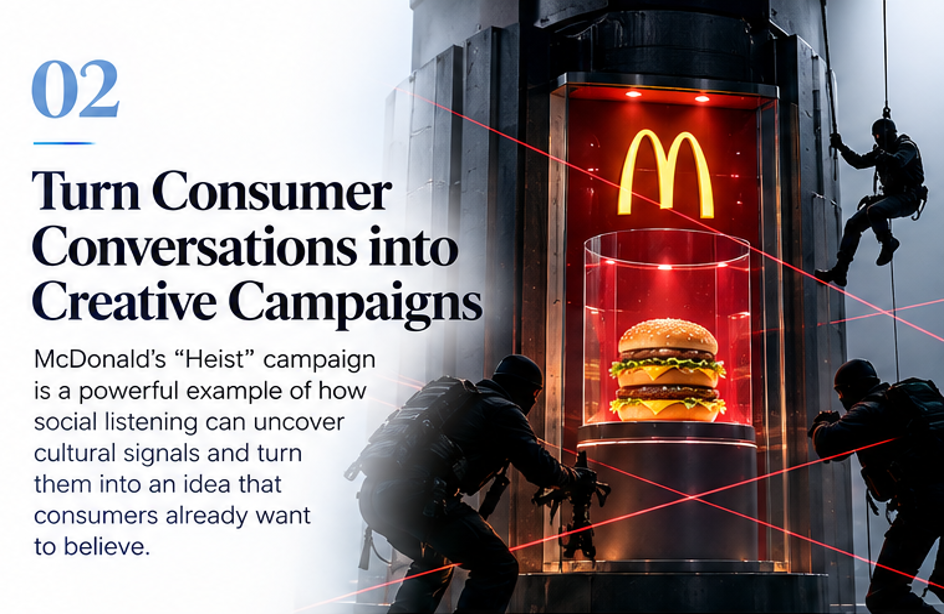
Few campaigns illustrate the shift as cleanly as McDonald’s “World Menu Heist.” The premise was theatrical—a globe-spanning caper in which fans helped “smuggle” beloved international menu items, from Japan’s garlic-and-black-pepper nuggets to Australia’s Pineapple McSpicy, into new markets. But the theatre sat on top of a strategic observation, not an inventive one. For years, fans in the UK and elsewhere had used social media to voice a very specific frustration: envy at menu items available to diners in other countries but not their own. McDonalds and its agency, Leo, did not manufacture that tension. They noticed it, then dramatised it across a three-act campaign of cinema, out-of-home advertising, and real-time social storytelling.
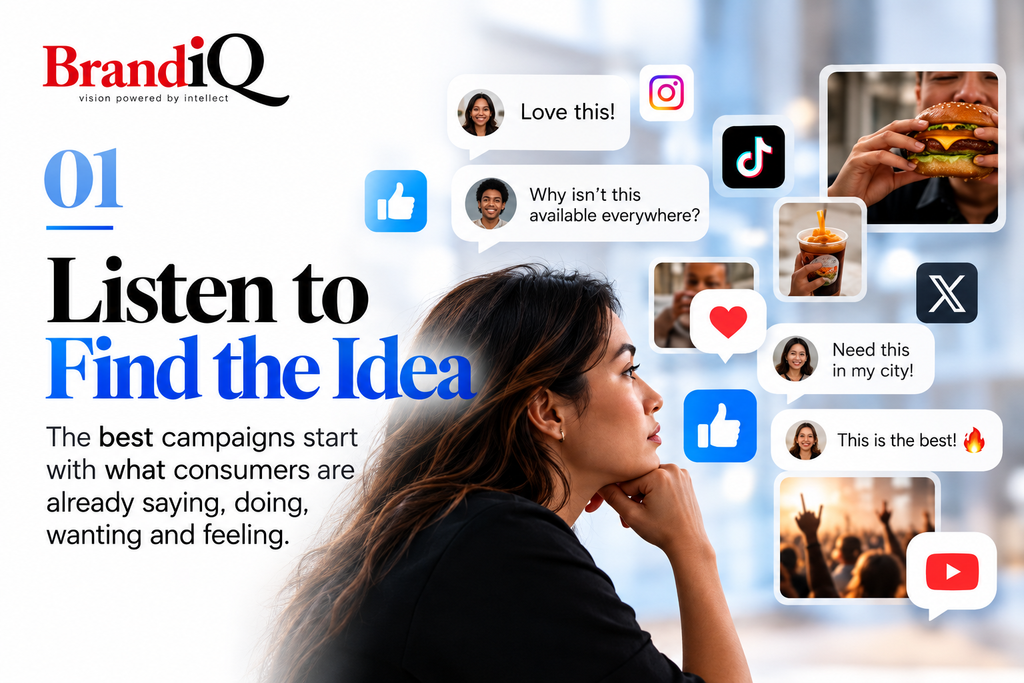
The brand’s own language makes the mechanism explicit: fans, in the words of one McDonald’s marketing director, “are very good at telling us which products they want us to bring home next – so this year we listened.” The same instinct has shown up in smaller, stranger ways at the brand, including a viral pairing of McNuggets and caviar that started life as an unlikely fan combination online before McDonald’s built communications around it. In each case, the consumers doing the posting had no idea they were briefing an agency. In effect, they were supplying the language, the desire, and the emotional evidence a formal research deck could never fully capture. This is what separates social listening from co-creation. Listening collects opinion. Co-creation treats that opinion as a design constraint the brand is obliged to honour.
Beyond the Formal Brief
A conventional brief is still useful – it disciplines a business problem into an audience, a proposition and a desired response. But culture rarely arranges itself into those categories. It shows up instead in comment threads, memes, search patterns, fan communities, complaints and the improvised language people use with one another, most of it too messy to fit a slide.
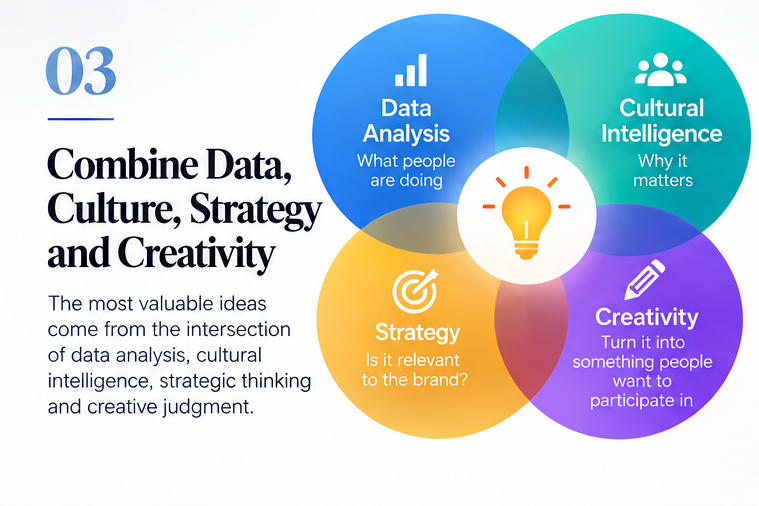
Data on its own does not constitute an insight. A million mentions do not automatically produce an idea. What turns raw behaviour into strategy is judgement: the ability to separate a recurring human tension from passing noise. That is why the strongest creative development now depends on data analysts, cultural researchers, strategists and creatives solving the same problem together, rather than in the traditional sequence of research first, creativity later. None of those disciplines can substitute for the others.
The Tension at the Centre of the Idea
The most enduring campaigns tend to dramatise a contradiction rather than resolve it. People want convenience but distrust what convenience often represents. They want individuality and belonging in the same breath. They profess concern for sustainability while shopping in ways that contradict it.
Dove built one of the past quarter-century’s most studied campaigns on exactly this kind of tension. Company research had found that only four percent of women worldwide would describe themselves as beautiful. Rather than manufacture a new claim about beauty, Ogilvy’s “Real Beauty Sketches” simply dramatised the gap already sitting inside that statistic: a forensic artist sketched women twice, once from their own self-description and once from a stranger, and the two portraits were never the same woman. The idea did not tell consumers what to feel. It showed them a discrepancy they already, uncomfortably, half-knew existed. That is why the film became one of the most-watched pieces of branded content of its era — the insight, once revealed, felt inevitable rather than invented.
THE BRAND AS PARTICIPANT, NOT HERO
Sophisticated brands have also grown more comfortable stepping out of the spotlight they spent decades trying to occupy. Cadbury’s “Not Just a Cadbury Ad”, produced by Ogilvy India for Diwali during the pandemic, is instructive precisely because the brand’s product is almost incidental to the idea. Small retailers across India had been devastated by lockdowns; Cadbury used its brand ambassador, Shah Rukh Khan, and AI-driven video technology to generate more than a hundred thousand hyper-personalised ads naming individual local shopkeepers by store and location. The brand’s chocolate barely appears. What the campaign sells instead is the demonstration that a global company noticed a local hardship and acted on it – evidence, not assertion.
That distinction between behaviour and claim is becoming the more valuable currency. Consumers are saturated with brands announcing that they care, that they innovate, and that they put people first. Such statements are cheap to make and increasingly discounted. A brand that changes something in response to a genuine grievance or builds a platform around an inconvenience it did not cause but chose to fix produces evidence a slogan cannot fake.
Culture as Competitive Territory, Including Africa’s Own
Nowhere is this more apparent than in how global brands have had to relearn African markets on African terms. Guinness’s long dominance across the continent – it accounts for roughly half of all beer sold in parts of sub-Saharan Africa – did not protect the brand from an ageing image. By the early 2010s, Guinness’s African audience had shifted decisively younger, and the brand’s association with old-fashioned notions of wisdom and material success no longer matched how a new generation of African creatives, musicians and entrepreneurs saw themselves. The resulting “Made of Black” platform, built with African artists and performers across Lagos, Accra, Nairobi and Johannesburg, repositioned the brand’s own colour as an attitude — boldness, self-invention, creative confidence – rather than a heritage claim. It was not a research insight so much as a cultural correction, arrived at by finally looking at who was actually drinking the beer and what they wanted the brand to say about them.
The lesson generalises. Global brands operating in Africa cannot import a Western cultural read and expect it to translate; the insight has to be sourced locally and genuinely, or the campaign reads as performance rather than participation.
Speed, Restraint and the Discipline of Listening
Digital platforms have compressed the distance between a cultural moment and a brand’s response to something close to real time. That is an advantage only for organisations with the judgement to use it well. The abundance of data has made restraint more important, not less: a fleeting meme is not a durable insight, and a brand that joins every conversation earns none of the credibility of the brand that joins the right one. Relevance is not the same as participation, and a brilliant idea that does not belong to a brand’s history or character is still the wrong idea for that brand.
The New Creative Idea
The competitive edge for global brands is shifting away from the size of the media budget and toward the discipline of attention itself: the ability to listen continuously, interpret quickly, and act in ways credible enough to be believed. McDonald’s needed years of fan chatter before “World Menu Heist” made sense. Dove needed a single, uncomfortable statistic. Cadbury needed a crisis it did not create but chose to answer. Guinness needed to notice that its own audience had already moved on without it.
In each case, the organisation’s task was never to invent desire. It was to recognise it early enough, and treat the people expressing it as something more valuable than an audience – as, in effect, the first members of the creative team.