

Nigeria carries more than a quarter of the world’s malaria burden. For decades, its most essential line of defence – the insecticide-treated net – has been manufactured abroad and shipped in. A wholly Nigerian-owned facility in Ogun State has begun changing that – and the story it tells is bigger than any single product.
The numbers are not easy to sit with. Nigeria accounts for approximately 27 per cent of all malaria cases globally – more than any other country on earth. Each year, hundreds of thousands of Nigerians, predominantly children under five, die from a disease that is preventable and treatable. The insecticide-treated net is one of the most cost-effective tools in the global public health arsenal for preventing malaria.
And until very recently, not a single one of those nets was manufactured in Nigeria. Every net deployed in every Nigerian home, every net distributed in every government mass campaign across all 36 states, had been made overseas and transported across thousands of miles of ocean before it ever reached the child it was designed to protect.
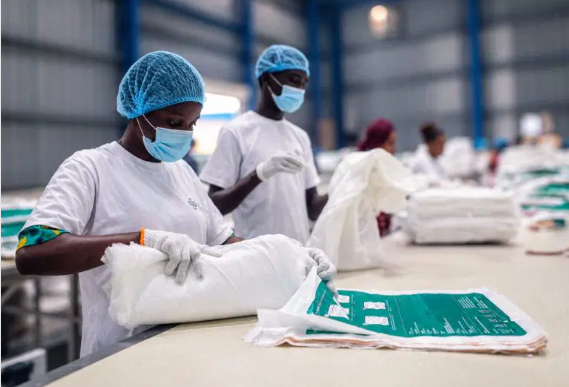
That has now changed. On 13 September 2026, Harvestfield Healthcare FZE commenced commercial production of Synera DuoForte, a next-generation dual active ingredient long-lasting insecticidal net, at its manufacturing facility in the Harvestfield Free Trade Zone in Ogun State. The facility is the first of its kind in Nigeria to be wholly Nigerian-owned.
It manufactures Synera DuoForte under a manufacturing agreement with GDM Health Products, producing nets of the pyrethroid-chlorfenapyr class – a category the World Health Organisation recommends specifically for areas where mosquito populations have developed resistance to conventional pyrethroid-only nets. The facility is already supplying a World Bank-funded programme that reaches 31 Nigerian states.
The technical distinction between conventional and dual active ingredient nets is not merely a product specification. It is a reflection of the specific disease environment in Nigeria. Mosquito populations across much of the country have developed resistance to pyrethroids – the insecticide class that has formed the backbone of net-based malaria prevention for decades.
While a conventional net continues to provide a physical barrier, its insecticidal function is increasingly compromised in resistant mosquito populations. Dual active ingredient nets address this directly, combining the pyrethroid with a second insecticide that acts through a different biological mechanism and remains effective where resistance has taken hold.
Synera DuoForte carries WHO prequalification – the internationally recognised quality benchmark required for procurement by major global health funders including the Global Fund and USAID. The Harvestfield facility in Ogun State is included as an approved manufacturing location under that prequalification, and is separately certified by NAFDAC and holds ISO certification.
These are not regulatory decorations. They are the conditions of market access for internationally funded health programmes, and achieving them represents a considerable institutional and technical achievement for a first-time manufacturer in this category.
“Building the capacity to manufacture our own health products is central to Nigeria’s health security.” – Prof. Muhammad Ali Pate, Coordinating Minister of Health and Social Welfare
Harvestfield is not a newcomer to Nigeria’s malaria control ecosystem. The Harvestfield group has operated in the country’s vector control sector for 26 years, distributing more than 42 million insecticide-treated nets across all 36 states and serving as an exclusive national distribution partner for WHO-prequalified nets since 2018.
The transition from distributor to manufacturer is therefore not a disruption of a business model but its logical extension – a company that has spent more than two decades understanding the logistics, the regulatory environment and the disease burden of the market it serves, now adding the capability to produce for that market domestically.
The development sits within a notably active moment for healthcare manufacturing in Nigeria. Harvestfield is also the promoter of the Harvestfield Medical Free Trade Zone, to which the Nigeria Export Processing Zones Authority has granted operational licences. Through a separate joint venture – SNG Health, formed with Swiss net manufacturer Vestergaard – the group is producing PermaNet Dual, Vestergaard’s own dual active ingredient pyrethroid-chlorfenapyr net, with an annual capacity of 10 million nets.
That programme is projected to meet approximately 30 per cent of Nigeria’s insecticide-treated net demand in its first phase and has created an estimated 600 jobs in manufacturing, quality control and logistics. The two manufacturing streams – Synera DuoForte under the GDM agreement and PermaNet Dual through SNG Health – represent a meaningful and rapidly maturing local production base for a product category that has been almost entirely import-dependent.
BRANDIQ ANALYSIS & VERDICT
The strategic logic of healthcare manufacturing sovereignty
The Harvestfield story is, on the surface, a public health story. But for the brand, marketing and business community that BrandiQ serves, it is also a strategy story – one that repays careful examination for what it reveals about how institutional ambition, patient capital and regulatory intelligence combine to create durable competitive advantage in markets that most operators are content to treat as distribution territories.
Nigeria spends an estimated several billion naira annually importing medical consumables, pharmaceuticals and healthcare equipment. The malaria net category is a small but symbolically significant subset of that import bill. The decision to manufacture locally rather than continue distributing imports carries costs – capital investment in facility and certification, the complexity of a manufacturing operation versus a distribution one, the time required to achieve the regulatory credentials that international buyers accept. What Harvestfield has demonstrated is that these costs can be absorbed by a company with sufficiently deep market knowledge, sufficiently patient institutional support and a sufficiently clear-eyed reading of where regulatory and procurement policy is heading.
“PVAC exists to move Nigeria from importing its health products to making them.” – Dr Abdul Mukhtar, Presidential Initiative for Unlocking the Healthcare Value Chain
That last point is critical. The Harvestfield manufacturing investment did not happen in a vacuum. It was enabled by a specific and deliberate policy architecture: the Presidential Executive Order on Local Manufacturing of Healthcare Products signed in 2024, the Presidential Initiative for Unlocking the Healthcare Value Chain (PVAC), the Nigeria First procurement policy, and the granting of Free Trade Zone status to the Harvestfield facility. Each of these represents institutional infrastructure that reduces the risk of local manufacturing investment by signalling government commitment, providing procurement preference for locally produced goods and simplifying the regulatory pathway for compliant manufacturers. Harvestfield read that architecture correctly and moved early. The World Bank-funded programme supplying 31 states on day one of commercial production is the clearest possible evidence that the policy signal was credible.
The brand implications of ‘Made in Nigeria’
For Nigerian health product brands considering the same transition – from distribution or importation to domestic manufacturing – the Harvestfield case offers a template that is as much about brand positioning as it is about operations. The phrase ‘wholly Nigerian-owned’ in the press release is not incidental. It is a deliberate brand statement, addressed simultaneously to the Federal Government’s Renewed Hope agenda, to global health funders who are under increasing pressure from their own donor governments to support in-country manufacturing capacity, and to the Nigerian public, for whom health sovereignty – the ability to produce the products that keep you alive within your own borders – is an increasingly resonant political idea.
The dual partnership structure Harvestfield has built is also instructive. By maintaining two simultaneous manufacturing arrangements – one with GDM Health Products for Synera DuoForte and one with Vestergaard through SNG Health for PermaNet Dual – the company has diversified both its product range and its technology partnerships. It is not dependent on a single international partner for either technical knowledge or market access. This is a form of strategic resilience that most Nigerian manufacturers in any sector would recognise as valuable: the avoidance of single-point-of-failure relationships in the supply chain.
What the 45-day ocean journey actually costs
There is a line in the press release that does not receive as much attention as it deserves: the observation that local manufacturing eliminates the 45 to 60-day ocean journey associated with imported nets. In a country managing malaria at the scale Nigeria does – with mass distribution campaigns timed to seasonal transmission peaks, with distribution logistics spanning 36 states and a population of over 220 million – the supply chain flexibility that local production provides is commercially and epidemiologically significant. A campaign that runs short of nets because a container was delayed in a European port, or because a naira devaluation made an emergency re-order prohibitively expensive, has measurable consequences in disease transmission. Local manufacturing reduces that vulnerability. The brand value of supply chain reliability is, in healthcare, ultimately measurable in lives.
For the wider Nigerian business community, the Harvestfield story is also a reminder that the most durable competitive positions in any market are built by companies that understand their sectors deeply enough to see, years before their competitors, where the regulatory and institutional environment is heading – and which have the organisational capacity and financial patience to be in position when it arrives. Harvestfield did not build a mosquito net factory because the moment suddenly presented itself. It built one because 26 years of operating in Nigeria’s vector control market had given it the intelligence to know that the moment was coming, and the relationships to ensure it was trusted when it did.
BrandiQ Verdict: The Harvestfield Healthcare manufacturing launch is one of the more consequential industrial brand stories in Nigeria this year – not because it is the largest investment, but because it represents the clearest recent example of a Nigerian company successfully navigating the full arc from market entry to sovereign manufacturing in a sector that matters enormously to the country’s development. The WHO prequalification, the NAFDAC certification, the ISO standard, the World Bank programme supply, the Free Trade Zone, the 31-state reach on day one – these are not marketing claims. They are the verifiable outcomes of a strategy that was patient, intelligent and deeply rooted in the specific conditions of the Nigerian market. That is, in the end, the only kind of brand-building that lasts.