
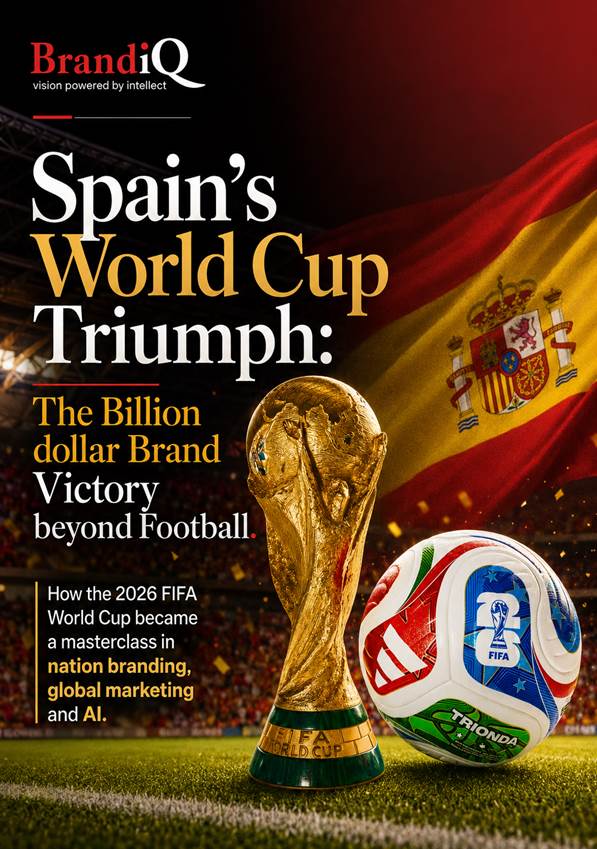

How the 2026 FIFA World Cup became a masterclass in nation branding. global marketing and Artificial Intelligence.
Football decides champions; the World Cup manufactures brands. That distinction was easy to miss on Sunday night, when Ferran Torres’ 106th-minute strike settled a goalless, nerve-shredding final between Spain and Argentina at the New York New Jersey Stadium. Spain’s 1-0 win, was sealed in extra time. Lionel Messi walked off the pitch probably for the last time in an Argentina shirt. Lamine Yamal, barely out of his teens, confirmed his arrival as the sport’s next commercial phenomenon.
None of that, however, is the most consequential story to emerge from the first 48-team World Cup. The more durable one is structural: football’s showpiece has become the world’s largest functioning marketplace for attention, and attention is now the scarcest input in the global economy.
The Attention Economy’s Biggest Event
Every four years, the tournament briefly becomes the planet’s dominant advertising medium. Billions of television viewers, several million travelling fans, and a compressed month of unbroken narrative tension create a form of reach no media plan can otherwise buy. A jersey, a stadium hoarding, a post-match interview backdrop: each becomes inventory in an economy of emotion.
That is why Adidas, Coca-Cola, Visa, Hyundai, Lenovo, Qatar Airways and Hisense continue to pay extraordinary sums for proximity to it. They are not purchasing eyeballs so much as renting the residue of collective feeling, which behavioural research has long shown outperforms ordinary advertising on recall and loyalty. Four yearly weeks of that feeling are worth more to a marketing department than years of conventional campaigning.
A Nation’s Balance Sheet
Spain returns home with an asset that will not show up in any federation’s accounts: an upgraded national brand. Country reputation is one of the more under-priced levers of competitiveness. It shapes where capital flows, which passports get preferential visa treatment, which cities host the next global conference, and how exporters are received in markets they have never visited.
Spain has spent two decades cultivating an image built on renewable-energy leadership, culinary reputation, architecture, tourism infrastructure and footballing pedigree. A second World Cup does not create that image; it renews the lease on it, at a moment when European economies are competing hard for capital and talent.
Argentina’s calculation is different, and instructive. A final lost in extra time is not the same as a brand in decline. Its run to consecutive finals, layered on the 2022 title and Messi’s global following, has done more for Argentine sports diplomacy and tourism than a single trophy could undo. Institutions and reputations compound over years; a scoreline is a single data point.
Football’s Quiet AI Tournament
The less visible headline from this World Cup is technological. Squads leaned harder than ever on predictive analytics, computer-vision tracking, injury-risk modelling and machine-assisted opposition scouting. None of it appeared on a scoreboard, yet coaching staffs increasingly regard it as decisive as any transfer.
The lesson transfers directly to boardrooms. Organisations that treat artificial intelligence as a decision-support layer, rather than a novelty bolted onto marketing, are building a durable edge. Those that delay integration are not merely missing a trend; they are ceding the same kind of marginal advantage that separated Spain’s data-informed patience from Argentina’s more improvisational approach in extra time.
FIFA’s Expanding Commercial Machine
One participant wins every World Cup regardless of the score: FIFA itself. The expansion to 48 teams for this edition manufactured more matches, more broadcast windows and more sponsorship inventory across three host countries. More matches produce more audiences; more audiences justify higher sponsorship fees; higher fees fund the next cycle of expansion. It is an unremarkable growth strategy, executed at a scale few industries can replicate – and a reminder that the tournament’s real product is not football but reach, sold repeatedly to the same buyers at a rising price.
Lessons for Nigerian Brands
Nigeria’s corporate leaders should study Spain’s victory carefully. Winning is rarely accidental. Successful organisations invest consistently in talent, technology, governance and long-term capability. Too many African businesses still focus excessively on quarterly performance while neglecting innovation, leadership development and institutional strength. Spain’s success reflects years of investment in football academies, coaching systems and youth development. Businesses require similar long-term thinking. The strongest brands are not built during crises. They are built before crises emerge.
The Lesson for African CEOs/Boardrooms
Spain’s route to the trophy was built on succession planning, youth development, tactical discipline and composure under extended, scoreless pressure – qualities more commonly praised in annual reports than post-match interviews. The broader point holds across sectors: organisations engineered around a single star eventually stall when that star departs or underperforms.
Organisations engineered around systems and institutional depth keep producing results after any one contributor moves on. Spain’s squad, deep enough to introduce a match-winning substitute in the 106th minute, is the footballing version of institutional bench strength. Nigerian and African executives should study the mechanics of Spain’s victory more closely than the scoreline. Sustainable winning is rarely improvised; it is the compounding return on investments made years before results are visible – in talent pipelines, coaching systems, governance and technology. Too many businesses on the continent still optimise for the next quarter while starving the innovation and leadership pipelines that produce a “Spain” a decade later. Brands built for resilience are assembled before the crisis, not during it.
Governments have a parallel lesson. Sport is too often filed under entertainment budgets rather than economic infrastructure. Yet a month of sustained sporting excellence can move tourism numbers, soften a country’s investment risk perception, and open diplomatic doors that years of conventional trade missions cannot. Few instruments reshape international perception as quickly, or as cheaply, as a well-run national team.
The BrandiQ Insight
The final whistle in New Jersey closed one tournament and opened a different conversation. The prize awarded on Sunday was not only a trophy; it was four weeks of unmatched global relevance, distributed unevenly among the nations, brands and technologies that positioned themselves to capture it. Spain proved that excellence, patiently built, travels. Sponsors proved that emotion remains marketing’s most reliable currency. Coaching staffs proved that artificial intelligence is already inside the machinery of elite performance, however invisible on television. And governments were reminded, again, that sport is now a genuine instrument of economic diplomacy – one African institutions have been slower than most to use.