

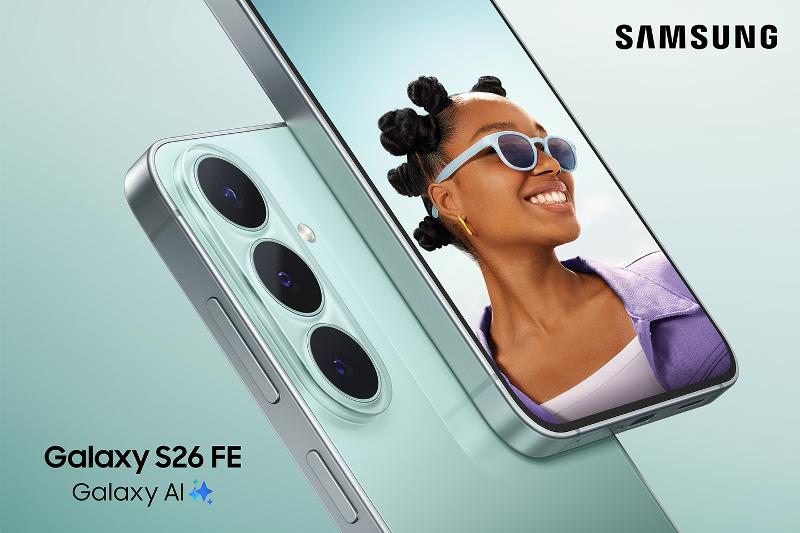

Samsung Nigeria has launched the Galaxy S26 FE in Lagos, extending its flagship S-series with a model built specifically to sit beneath the standard, Plus, and Ultra variants – and to serve, as the company puts it, as the door through which new customers first step into the Galaxy ecosystem.
Speaking at the launch, Omolade Agbadola, Head of Product Marketing for Samsung Nigeria’s MX Division, described the FE range as a deliberate strategy to widen the premium smartphone market rather than simply add another SKU to it. The line has served this role since earlier S-series generations, and Agbadola was direct about its purpose within the family: it is the product Samsung uses to welcome new customers into the S-series, rather than a compromise pitched at customers priced out of it. The launch, she said, is part of a broader push to build awareness of Samsung’s expanding device range and to underline the brand’s competitiveness in a segment where every major manufacturer is fighting for the same upgrade cycle.
On the technical side, Samsung Nigeria’s Training Manager, Ayo Akinrinnola, walked through what separates this generation from its predecessors. The improvements span photography, video, on-device AI, battery performance, and – notably – long-term software support. The standout camera upgrade is a wider selfie capability: an 85-degree field of view on the front camera that automatically adjusts as more people step into frame, letting group photos fit everyone in without anyone needing to lean back or hand off the phone. “We’ve improved on the wider selfie to actually capture more people into the frame, so that you can have a lot of people in your pictures,” Akinrinnola said.
Samsung is also extending its software commitment on the device, promising seven years of security updates – a figure that places the S26 FE’s support window on par with the company’s premium Ultra models, rather than treating it as a lesser commitment reserved for the top of the range. Under the hood, the phone runs on Samsung’s Exynos 2500 processor and features a 6.7-inch Dynamic AMOLED 2X display with an adaptive refresh rate of up to 120Hz – specifications consistent with Samsung’s global rollout of the device earlier this year, alongside the standard Galaxy S26, S26 Plus, and S26 Ultra.
BrandiQ Analytic Insight
The most telling line in Samsung’s own messaging is Agbadola’s description of the FE as the product built to make a customer feel welcomed into the S family. That single sentence reveals the actual job the FE line is hired to do: it is not a budget phone wearing a flagship badge, it is a conversion tool, engineered to move price-sensitive but aspirational buyers into a brand ecosystem they might otherwise never enter, with the expectation that later purchases wearables, tablets, eventual Ultra upgrades – follow once a customer is inside it.
Matching the FE’s software-support window to the Ultra’s is a quiet but significant signal in that same direction. Long-term security updates are typically the feature manufacturers ration most carefully to protect flagship pricing; extending seven years of support down to an entry-tier S-series device suggests Samsung is treating software longevity as a baseline expectation across its ecosystem rather than a premium perk, likely in direct response to competitors – and increasingly, regulators – pushing device longevity up the list of what buyers compare before they compare price.
The wider-selfie feature, meanwhile, is a small piece of engineering doing outsized cultural work in markets like Nigeria, where group photography – families, friend circles, event culture – is a defining use case for a smartphone camera in a way Western marketing materials rarely foreground. That Samsung is highlighting this feature specifically at a Lagos launch, rather than leaving it as a footnote spec, suggests the company is tailoring its regional messaging to reflect how its device is actually used locally, not simply translating a global press release.
For brand strategists, the S26 FE launch is a compact case study in tiered-family marketing: the same underlying strategy – a well-specified “almost-flagship” designed to expand a premium ecosystem’s addressable market rather than cannibalise its top tier – that Apple, Google and others now run in parallel, adapted here with camera and support choices calibrated for the market it is actually launching into.