
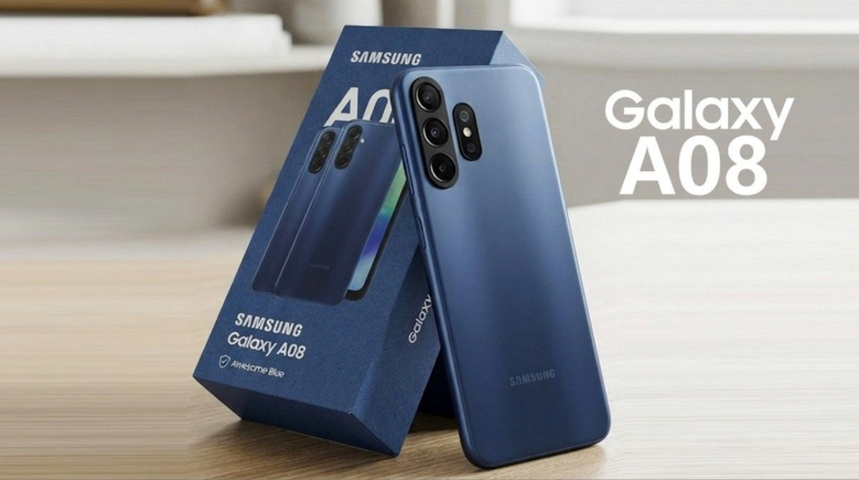

Samsung Electronics West Africa has added a new entry to its Galaxy A-Series with the launch
of the Galaxy A08, a smartphone positioned at the accessible end of the market but equipped,
the company says, with capabilities that have until recently been associated with considerably
more expensive devices. The launch, announced through Samsung Experience Stores,
authorised dealers and partner retailers across the region, introduces a device built around three
headline propositions: a large battery, AI-powered features and an unusually long software
support commitment.
The battery is, by the standards of the entry-level market, genuinely notable. At 6,000mAh, the
Galaxy A08 offers approximately 22 hours of video playback, a figure that, if it holds in realworld
usage conditions, addresses one of the most persistent and commercially significant
frustrations in Nigeria’s smartphone market. Power infrastructure in Nigerian cities remains
inconsistent, and the demand for devices that can hold charge through an unpredictable day -or
the beginning of a load-shedding cycle – is not a nice-to-have. It is a baseline consumer
requirement that premium device manufacturers have long understood and entry-level makers
have only inconsistently served.
The device carries IP64 dust and water resistance, a side-mounted fingerprint sensor, a 6.7-inch
display and a MediaTek Helio G99 processor with 4GB of RAM and 128GB of onboard storage expandable via memory card. It comes in Dark Blue, Silver and Green.
What will generate the most marketing attention, however, is the AI feature set. Samsung has
brought two capabilities from its higher-tier Galaxy range down into the A08: Circle to Search,
which allows users to query anything on their screen without leaving the app they are using, and
Multiple Agentic AI, which enables more integrated task completion across supported
applications through Gemini and Perplexity.
These are not cosmetic additions. Circle to Search, in particular, has become one of the more practically useful AI tools in everyday smartphone usage – a genuinely functional shortcut for a generation of consumers who live between multiple apps and browser windows simultaneously.
The announcement that carries perhaps the most strategic weight, however, is the software
support commitment. Samsung says the Galaxy A08 will receive up to six generations of
operating system upgrades and six years of security updates. To understand how unusual this is
at the entry-level price point, consider the context: the Galaxy A06, Samsung’s previous
comparable entry-level launch in Nigeria, priced at N146,000 in October 2024, was committed
to only two major Android updates.
The leap from two OS updates to six, in the space of roughly two years and one model iteration, is not a modest incremental improvement. It is a fundamental shift in how Samsung is thinking about the lifecycle value of its most affordable devices. The Galaxy A08 is available now across Samsung’s West African retail network. Pricing for Nigeria has not been formally stated in the launch materials, but comparable markets suggest a
range broadly consistent with the A06’s entry price adjusted for currency movement.
BRANDIQ ANALYSIS
The Galaxy A08 is not a revolutionary device. Samsung did not intend it to be. What it is – and
what makes it worth examining carefully from a brand and market strategy perspective – is a
precise and revealing statement about how Samsung understands the West African consumer
market in 2026, where it sees the competitive pressure coming from, and what it believes it
needs to offer to hold its position in the one segment that is growing fastest on this continent.
The entry-level smartphone market in Nigeria and across West Africa is not short of
competition.
Tecno, Itel and Infinix, all brands operating under the Transsion Holdings
umbrella, have collectively dominated the sub-N200,000 price segment for years with devices
specifically engineered for African market conditions: extended battery life, multiple SIM
slots, camera software tuned for darker skin tones, and price points calibrated to purchasing
power that Samsung’s Korean production economics have historically struggled to match. The
Galaxy A-Series is Samsung’s sustained answer to Transsion’s market intelligence. The A08 is
the latest iteration of that answer, and it is a more complete one than most of its predecessors.
The 6,000mAh battery is the clearest evidence of Samsung listening to what this market
actually needs rather than adapting a specification designed for a different market. A 6,000mAh
battery is not a feature that Samsung’s Galaxy S-Series users in Seoul or London are asking for.
It is a feature that a Lagos-based user whose office block loses power at 2pm every Tuesday has
been asking for implicitly since the first time their phone died during a client call. The fact that
Samsung has included it at this price tier, alongside IP64 protection against the dust of a West
African dry season and the splash of a Lagos rain, suggests a product team that has done its
homework on the conditions of daily use.
The AI features are a more complex story. Circle to Search is genuinely useful and its inclusion
at this price point extends a meaningful capability to a much broader user base than currently
accesses it. The Multiple Agentic AI integration – connecting Gemini and Perplexity across
supported apps – is more aspirational in its positioning. Its real-world utility will depend heavily
on the quality of mobile data connectivity available to Galaxy A08 users, and in markets where
data costs remain significant relative to income, AI features that are data-intensive may remain
more impressive in a product brochure than in daily practice. Samsung would do well to ensure
that these features are optimised for lower-bandwidth environments rather than simply ported
from flagship models where data consumption is rarely a constraint.
The software support commitment is, from a brand strategy perspective, the most significant
element of this launch. Six years of OS upgrades and six years of security updates at the entrylevel
price point is a commitment that most manufacturers – including Samsung’s direct
competitors in the West African market – do not come close to matching. It repositions the
Galaxy A08 from a device you buy because it is cheap to a device you buy because it is a sound
long-term investment. That is a fundamentally different value proposition, and it speaks to a
consumer who is thinking not just about what they can afford today but about the total cost of
ownership over time.
In a market where disposable income is under sustained pressure and the replacement cycle for
smartphones is lengthening, the promise that a device bought today will receive security
patches and major software updates until 2032 is commercially meaningful in ways that a
headline spec sheet cannot easily convey. It is also, for Samsung, a differentiation play that
Tecno and Infinix cannot easily replicate at equivalent price points – and one that, if
communicated effectively in Samsung’s West African marketing, has the potential to shift the
conversation from price comparison to value comparison.
That communication challenge is where Samsung’s marketing team in West Africa will earn its
budget over the coming months. The Galaxy A08’s spec sheet is competitive. Its battery and
software commitments are genuinely strong. But the Nigerian consumer who is choosing
between a Galaxy A08 and an equivalent Tecno or Infinix device at a similar price point will
make that choice based on a combination of brand trust, peer recommendation and retail
experience – not on a press release. Samsung’s six-year software commitment needs to be the
centrepiece of an accessible, locally resonant campaign that turns a technical promise into a
human one. Something along the lines of: “The phone that will still be working when your child
starts secondary school.” That is the sentence that moves a purchase decision. The spec sheet is
just the evidence behind it.
BrandiQ Verdict:
The Galaxy A08 is a well-considered entry-level launch that demonstrates Samsung’s
increasing sophistication in reading the West African market. The battery, the IP64 protection,
the AI features and – above all – the six-year software support commitment represent genuine
value additions at this price tier. The device’s competitive positioning against Transsion’s West
African stable is stronger than it has been at comparable price points for several years. The
outstanding question is not whether the product is good enough. It is whether Samsung’s
marketing communications in Nigeria and across West Africa will be bold enough, local
enough and sustained enough to make that goodness legible to the consumer who needs to hear
it most – the one standing in a Lagos phone shop, budget in hand, deciding whether Samsung is
worth the stretch.