
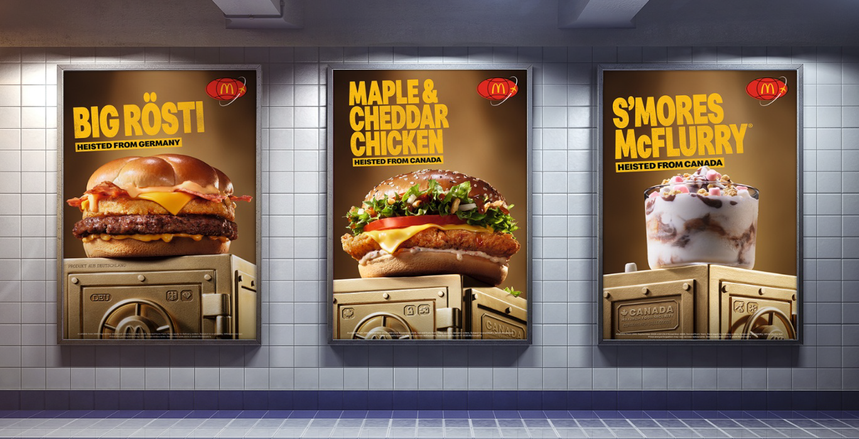

The World Menu Heist is back – bigger, fan-driven and globally scalable. But
the real story is not nine menu items from eight countries. It is what happens
when a brand hands creative authority to the people it serves.
It started, as so many things do now, with people complaining on the internet. For years, UK
McDonald’s customers had been posting the same kind of digital envy – photographs from trips
abroad, captions asking why Germany’s Big Rösti or Canada’s Maple and Cheddar Chicken
never made it through customs. Social media had turned the global McDonald’s menu into a
permanent object of longing, and the brand had spent years watching that frustration
accumulate. Then, rather than simply solving the supply chain problem and adding the items
quietly, someone at McDonald’s and Leo UK asked a more interesting question: what if the
frustration itself was the campaign?
The answer, first executed in 2025 and now returning in an expanded 2026 edition, is called the
World Menu Heist. Nine items. Eight countries. A campaign built entirely around the fiction
that the products have been stolen – from Germany, Canada, China and five others – and
smuggled onto UK and Irish menus through an elaborate, multi-phase operation. Creators are
cast as insiders. Media partners play investigative reporters. A former detective, via a
LADbible partnership, analyses the hero film for planted clues. Gold vaults display the
contraband items. A golden parachute appears across the Golden Arches. An immersive vault
event in London on 25 September invites journalists and creators inside the operation itself. A
second film drops on 20 October, with a promised plot twist.
The mechanics are theatrical. The strategic intelligence behind them is serious.
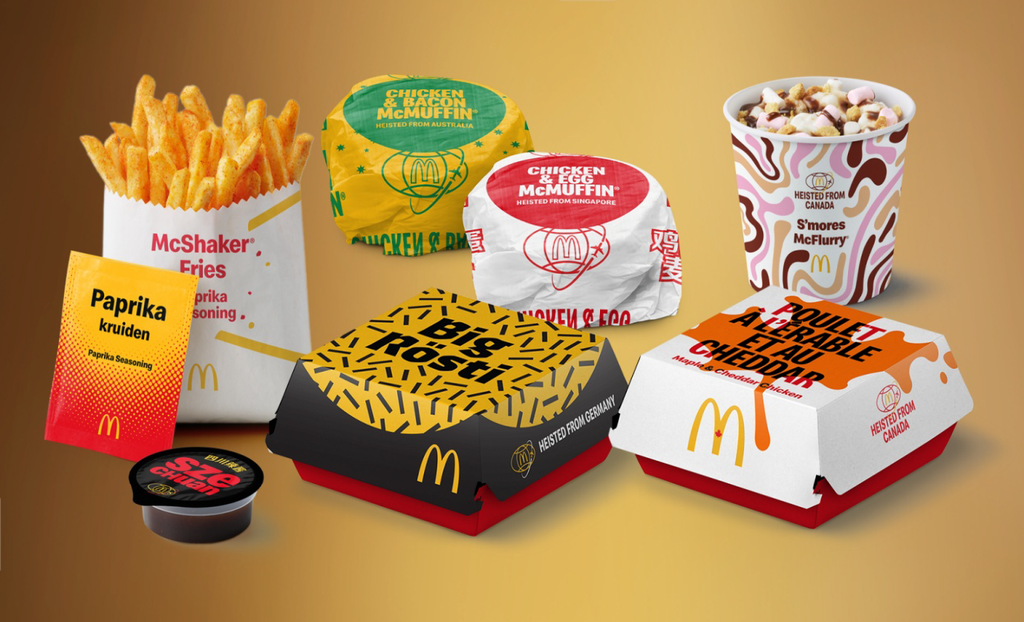
What Leo UK’s creative directors described in a single sentence – “McDonald’s fans gave us the
targets. We just planned the heist” – is a precise description of something that is fundamentally
reshaping how the most sophisticated brands build campaigns. The social listening that
identified the nine winning products was not market research in the conventional sense. It was
co-creation. The consumers who spent years posting about the Big Rösti did not know they
were briefing an agency. But they were. And the campaign that emerged from that brief is
structurally more credible than anything a focus group could have produced, because its
emotional foundations are genuine. The desire is real. The frustration was real. The heist is the
brand’s way of saying: we heard you, and we agreed.
This is the second iteration of a campaign that, in its 2025 edition, delivered results that would
make most brand managers quietly question their own careers. The original World Menu Heist
generated £10 million in earned media. It produced the biggest single sales day in McDonald’s
UK history. One product sold out in its first week. The campaign exceeded its performance
targets by 18 per cent and won a Bronze at the 2026 Performance Marketing Awards for Best
Multi-Channel Campaign. More significantly still, it was subsequently adapted by more than
40 McDonald’s markets globally – turning a UK campaign into an international brand platform.
The 2026 edition expands the blueprint in two directions. The first is scale: nine items from
eight countries represents a larger and more internationally diverse selection than the 2025
haul. The second is depth of co-creation. Where the first campaign identified fan demand
through social listening, the sequel makes that process explicit and public – fan behaviour was
used as both the research instrument and the campaign’s central plot point. The fans are now
characters in the story, not merely its audience.
The campaign’s architecture is worth examining for what it reveals about the current state of
integrated brand communications. The eight-week run – across television, cinema, out-ofhome,
social, radio, CRM, influencer partnerships and experiential – is coordinated across six
specialist agencies: Leo UK on creative, OMD on media, Red Consultancy on PR and events,
LADbible on social partnerships, TMW on CRM and Linney on in-restaurant communications.
It is a single narrative unfolding simultaneously across every channel a UK consumer inhabits,
with each touchpoint designed to advance a story rather than simply repeat a message.
That narrative structure – the three-act heist movie borrowed from Ocean’s Eleven – does
something that product launches rarely manage: it creates a reason to pay attention at each
stage.
The Plan phase builds anticipation. The Execute phase delivers the product and the
drama simultaneously. The Getaway phase – countdown clocks on digital out-of-home, urgent
CRM messages, social warnings that the items are about to disappear – manufactures scarcity
and urgency that is entirely fictional but commercially entirely real. People buy things they
believe they might lose. McDonald’s built that psychology into the campaign’s bones.
The context in which this campaign launched is also worth noting. McDonald’s UK entered
2025 facing declining guest counts, squeezed by a cost-of-living crisis that made higher-priced
limited-time offers a genuinely difficult sell. The World Menu Heist did not ignore that
challenge. It reframed it. A product that costs more than the core menu is, in conventional
marketing, a harder sell. A product that has been stolen from another country, that you can only
get for a limited window, that your favourite creator is talking about, that a former detective is
investigating – that is a story you want to be part of. The premium almost disappears inside the
narrative.
Hannah Pain, McDonald’s UK Marketing and Menu Director, chose her words carefully: “Our
fans are very good at telling us which McDonald’s products they want us to bring home next, so
this year we listened.” That sentence contains the entire strategic philosophy of the campaign.
The brand is not the author of desire. The brand is the instrument through which desire already
present in the culture is given form and fulfilment. It is a posture of listening rather than
broadcasting – and in a media environment where audiences have developed near-perfect filters
against messages they did not ask for, it is increasingly the only posture that works.
BrandiQ Analysis
Strip the heist metaphor away and what you have is a masterclass in something deceptively
simple: a brand that listened before it spoke. The World Menu Heist’s greatest strategic
achievement is not the campaign itself. It is the insight that preceded it – the recognition that the
demand for international menu items was not a gap in the product range but a living, publicly
documented cultural phenomenon. Social media had been doing McDonald’s research for
years. Leo UK simply had the intelligence to read it.
This is the first lesson for every brand and agency team paying attention. Data is not strategy.
But data in the hands of a team with the creative courage to act on it becomes strategy.
McDonald’s did not commission research to tell it that UK customers wanted the Big Rösti. It
already knew, because its customers had been saying so, loudly and repeatedly, in public. The
brief wrote itself. The agency’s job was to turn a brief into a belief.
The three-act structure – Plan, Execute, Getaway – is a model that any brand launching a
limited-time product or seasonal campaign should study carefully. Most brands build
campaigns around a message. McDonald’s built this one around a story. The difference is
profound. A message requires attention; a story generates it. A message ends when the media
spend stops; a story continues in the conversations it provokes. A message is something a brand
does to an audience; a story is something an audience participates in.
The 2026 edition goes further than its predecessor in one critical respect: it makes the cocreation
visible. In 2025, fans identified the products through their social behaviour without
knowing they were doing so. In 2026, the campaign explicitly acknowledges that the fans chose
the targets. This is not a cosmetic difference. It changes the nature of the audience’s relationship
to the campaign. When you know that your preferences shaped what you are being offered, the
product feels like yours before you have bought it.
For brand managers on this continent, where consumer trust is hard-won and institutional
credibility is perpetually contested, this principle carries particular weight. African consumers –
and Nigerian consumers especially – have a finely calibrated sensitivity to whether a brand is
speaking at them or with them. The brands in this market that have built the most durable
relationships with their customers are those that have found ways to make the consumer feel
like an insider, a participant, a co-author of the brand’s story. McDonald’s, in a very different
market context, has done exactly that – and the results speak for themselves.
The six-agency structure raises a question worth examining honestly: does this model produce
better work, or does it produce more complicated work? The answer, in this case, is clearly the
former – but the conditions that made it possible are specific. The campaign works across six
agencies because it has a single, unambiguous idea at its centre. The heist is the idea. Every
channel, every partner, every activation is an expression of that one idea in a different register.
This is the lesson that gets lost in most discussions about integrated marketing: integration is
not about channels. It is about clarity of idea.
The World Menu Heist 2026 is, by any serious measure, one of the most strategically
sophisticated fast-food campaigns of the decade. It is not beautiful in the way that a luxury
brand campaign is beautiful. It is intelligent in the way that the best strategic thinking is
intelligent: it looks obvious in retrospect, which is the surest sign that it was not obvious at all.
BrandiQ Verdict: This is what happens when a brand trusts its audience enough to let them
write the brief. The numbers from 2025 – £10 million in earned PR, the biggest single sales day
in McDonald’s UK history, 18 per cent above target – were not luck. They were the predictable
outcome of a strategy that earned attention by giving people something to be part of rather than
something to be sold. The 2026 edition will be watched closely by every integrated agency
team in the world. It should be watched equally closely by every brand strategist in Africa who
is still waiting for the right brief. This is the brief.