

Agency consolidation signals a new era of scale, data integration and AI-driven media services as global holding companies reshape the future of marketing
Following reports from Dhanya Vimalan of Marketing Interactive, Omnicom Media has announced plans to merge its media agency brands Mediahub and Hearts & Science into a single global agency network spanning approximately 40 markets, marking one of the advertising industry’s most significant agency consolidations since the integration wave that followed Omnicom’s acquisition of Interpublic Group (IPG).
The new agency, expected to launch next month under a new name and brand identity, will combine the complementary capabilities of both networks into a single global organisation overseeing approximately US$9.1 billion in annual media billings, creating one of the world’s largest integrated media agency operations.
Omnicom Media confirmed that while the integration will take place across its international markets, the Australian business will retain its unique operating structure. Both Mediahub and Hearts & Science Australia will continue to function independently, although Hearts & Science Australia will adopt the new global brand identity once it is unveiled.
According to the company, the transition will not disrupt existing client relationships or operational teams. “Mediahub and Hearts & Science are coming together across our markets globally. In Australia, however, there will be no change to the way either agency operates. This reflects our unique Australian operating model, where both agencies operate independently,” an Omnicom Media spokesperson said.
Clients across Australia will continue working with their existing leadership teams and account management structures, with the agency describing the transition as “business as usual.”
The merger combines two agencies with distinct but complementary strengths.
Founded in 2016, Hearts & Science built its reputation around data-driven media planning, analytics, audience intelligence and performance optimisation. Mediahub, meanwhile, has developed a strong global reputation as an innovation-led challenger agency recognised for culturally driven communications strategies and integrated media solutions. In 2025, COMvergence ranked Mediahub among the fastest-growing major global media agency networks.
Industry leadership appointments are already taking shape ahead of the formal launch.
Nicole Estebanell, currently Chief Executive Officer of Mediahub US, is expected to lead the combined business in the United States, while Ross Jenkins, who currently oversees Mediahub across Europe, the Middle East and Africa (EMEA), will assume responsibility for that region. Leadership appointments across Asia-Pacific and Latin America are expected to be announced alongside the unveiling of the agency’s new global identity next month.
The announcement follows Omnicom Media’s recent establishment of a dedicated Client Success discipline across Asia-Pacific, designed to improve client leadership, strengthen collaboration across agency brands and deliver more integrated services to multinational clients navigating increasingly complex marketing environments.
The latest move forms part of a broader strategic transformation underway within Omnicom as the company continues integrating capabilities following its acquisition of Interpublic Group, creating what is now one of the world’s largest marketing and communications organisations.
The BrandiQ Perspective
At first glance, this appears to be another agency merger. In reality, it represents something much bigger. It reflects the accelerating transformation of the global advertising industry from a collection of specialised agency brands into connected marketing platforms built around data, artificial intelligence, technology and integrated client solutions.
For decades, advertising holding companies expanded by creating or acquiring multiple agency brands, each with distinct cultures, capabilities and market positioning.
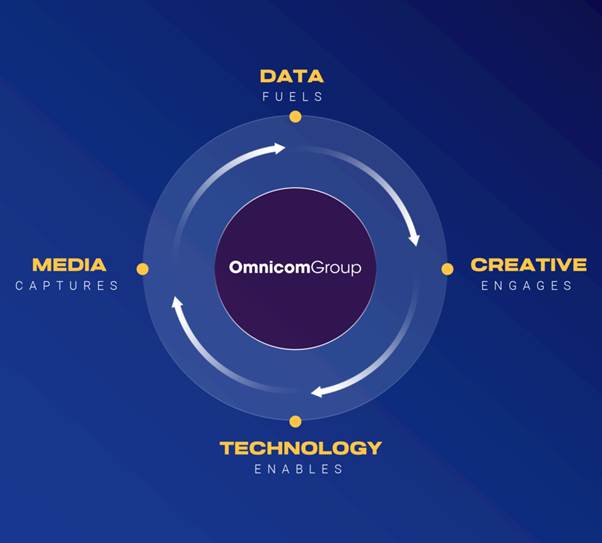
Today’s environment is fundamentally different. Clients are increasingly less interested in managing multiple agencies and more concerned with obtaining integrated solutions capable of combining creative thinking, media planning, customer data, commerce, technology, analytics and AI under one strategic framework. The traditional agency model is gradually giving way to what might be called the platform agency model.
This explains why Omnicom continues to simplify its global structure. Rather than competing internally through multiple overlapping agency brands, holding companies are increasingly combining complementary capabilities to improve efficiency, reduce duplication, accelerate innovation and deliver more seamless client experiences.
The merger also demonstrates how artificial intelligence is reshaping agency economics. AI is dramatically reducing the distinction between media planning, audience analytics, performance optimisation, consumer intelligence and campaign measurement. Activities once performed by separate specialist teams are becoming increasingly interconnected through AI-powered platforms and unified data environments.
In this context, maintaining multiple agencies performing similar functions becomes commercially less attractive. Instead, scale, connected data and integrated technology become the primary competitive advantages.
Why This Matters for African Agencies
African marketing agencies should pay close attention. Many independent agencies across Africa still operate within traditional structures that separate creative, media, digital, strategy and analytics into isolated functions.
Global competitors are moving in the opposite direction.
Future agency competitiveness will increasingly depend on the ability to integrate:
- Artificial Intelligence
- Customer data
- Media buying
- Commerce
- Content
- Technology
- Measurement
- Business consulting
into one connected client offering.
This evolution presents both a challenge and an opportunity for African agencies. Smaller firms often possess greater agility than multinational networks and may be able to adopt integrated operating models more quickly if they invest strategically in digital capabilities and AI-enabled services.
BrandiQ Analysis: Five Strategic Lessons
1. The age of integrated agencies has arrived
The separation between media, data, strategy and technology is disappearing. Clients increasingly expect agencies to solve business problems rather than deliver isolated marketing services.
2. Scale now creates competitive advantage
Combining US$9.1 billion in media billings significantly strengthens negotiating power with media owners, technology platforms and data providers while improving investment in proprietary technology and AI capabilities.
3. AI is accelerating industry consolidation
Artificial intelligence rewards organisations that possess large datasets, integrated technology stacks and unified operating models. Consolidation therefore becomes both a technological and commercial strategy.
4. Brand architecture is evolving
Interestingly, Omnicom is retiring two well-established agency identities in favour of a completely new global brand. This illustrates how even successful agency brands are becoming secondary to broader organisational capabilities and client value creation.
5. Africa should prepare for the next wave
As global agency networks simplify their structures and strengthen integrated capabilities, African agencies will face increasing pressure to evolve. Future competitiveness will depend less on agency size and more on technological sophistication, strategic consulting capability, AI readiness and measurable business outcomes.
BrandiQ Verdict
Omnicom Media’s decision to combine Mediahub and Hearts & Science is not simply another corporate restructuring. It reflects a fundamental shift in the architecture of the global marketing services industry. In an era increasingly shaped by artificial intelligence, data ecosystems and integrated client solutions, advertising agencies are transforming into technology-enabled business partners rather than traditional media buying organisations. For agencies across Africa, the message is unmistakable: the future belongs not to those with the largest portfolios of brands, but to those with the most connected capabilities.