

Record mobilisation, guarantees and a sharper focus on job-rich sectors signal a new model of development finance – with Africa increasingly positioned as both a challenge and an investment opportunity.
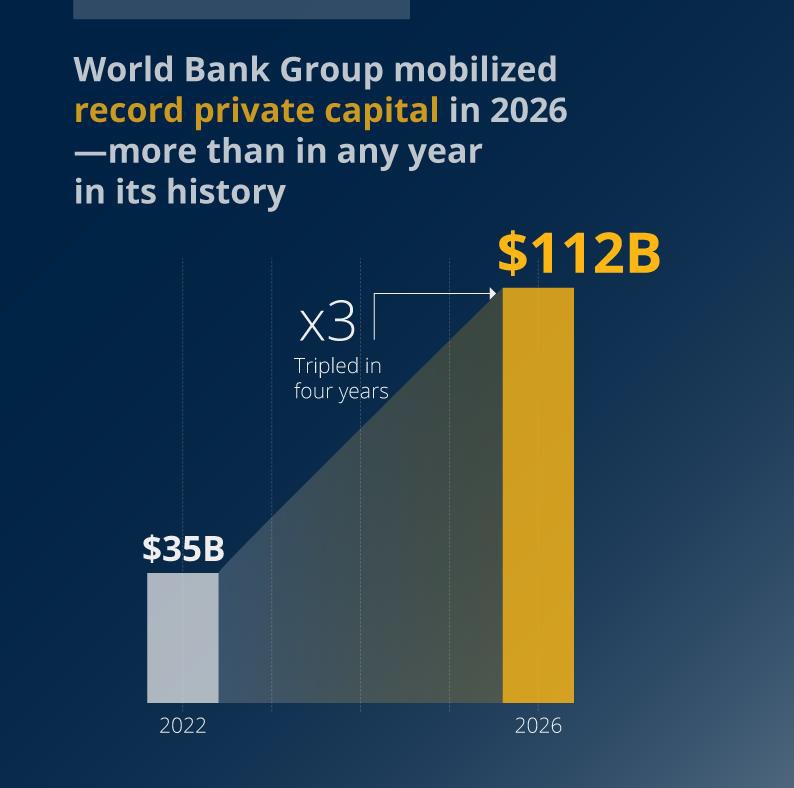
The World Bank Group has mobilised a record $112bn in private capital for developing economies in fiscal year 2026, more than tripling the amount recorded four years earlier and signalling a potentially significant shift in the way development finance is being deployed across emerging markets.
The figure, announced by the World Bank Group on September 17, represents the highest level of private capital mobilisation in the institution’s history. In FY22, the corresponding figure stood at $35bn. Combined with the World Bank Group’s own financing, total financing and private capital mobilisation in developing economies exceeded $200bn in FY26.
But beneath the headline number is a more consequential development for businesses, investors and policymakers: the World Bank is increasingly positioning itself not simply as a provider of development finance, but as a catalyst for private investment. That distinction matters.
For decades, one of the central challenges confronting developing economies has been how to attract sufficient private capital into markets where investors often perceive high regulatory, currency, infrastructure, political and operational risks. The latest World Bank figures suggest that the institution is attempting to address that problem by using its own financial strength and risk-mitigation instruments to make previously difficult investments more attractive to private investors.
Africa’s share rises sharply
Africa is already showing up prominently in this new capital mobilisation strategy. According to the World Bank, private capital mobilisation across Africa increased from approximately $9bn in FY22 to $22bn in FY26, representing an increase of nearly 150 percent.
The growth has not been confined to Africa. Private capital mobilisation to lower-middle-income countries rose from $14bn to $37bn over the same period, while mobilisation in upper-middle-income countries increased from $12bn to $50bn.
Perhaps equally significant is that mobilisation in low-income countries remained at approximately $3bn – markets where attracting private capital remains particularly difficult. The numbers therefore tell two stories simultaneously. Private capital is becoming more available in developing markets, but the distribution of that capital remains uneven, reflecting the different levels of risk and investment readiness across economies.
For Africa, the increase is nevertheless important. It suggests that international development finance institutions are increasingly seeking ways to move beyond traditional public-sector lending and bring commercial investors into projects capable of generating both economic and social returns.
The Guarantee is Becoming the Bridge
One of the most revealing components of the World Bank’s strategy is its growing use of guarantees. The Group issued more than $25bn in guarantees in FY26, exceeding its previously established target of $20bn in annual issuance by 2030 – four years ahead of schedule.
This is significant because a guarantee can change the investment equation without necessarily requiring a development institution to provide all the capital itself. For investors, the fundamental question is often not whether an opportunity exists but whether the perceived risks are manageable. Guarantees, local-currency financing, foreign-exchange solutions and other risk-sharing mechanisms can help bridge that gap.
The World Bank Group Guarantee Platform, created in 2024, has also sought to simplify access to guarantee products across the institution by providing clients and investors with a single point of entry. In practical terms, the model is evolving from “lend money to development projects” towards “use development finance to make more private money willing to enter development projects.” That is a fundamentally different proposition.
From Financing Projects to Building Investment Ecosystems
The World Bank attributes the latest results partly to three years of institutional changes designed to make it easier to work with private investors. These include bringing the public and private arms of the institution closer together, simplifying processes, developing integrated country strategies and expanding instruments available to investors.
The institution also points to the work of its Private Sector Investment Lab, which has focused on identifying practical barriers preventing private investment in developing economies.
Those barriers are familiar to businesses operating across Africa: regulatory uncertainty, inadequate infrastructure, foreign-exchange constraints, limited access to local-currency financing and insufficient mechanisms for institutional investors to participate at scale.
The World Bank says it has responded by expanding guarantees and local-currency financing, addressing foreign-exchange challenges, increasing equity tools and developing new mechanisms for institutional investors. The significance goes beyond development economics. It represents an attempt to change the investment environment itself.
The Jobs Question
There is another reason the $112bn figure matters. The World Bank says 1.2 billion young people in developing economies are expected to reach working age over the next 10 to 15 years, while only around 420 million jobs are projected to be created. That gap places employment at the centre of the institution’s private-sector strategy.
The World Bank estimates that the private sector creates nine out of every 10 jobs in developing economies. Consequently, mobilising private investment is being treated not simply as a financing exercise but as an employment strategy.
In FY26, 55 percent of total financing – comprising the Group’s own financing and capital mobilised—went into five identified job-rich sectors: infrastructure and energy, agribusiness, healthcare, tourism, and value-added manufacturing.
This is particularly relevant for Africa, where population growth is creating a huge labour force while many economies struggle to generate sufficient productive employment.
What Does This Mean for Nigeria?
For Nigeria, the development is worth watching closely. Africa’s largest economy sits within the broader investment universe targeted by the World Bank’s private-capital mobilisation strategy. Yet attracting capital at scale will depend on more than the availability of international money.
Investors still need investable projects, credible institutions, predictable regulation, appropriate risk-sharing mechanisms, functioning infrastructure and viable business models. This is where the World Bank’s evolving approach becomes particularly relevant.
Its strategy effectively recognises that development institutions cannot finance the scale of infrastructure, businesses and employment opportunities required across developing economies by relying on their own balance sheets alone.
The Bigger Opportunity Lies in Crowding in Private Capital.
As World Bank Group President Ajay Banga put it, “The result is $112 billion mobilized this year, more than three times where we started. But the number only matters if the capital goes where it can create opportunity and jobs.”
That final qualification may be the most important part of the announcement. A record mobilisation figure is an impressive institutional achievement, but its development significance ultimately depends on where the money goes, what it finances and what it produces.
The New Competition for Capital
There is also a broader lesson for African governments and businesses. The world is not short of capital. The more difficult question is how to make capital move into the places where it can generate productive economic activity.
That means countries will increasingly compete not simply for aid or concessional loans, but for private investment. They will need to demonstrate that their markets can convert capital into viable businesses, infrastructure, jobs and sustainable returns.
For companies, the implication is equally clear. The emerging financing environment increasingly favours businesses capable of demonstrating strong governance, credible financial models, scalability, measurable impact and the ability to operate within transparent regulatory frameworks.
The World Bank’s next frontier is already taking shape. Through its originate-to-distribute initiative, the Group is developing mechanisms for packaging and distributing investments to institutional investors at greater scale, connecting long-term pools of global capital with opportunities in developing economies.
This could prove consequential because pension funds, insurers, sovereign wealth funds and other institutional investors control enormous pools of long-term capital. The challenge has traditionally been creating investment structures that make developing-market opportunities suitable for these investors. The World Bank is now attempting to become part of that bridge.
BrandiQ Insight
The $112bn announcement represents more than a record-breaking financial statistic. It points to an emerging new architecture of development finance in which development institutions increasingly use their capital and credibility to attract substantially larger pools of private money. For Africa, the opportunity is substantial – but so is the responsibility.
Capital will increasingly follow markets that can demonstrate investability, scale, transparency and credible pathways to economic returns and social impact. The question for African economies may therefore be changing from “Where will the development money come from?” to “How do we build economies capable of attracting, absorbing and multiplying private capital at scale?” That is the more consequential story behind the World Bank’s $112bn