
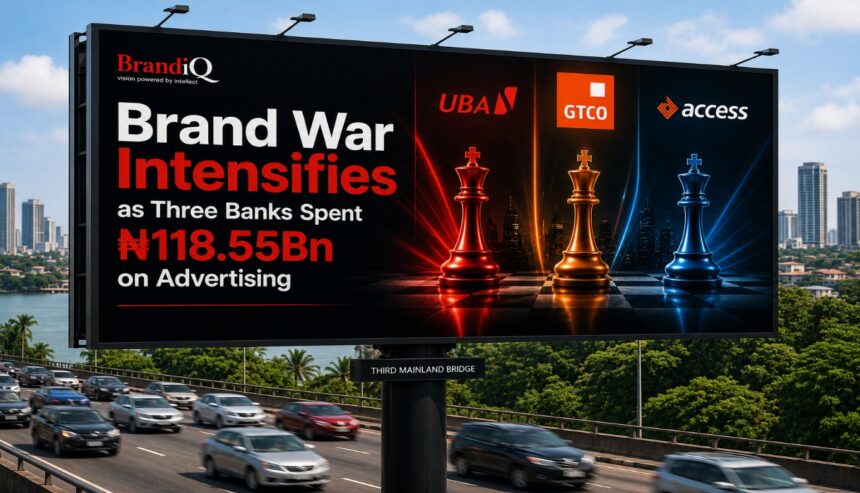

Analysis of corporate filings shows UBA, GTCO and Access Holdings significantly increased brand investment in early 2026 as banks battle fintech disruption and compete for customer attention
Three of Nigeria’s leading banking groups collectively spent ₦118.55 billion on advertising and marketing over a 15-month period spanning the full 2025 financial year and the first quarter of 2026, underscoring the growing strategic importance of brand investment in an increasingly competitive financial services market.
An analysis of publicly available financial disclosures by The PUNCH showed that United Bank for Africa (UBA), Guaranty Trust Holding Company (GTCO) and Access Holdings spent a combined ₦95.71 billion on advertising and marketing during 2025, followed by an additional ₦22.84 billion in the first quarter of 2026.
The spending patterns suggest that while overall marketing expenditure moderated during 2025 compared with the previous year, competition for market visibility accelerated significantly at the beginning of 2026.
According to the analysis, the three institutions spent ₦95.71 billion on advertising and marketing in 2025, representing a 25.1 per cent decline from the ₦127.75 billion recorded in 2024. The decline was driven primarily by UBA, which reduced its advertising, promotion and branding expenditure to ₦56.95 billion, down from ₦89.99 billion in 2024.
GTCO, however, moved in the opposite direction, increasing its marketing investment to ₦20.02 billion, compared with ₦17.42 billion in the preceding year. Access Holdings also moderated spending, reducing advertising expenditure to ₦18.75 billion from ₦20.35 billion in 2024. Despite the moderation recorded during the full year, marketing activity accelerated sharply in the first quarter of 2026. Combined expenditure by the three banking groups rose to ₦22.84 billion, compared with ₦14.06 billion during the corresponding period of 2025, representing a 62.4 per cent increase.
UBA accounted for the largest share of first-quarter spending at ₦15.86 billion, while GTCO and Access Holdings spent ₦2.84 billion and ₦4.14 billion, respectively. Across the entire 15-month period, UBA invested ₦72.81 billion in advertising and marketing, representing approximately 61.4 per cent of the combined expenditure.
GTCO and Access Holdings spent ₦22.86 billion and ₦22.89 billion, respectively, each accounting for roughly 19 per cent of the total. Marketing professionals attribute the changing spending patterns to intensified competition within Nigeria’s financial services industry, particularly as fintech companies continue to expand aggressively into payments, lending and digital banking.
Commenting on this, a marketing expert, Anietie Udoh, said banks are increasingly allocating larger portions of their marketing budgets to digital platforms, sponsorships, experiential marketing and lifestyle-driven campaigns rather than relying solely on traditional mass communication.
According to him, communication strategies have become increasingly data-driven and audience-specific. Udoh observed that competition from fintech operators has significantly altered the banking industry’s marketing landscape.
“Look at what OPay is doing now. OPay is spending heavily on communication, trying to understand what the consumer wants to hear. They are pushing that communication using influencers,” he said. He added that institutions such as OPay and Moniepoint have intensified pressure on conventional banks by adopting digital-first communication strategies that combine influencer marketing, social media and mass media advertising.
The analysis also noted that marketing activity typically increases during recapitalisation programmes, public offers and other capital market transactions when financial institutions seek to strengthen investor confidence and public awareness.
Separately, findings from the P+ Measurement Services Q1 2026 Print Media Advertising and Placement Audit indicate that commercial banks remained Nigeria’s largest users of print advertising during the first quarter of 2026.
The report found that 18 of the 29 commercial banks monitored placed a total of 1,260 print advertisements, generating combined expenditure of ₦1.28 billion. According to the audit, Zenith Bank accounted for 38 per cent of all print advert placements, followed by Access Bank (14 per cent), UBA (12 per cent) and GTBank (10 per cent).
In terms of front-page newspaper advertising, Access Bank led with 42 per cent, followed by Zenith Bank with 37 per cent, while Stanbic IBTC accounted for 21 per cent. By advertising expenditure, Zenith Bank ranked highest with 39 per cent of total sector spending during the quarter, followed by Access Bank with 20 per cent, GTBank with 11 per cent and Polaris Bank with 10 per cent, according to the report.
BrandiQ Analysis
Banking competition is increasingly becoming a battle for mindshare. The figures reveal more than rising advertising expenditure. They reflect a structural transformation in Nigeria’s banking industry.
Historically, commercial banks competed primarily through branch expansion, product offerings and pricing. Today, competition increasingly revolves around brand visibility, customer experience and digital engagement.
Banks are no longer competing only with one another. They are competing with fintech companies that have fundamentally changed how consumers discover, evaluate and adopt financial services. This explains why marketing budgets are becoming more strategic rather than merely promotional.
Advertising Has Become a Strategic Investment
The increase in first-quarter marketing expenditure suggests that banks increasingly view advertising as a long-term investment in customer acquisition and retention rather than a discretionary operating expense.
Modern financial institutions now invest across multiple channels – including digital media, sponsorships, experiential campaigns, influencer partnerships and content marketing – to remain relevant in an increasingly fragmented media environment.
For banking brands, visibility has become closely linked to trust, particularly as consumers face a growing number of financial service providers.
Digital Competition Is Reshaping Marketing
Perhaps the most significant development highlighted in the report is the growing influence of fintech companies on marketing strategy. Digital-first institutions have demonstrated that customer acquisition can be accelerated through targeted communication, data analytics and platform-based engagement.
Traditional banks are responding by modernising their own marketing approaches, investing more heavily in digital channels while maintaining their presence across television, newspapers, outdoor advertising and experiential events. The result is a more competitive communications environment in which brand differentiation increasingly depends on customer relevance rather than advertising volume alone.
Marketing Is Becoming a Driver of Business Growth
For many years, marketing expenditure was often viewed as a cost centre within financial institutions. That perception is changing. Banks increasingly recognise that sustained brand investment supports customer acquisition, strengthens investor confidence, enhances digital adoption and reinforces long-term competitiveness.
The spending trends reported across Nigeria’s leading banking groups therefore point to a broader strategic shift. In an industry being reshaped by technology, customer expectations and fintech innovation, marketing is no longer simply about promoting banking products—it has become a core driver of business growth, competitive positioning and long-term enterprise value.