

What the Scramble Reveals About African Capital Markets – Dangote Ipo
There is a particular kind of urgency that grips a bank’s marketing department when a deal is too big to sit out. Nigerians who logged into their banking apps on the morning of September 14th encountered exactly that urgency, dressed up as an invitation. “The opportunity is here,” FCMB told its customers, in a message that read less like routine correspondence and more like a starting gun. First Bank’s version arrived with a table, a hyperlink, and the studied formality of an institution that wanted to be taken seriously as more than a bystander. Both banks were writing about the same thing: the ₦2.15 trillion initial public offer of Dangote Petroleum Refinery and Petrochemicals, and both wanted their customers to know they were the ones to trust with it.
What is unfolding is not simply an IPO. It is a contest among Nigeria’s financial institutions for a form of relevance that money alone cannot buy – the right to be seen as the gateway through which ordinary Nigerians step into ownership of the continent’s largest single-train refinery. Aliko Dangote’s $20 billion asset, built on the promise of ending Nigeria’s paradoxical dependence on imported fuel, is now also a test of which banks can mobilise a retail public that has historically treated the stock market with suspicion, if it thought about it at all.
A Deal Built for the Masses, and for the Banks That Reach Them
The scale of the distribution effort is the story before the story. Dangote Refinery has approved roughly fifty-five electronic channels through which Nigerians can subscribe—nineteen commercial banks, ten fintech and digital investment platforms, two mobile money operators, and the Nigerian Exchange’s own NGX Invest portal. This is, by a wide margin, the most expansive channel network ever assembled for a Nigerian public offer, and it was assembled deliberately. People close to the transaction say Dangote insisted on a digital-first, mass-participation design intended to draw in as many as ten million subscribers, a figure that would dwarf the shareholder base of almost any company on the Nigerian Exchange.
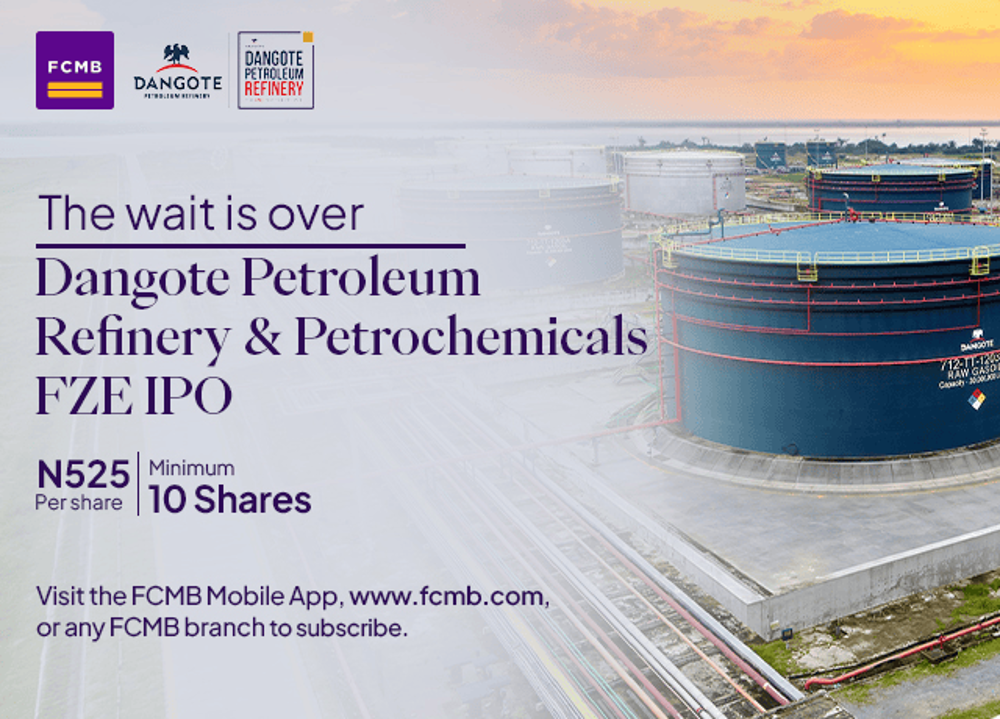
That design choice reshapes the competitive question facing the banks. In a conventional IPO, a handful of issuing houses and stockbrokers compete for institutional allocations and underwriting fees. Here, the real prize is retail attention, and the banks that already sit inside tens of millions of transaction accounts have an obvious advantage: they do not need to acquire a customer to sell them a share, only to convert a saver into a shareholder. FCMB’s message pointed customers straight into its mobile app, where an “Invest in the Energy Future” banner does the persuading that a relationship manager once would have. First Bank, for its part, leaned on the breadth of its own distribution – FirstMobile, FirstOnline, the LIT App, agency banking outlets reaching into markets and towns no branch has ever served, and FirstDirect for corporate treasuries with balance sheets to deploy. Both banks are receiving banks in the formal sense the offer document requires, but the letters read as something more competitive than a regulatory function. They read as a bid for mindshare in a market where nineteen banks are chasing the same subscribers.
The Economics of Being First to the App
Why does any of this matter to an institution’s bottom line? Receiving banks in a Nigerian public offer typically earn a modest processing commission on the value of applications they process, which on its own would not justify the scale of customer messaging now under way. The more durable prize is what the offer does inside the bank’s own ecosystem. Every customer who opens a CSCS account through an FCMB or First Bank channel, funds it, and completes a share application has been walked through a digital investment journey that the bank can build on—cross-selling wealth products, deepening app engagement, and collecting the kind of behavioural data that increasingly separates a transactional bank from a financial platform. In a market where fintech challengers have eroded the primacy of traditional banking relationships, an event that pulls customers back into the bank’s own app, for a genuinely compelling reason, is worth more than the commission line suggests.


There is a reputational calculation layered on top. Nigeria’s banks have spent much of the past two years persuading a sceptical public that they can be trusted stewards of long-term savings, after a period of currency volatility that punished anyone holding naira. Being visibly associated with what may become the most subscribed offer in the country’s history – a Nigerian industrial champion, not a foreign multinational or a government bond – allows a bank to align itself with a story of national economic assertion. That association is worth cultivating even where the direct fees are thin, because it positions the bank as a partner in the kind of capital formation Nigeria has needed and rarely produced at this scale.
What the Scramble Reveals About African Capital Markets
Step back from the individual letters and a broader pattern comes into view, one that speaks to the condition of African capital markets more than to Dangote alone. For decades, the continent’s largest industrial and infrastructure assets have been financed overwhelmingly by foreign capital, development finance institutions, or private placements among a narrow circle of the already wealthy. The structure of this offer – a $2.5 billion private placement preceding a retail-heavy public tranche, with bonus shares dangled to reward small subscribers – inverts that pattern. It treats the Nigerian public not as spectators to industrial development but as its financiers, and it treats the banking sector not as gatekeepers of capital but as its distribution infrastructure.
Whether that inversion succeeds will depend on execution the banks cannot fully control. Nigeria’s retail investing culture remains thin relative to its population; a large share of the ten million subscribers Dangote is targeting will be applying for a listed share for the first time in their lives, often through a mobile app rather than a broker’s office. The banks racing to onboard them are, in effect, building retail capital markets infrastructure in real time, under commercial pressure, during a five-week subscription window that closes on October 13th. If the offer is oversubscribed, as early market chatter suggests it may be, the banks that processed applications smoothly will have demonstrated something valuable about their digital readiness. If the process is marred by failed transactions, CSCS bottlenecks, or confusion among first-time investors, the reputational cost will attach to the banks as visibly as the reputational benefit would have.
There is also a quieter contest running beneath the visible one, over who gets credited as an adviser rather than merely a receiving bank. As of this writing, the identities of the investment banks formally engaged as issuing houses and bookrunners on the transaction have not been made public, a gap the eventual prospectus is expected to close. That silence has not stopped receiving banks from marketing themselves as central to the deal, which is itself instructive: in a retail-driven offer of this size, the institution that reaches the subscriber first captures much of the commercial and reputational value, regardless of where it sits in the formal transaction hierarchy.
For Nigeria’s banking sector, the Dangote refinery offer is a rehearsal for a future in which the country’s largest private companies increasingly look to the public market, and to the banks that can mobilise it, rather than to a narrow circle of institutional lenders. FCMB and First Bank’s letters were not really about a single share offer. They were opening bids in a longer argument about which banks will own the relationship with Nigeria’s next generation of retail investors – an argument this IPO has only just begun to settle.