

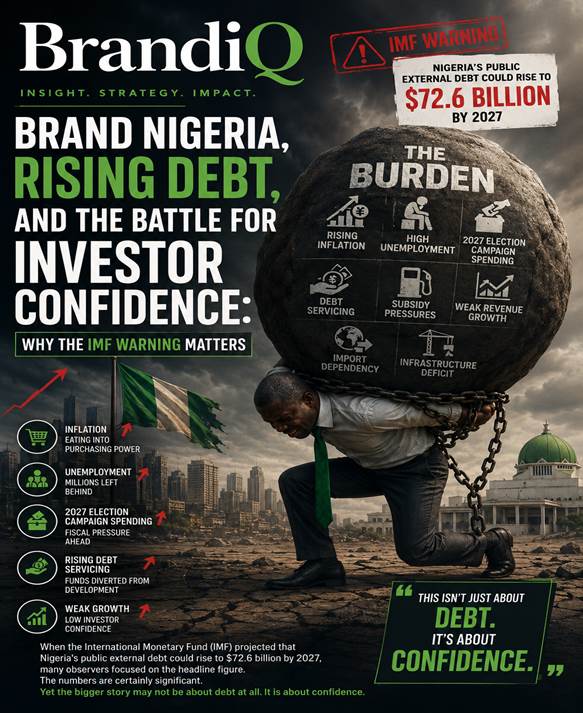

When the International Monetary Fund (IMF) projected that Nigeria’s public external debt could rise to $72.6 billion by 2027, many observers focused on the headline figure. The numbers are certainly significant. Yet the bigger story may not be about debt at all. It is about confidence.
In today’s global economy, countries compete for investment much like companies compete for customers. Investors assess nations the way consumers assess brands—by examining credibility, consistency, transparency, risk, and future prospects.
Viewed through this lens, the IMF’s latest debt projections raise important questions about the strength of Nigeria’s economic brand and its attractiveness to both local and international investors. The modern investment environment is driven as much by perception as by economic fundamentals. Capital flows to places where investors believe their money can earn predictable returns under stable conditions. This is why economic reputation has become one of the most valuable assets a nation can possess.
Countries such as Singapore, the United Arab Emirates, and Rwanda have spent decades building brands associated with efficiency, policy consistency, and investor friendliness. Their success is not simply the result of economic performance; it is also a product of deliberate reputation management.
Nigeria faces a more complicated challenge. On one hand, recent reforms have earned praise from international institutions. The IMF itself acknowledges improvements in macroeconomic stability, exchange-rate management, and economic resilience. Economic growth is projected to remain above four percent over the next two years. These are positive signals that strengthen Nigeria’s investment narrative.
On the other hand, the prospect of rising debt, persistent fiscal deficits, and growing debt-service obligations introduces concerns about long-term sustainability. Investors are not merely interested in how much a country owes. They want to know whether that country possesses a credible strategy for generating future growth and revenue.
In business language, investors are asking a simple question:
Can Nigeria deliver on its growth promise?
This is where the debt conversation becomes a brand conversation. Every major brand relies on trust. Apple sells premium products because consumers trust its innovation. Toyota benefits from trust in reliability. Amazon thrives because customers trust its systems and delivery mechanisms.
Similarly, sovereign credibility influences how governments access capital markets. When investors trust a country’s economic management, borrowing costs fall. When confidence weakens, risk premiums rise. Countries then pay more to attract the same capital.
The IMF’s warning about election-related fiscal pressures is particularly noteworthy in this regard. Election years often create uncertainty for investors because they raise questions about policy continuity and fiscal discipline. Markets become sensitive to signs that governments may prioritise political considerations over long-term economic management.
For Nigeria, this challenge is amplified by existing concerns around revenue generation. One of the most striking observations in the IMF report is not the size of the country’s debt but the fact that debt servicing continues to consume a substantial share of government revenues. For investors, this signals a structural weakness. Strong brands are built on sustainable business models. Likewise, strong economies are built on sustainable revenue systems.
Nigeria’s economy remains rich in opportunities, but its public finances continue to reflect a dependence on borrowing that many investors view as a vulnerability rather than a growth strategy.
The implications extend beyond government finances.
Private sector growth depends heavily on investor confidence. Multinational corporations, venture capital firms, development finance institutions, and foreign direct investors all monitor macroeconomic indicators when making allocation decisions. A country perceived as fiscally unstable often struggles to attract the long-term capital required for industrialisation, infrastructure development, and innovation.
This is why the IMF’s concerns about transparency and risk management in proposed financing structures are significant. In the global investment community, transparency is no longer a governance issue alone; it is a brand asset.
Investors increasingly reward economies that demonstrate openness, accountability, and policy predictability. The challenge for Nigeria, therefore, is not simply reducing debt levels. It is strengthening the narrative that debt is being used productively to create future value.
The world’s most successful companies borrow. The world’s most successful economies borrow too. What distinguishes successful borrowers from struggling ones is the ability to demonstrate that borrowed resources are being transformed into productive assets, competitive advantages, and future cash flows.
For Nigeria, this means showing clear links between borrowing and measurable outcomes such as infrastructure development, energy security, manufacturing growth, export expansion, digital transformation, and job creation. The conversation must move beyond how much the country is borrowing to what the country is building.
Ultimately, the IMF projection presents Nigeria with both a warning and an opportunity. The warning is that rising debt without corresponding growth in revenue and productivity can weaken investor confidence. The opportunity is that Nigeria still possesses one of Africa’s largest markets, one of the continent’s youngest populations, abundant natural resources, and significant entrepreneurial energy.
The country’s long-term economic brand will not be determined by debt figures alone. It will be determined by whether policymakers can convince investors that Nigeria remains a credible growth story in an increasingly competitive global marketplace.
In the end, nations, like brands, are judged not only by their promises but by their ability to deliver on them.