

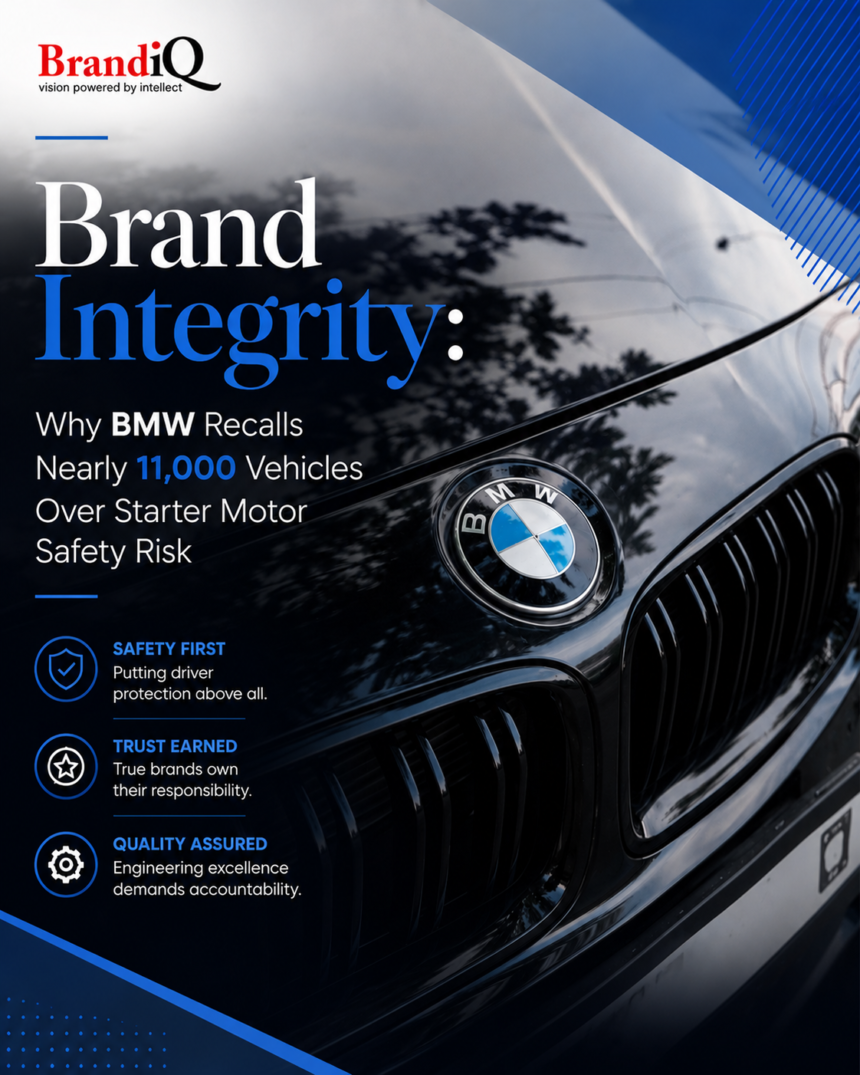

What does this say about brand trust, transparency, and responsibility. What distinguishes world-class brands is their willingness to acknowledge problems, communicate honestly and place customer safety above short-term commercial considerations
BMW South Africa has initiated a voluntary recall of 10,961 vehicles across several model ranges after identifying a manufacturing-related defect that could, under certain circumstances, lead to overheating and, in rare cases, smoke or fire.
The recall, announced through South Africa’s National Consumer Commission (NCC), affects selected BMW 3 Series, 4 Series, 5 Series, 7 Series, X3 and X4 vehicles manufactured from 2016 onwards and fitted with a Pinion Starter.
According to BMW, the issue relates to excessive wear of the starter motor’s solenoid switch caused by repeated engine starts. The company explained that the defect may reduce the vehicle’s ability to start and, in certain situations, create a short circuit capable of generating localised overheating.
BMW said drivers may notice smoke while operating the vehicle or shortly after parking. As a precaution, owners of affected vehicles have been advised not to leave their vehicles unattended immediately after starting the engine until the necessary repairs have been completed.
The manufacturer has also instructed customers to temporarily avoid using the Remote Engine Start feature available through the My BMW mobile application or the vehicle’s remote key. Owners are encouraged to contact authorised BMW dealerships for a complimentary vehicle inspection and repair.
BMW confirmed that all corrective work will be carried out free of charge. Consumers can determine whether their vehicles are affected by entering their Vehicle Identification Number (VIN) on BMW South Africa’s official recall portal.
The recall forms part of BMW’s established global product quality and customer safety procedures, through which manufacturers monitor vehicle performance and initiate corrective actions whenever potential safety concerns are identified.
BrandiQ Insight
A Product Recall Is Not Necessarily a Brand Failure
When consumers hear the word recall, they often assume a company has failed. In reality, product recalls are an essential component of modern quality management. In highly regulated industries such as automotive manufacturing, aviation, pharmaceuticals and consumer electronics, recalls demonstrate that manufacturers are continuously monitoring product performance after products have entered the market.
The real measure of corporate responsibility is therefore not whether defects occur, but how quickly organisations identify, communicate and resolve them.
Transparency Protects Brand Equity
BMW’s response illustrates one of the most important principles of reputation management. Rather than waiting for isolated incidents to escalate into a broader crisis, the company publicly disclosed the issue, provided clear guidance to customers and committed to resolving the problem at no cost.
Such transparency helps preserve consumer confidence while reducing potential safety risks. For premium brands, reputation is built not only on engineering excellence but also on accountability.
Quality Assurance Does Not End at the Factory
Modern vehicles contain thousands of mechanical and electronic components sourced from complex global supply chains. Even with rigorous testing, certain manufacturing defects may only emerge after prolonged real-world use.
That is why automotive companies invest heavily in post-market monitoring, customer feedback systems and engineering reviews. The objective is continuous quality improvement throughout a vehicle’s lifecycle rather than assuming every potential issue can be identified before production.
Consumer Protection Is Becoming a Competitive Advantage
The involvement of South Africa’s National Consumer Commission also highlights the growing importance of regulatory oversight. Consumers increasingly expect manufacturers to respond quickly to safety concerns, while regulators are demanding greater transparency and stronger product accountability.
Companies that demonstrate responsiveness and integrity in managing recalls are generally better positioned to retain customer loyalty over the long term.
Lessons for Brand Managers
For communications professionals, BMW’s action offers an important lesson in crisis management. A prompt, transparent and customer-focused response can often strengthen trust rather than diminish it.
Attempting to conceal product defects or delay corrective action, by contrast, can inflict far greater reputational damage than the defect itself. In today’s digital environment, where information spreads rapidly across social media and news platforms, openness has become one of the most effective reputation management strategies.
The Bigger Picture
The BMW recall serves as a reminder that brand excellence is not defined by perfection but by responsibility. Consumers recognise that complex products may occasionally develop technical faults. What distinguishes world-class brands is their willingness to acknowledge problems, communicate honestly and place customer safety above short-term commercial considerations.
Ultimately, effective product recalls are not simply exercises in risk management – they are demonstrations of corporate integrity. For global brands operating in increasingly transparent markets, trust is often strengthened not when nothing goes wrong, but when organisations respond responsibly when something does.