
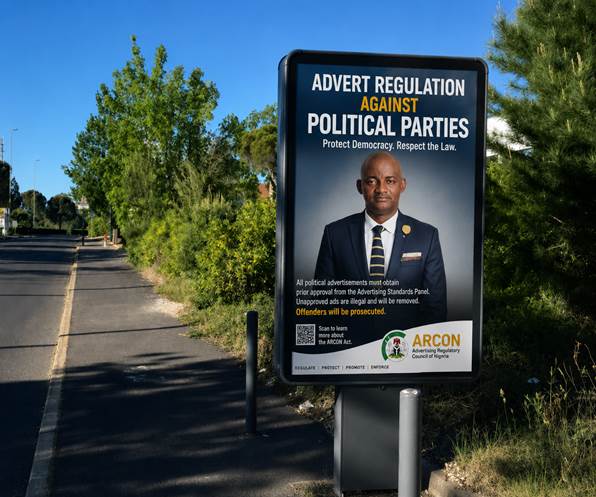

The Advertising Regulatory Council of Nigeria (ARCON) has issued a strong warning to politicians, political parties, campaign organisations, advertising agencies and media owners against the exposure of political advertisements without regulatory approval ahead of the 2027 general elections.
In a public notice dated June 16, 2026, and signed by its Director-General, Dr. Olalekan Fadolapo, ARCON expressed concern over the increasing deployment of unapproved political advertisements, some of which it said violate religious and ethnic guidelines contained in the Nigerian Code of Advertising.
According to the regulatory body, the commencement of political activities and voter education campaigns has led to a surge in advertising and marketing communication materials that have not received the mandatory approval of the Advertising Standards Panel (ASP). ARCON reminded stakeholders that all political advertisements and campaign communication materials must comply with the provisions of the Nigerian Advertising Law and other applicable regulations.
“The attention of the Advertising Regulatory Council of Nigeria (ARCON) has been drawn to the activities of some politicians, political parties and support groups that engage in the exposure of unapproved adverts, some of which have been found to violate religious and ethnic guidelines and are against the provision of the Nigerian Code of Advertising,” the council stated.
The regulator further noted that exposing advertisements on traditional or digital media platforms without prior approval from the Advertising Standards Panel constitutes an offence under Section 34(3) of the ARCON Act.
Consequently, political parties, elective office aspirants, campaign organisations, advertising agencies and media space owners have been directed to immediately desist from publishing, broadcasting or displaying political advertisements that have not received prior clearance from the Advertising Standards Panel.
ARCON also disclosed that it would collaborate with relevant law enforcement agencies to commence a nationwide enforcement exercise aimed at removing all political advertisements for which prior approval was not obtained before exposure.
The council warned that it would prosecute any individual or corporate entity found to have sponsored, approved, exposed, benefitted from or facilitated political advertising and marketing communications without the requisite approval. The notice signals the regulator’s determination to tighten compliance within Nigeria’s political advertising ecosystem as political activities intensify ahead of the 2027 elections.
BrandiQ Analysis
ARCON’s Warning Is More Than Regulatory Compliance – It Is About Protecting Democracy, National Cohesion and Brand Reputation
ARCON’s latest directive should not be viewed merely as another regulatory notice. It represents a significant intervention in the evolving relationship between political communication, advertising ethics and democratic stability in Nigeria.
With the 2027 election cycle gradually gathering momentum, the regulator appears determined to prevent a repeat of some of the communication excesses that have characterised previous election seasons, where campaign messages often descended into ethnic profiling, religious sentiments, misinformation and character assassination. At the heart of the directive is a simple principle: political advertising must be responsible.
The danger of unregulated political communication
Political advertising differs from commercial advertising because its impact extends beyond products and services to influence public opinion, social attitudes and national stability.
When political messages are disseminated without professional scrutiny and regulatory vetting, the risk of inflammatory content increases significantly. History has shown that divisive campaign messages can: Heighten ethnic tensions; Deepen religious divisions; Promote misinformation and fake narratives; Undermine electoral credibility; Fuel political violence; and Damage national unity. By insisting on pre-approval, ARCON is attempting to ensure that political communication remains factual, responsible and consistent with national advertising standards.
Implications for political parties and campaign managers
For political parties and campaign organisations, the directive means that campaign communication can no longer be treated as an unrestricted political activity. Campaign managers, media consultants, public relations advisers, advertising agencies and digital strategists will now be expected to build compliance into campaign planning from the outset.
Failure to do so could expose political organisations to: Regulatory sanctions; Removal of campaign materials; Disruption of campaign schedules; Legal liabilities; Financial losses; and Reputational damage.
For campaign managers, this introduces a new layer of professional responsibility. Political communication must now be subjected to the same standards of due diligence, legal review and regulatory compliance applicable to corporate advertising.
Media organisations are also on notice
One of the most significant aspects of the ARCON directive is that liability does not stop with politicians. Media organisations, outdoor advertising companies, digital media platforms and advertising agencies are equally exposed. The regulator specifically warned that anyone who sponsors, exposes, facilitates or benefits from unapproved political advertisements may face prosecution. This places a duty of care on: Television stations; Radio stations; Newspapers; Outdoor advertising firms; Digital publishers; Social media advertising managers; and Creative agencies.
The era of accepting campaign materials without verifying regulatory approval may now carry substantial legal and commercial risks.
A test for the advertising profession
The directive is also a test of professionalism within Nigeria’s advertising and marketing communications industry. For years, industry regulators have sought to elevate standards and reinforce ethical practice across advertising, public relations and integrated marketing communications. The 2027 election season will provide an important opportunity for agencies to demonstrate that political communication can be both persuasive and responsible.
The best agencies will likely distinguish themselves not merely through creative execution but through compliance, strategic counsel and ethical communication management.
The growing importance of reputation in politics
There is another dimension often overlooked in election communication. Political candidates are brands. Just as businesses build reputational capital over time, politicians increasingly compete on perception, credibility and trust. Campaigns that rely on inflammatory narratives may generate short-term attention but often create long-term reputational liabilities.
In an age of digital permanence, controversial advertisements do not disappear after election season. They remain searchable, shareable and capable of influencing public perception long after votes have been counted. For this reason, ARCON’s intervention may ultimately benefit political actors by encouraging issue-based communication rather than divisive messaging.
Protecting the integrity of the 2027 elections
Viewed from a broader governance perspective, the directive aligns with efforts to promote peaceful, credible and issue-driven elections. Democracy thrives when voters are presented with factual information, policy alternatives and constructive debate. It suffers when public discourse is dominated by propaganda, misinformation and identity-based attacks.
By enforcing advertising standards within political communication, ARCON is effectively positioning itself as one of the institutions helping to safeguard the quality of democratic engagement ahead of 2027.
The bigger lesson
The warning issued by ARCON is ultimately about more than advertising approval. It is about accountability. It is about professionalism. It is about protecting public trust. And it is about ensuring that political communication contributes to democratic development rather than social division.
Political parties, candidates, campaign managers, advertising agencies and media organisations would therefore be wise to treat the directive not as a bureaucratic hurdle but as a strategic imperative.
The consequences of non-compliance could extend far beyond regulatory penalties. They could affect reputations, campaign effectiveness, stakeholder trust and, ultimately, the quality of Nigeria’s democratic process itself.