

How the agenda signals more than an industry event, reflecting a steady repositioning of public relations in Nigeria as a strategic force in public trust, security, and nation-building
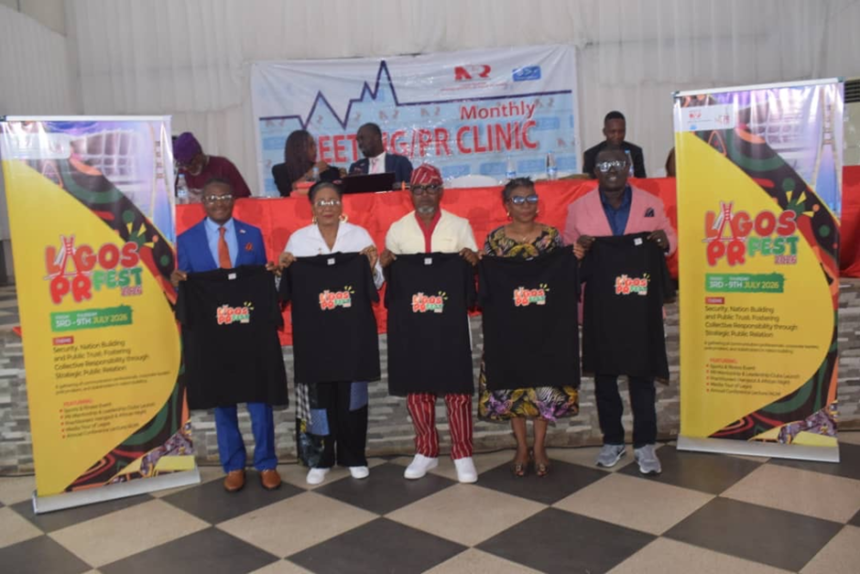
The Lagos State Chapter of the Nigerian Institute of Public Relations has announced plans for PRFest 2026, a week-long professional programme scheduled for July 3–9, 2026, with a central focus on security, public trust, and nation-building.
The announcement was made during the chapter’s monthly meeting and PR Clinic held at the Eko FM Multipurpose Hall in Ikeja, where executives outlined the objectives, structure, and strategic direction of the forthcoming festival.
Chairman of the Lagos State Chapter, Dr. Samuel Ayetutu, said the initiative is designed to deepen professional engagement among communication practitioners while strengthening the role of public relations in addressing complex national challenges.
He noted that public relations practitioners now occupy a strategic position in shaping trust between institutions and citizens in an increasingly fragmented information environment. “Public relations practitioners have a crucial role to play in fostering trust, promoting responsible communication and strengthening the relationship between institutions and the public,” Ayetutu said. “PRFest 2026 will provide a platform for stakeholders to examine these responsibilities and contribute to national development.”
He added that the 2026 edition will deliberately explore the intersection of security, nation-building, and public trust, stressing that strategic communication has become central not only to governance outcomes but also to social cohesion and institutional legitimacy.
Chairman of the PRFest 2026 Planning Committee, Bolaji Abimbola, said preparations are ongoing to deliver a well-structured programme capable of meeting expectations across the public and private sectors.
According to him, the committee is working toward a “memorable and impactful festival” that will bring together professionals, policymakers, academics, students, and industry stakeholders. The festival will feature a broad mix of activities, including a sports and fitness event, PR mentorship and leadership club launch, practitioners’ hangout and African night, a media tour of Lagos, an annual conference lecture, and the annual general meeting of the chapter.
Organisers said PRFest 2026 is designed not only as a professional gathering but also as a learning ecosystem that reinforces networking, mentorship, and continuous professional development while strengthening the role of strategic communication in governance and public trust-building.
The chapter has invited communication professionals, corporate organisations, government agencies, students, and other stakeholders to participate in the event.
BrandiQ Analysis and Takeaway: What PRFest 2026 really signals for the profession
The announcement by the Lagos State Chapter of the Nigerian Institute of Public Relations signals more than another industry calendar event, said Prof. Silk Ugwu-Ogbu, a Strategic and Governance Communication expert and scholar, at the Lagos Business School, LBS. He posits that NIPR Lagos State Chapter effort reflects a gradual but decisive repositioning of public relations in Nigeria – from a misunderstood support function often reduced to “publicity work,” to a structured profession asserting its strategic relevance in governance, corporate accountability, and national development.
This repositioning is not accidental. It is the result of years of professional advocacy, institutional strengthening, and a shifting global communication environment in which trust has become a scarce and highly valuable economic resource.
Lagos, in this context, plays a defining role. As Nigeria’s commercial nerve centre and Africa’s most dynamic urban economy, the state has consistently functioned as an incubator for professional innovation in communications, media, marketing, and public affairs. PRFest 2026 therefore becomes more than a local programme; it becomes a symbolic projection of how Nigeria’s PR ecosystem wants to be seen internally and externally.
By anchoring the conversation around security, public trust, and nation-building, the Lagos Chapter is deliberately expanding the boundaries of public relations practice into the core of public policy, governance legitimacy, and societal stability.
PR as a trust economy: why this moment matters
At the heart of PRFest 2026 is an important global reality: modern economies are no longer driven only by capital, labour, and technology. They are increasingly driven by trust.
In economic terms, trust reduces transaction costs, improves compliance, stabilises institutions, and strengthens investor confidence. In political terms, trust enhances legitimacy, reduces resistance to policy, and increases civic cooperation. In corporate terms, trust determines brand value, customer loyalty, and long-term market sustainability. Public relations sits at the centre of this trust economy. This is why PRFest 2026 is more than ceremonial. It represents a profession attempting to reposition itself as a key infrastructure of trust production in society.
In practical terms, PR professionals influence: Investor confidence in national economies, corporate reputation and brand valuation, government legitimacy and citizen engagement, crisis management and conflict de-escalation, public behaviour during emergencies and media framing of national narratives. In a country like Nigeria, where perception often moves markets faster than policy, this role becomes even more critical.
From publicity to policy architecture: the evolution of PR in Nigeria
For decades, public relations in Nigeria has struggled with perception. It has often been misunderstood as event planning, press release distribution, or corporate image polishing. However, the evolution of the profession globally – and increasingly in Nigeria – shows a different reality. PR today is deeply embedded in: Risk communication, strategic governance communication, crisis management systems, corporate diplomacy, stakeholder engagement frameworks and public sector reform communication
The Lagos PRFest agenda reflects this shift clearly. By focusing on security and nation-building, the profession is positioning itself not at the margins of governance communication, but at its centre. This is where the significance becomes structural rather than symbolic. PR is gradually becoming a “sense-making infrastructure” for modern society – helping institutions interpret reality and communicate decisions in ways that maintain stability.
Why Lagos matters in the PR transformation story
The leadership of the Lagos Chapter is particularly significant. Lagos is not just a Nigerian city; it is a brand in itself. It functions as: A financial hub, a cultural exporter, media capital, a technology innovation centre and a gateway to West African markets
When a professional body in Lagos sets an agenda of this scale, it tends to influence national professional direction. By institutionalising PRFest as a recurring platform, Lagos is effectively shaping how PR is practised, taught, and understood across Nigeria. More importantly, it is helping reposition PR away from being seen as “communication support” toward being recognised as a strategic governance discipline.
Economic implications: PR and Brand Nigeria
According to Prof. Isah Momoh, a Media Economist, at the Salem University, Kogi, the implications extend beyond the profession into the national economy. Nigeria’s global perception – often referred to as Brand Nigeria – has direct consequences on: Foreign direct investment, tourism inflows, Diaspora engagement, export competitiveness and multilateral partnerships
Poor perception increases risk premiums. Strong perception reduces them. This is where public relations becomes economically strategic. Prof. Momoh asserts that if PR is effectively deployed at national level, it can help: Improve Nigeria’s sovereign narrative in global markets, strengthen investor relations and risk perception management, support export branding for Nigerian businesses and enhance soft power influence in Africa and beyond
PRFest 2026, in this sense, is not just a professional festival. It is part of a larger attempt to refine how Nigeria tells its story to itself and to the world.
Africa and the global communication economy
Across Africa, the communication economy is becoming increasingly central to development outcomes. Countries competing for investment, talent, and trade are no longer only competing on infrastructure or policy – they are competing on narrative clarity and credibility. In this environment, public relations becomes a development instrument. African economies that successfully manage perception tend to: Attract more stable investment flows, experience better diaspora confidence, build stronger regional trade relationships, improve diplomatic positioning
Globally, we are also witnessing the rise of “reputation geopolitics,” where countries actively manage perception as part of their foreign policy strategy. PRFest 2026 therefore aligns Nigeria’s professional communication ecosystem with a global shift where narrative management is now a form of economic and political power.
The institutional challenge: beyond events to systems
While PRFest 2026 is significant, the deeper challenge lies in institutional sustainability, says Dr. James Agama, a Corporate Communications expert and Sustainability Scholar. The profession must move beyond episodic visibility to systemic influence. Sustainability he said is the currency in this matter. That means: Stronger integration of PR into government policy design, formal inclusion of communication strategy in economic planning, enhanced professional regulation and standards enforcement, continuous education and capacity building, academic-practice integration in universities Without these, Dr. Agama affirms, even impactful events risk becoming symbolic rather than transformative.
Conclusion: PR at a turning point
PRFest 2026 represents a moment of professional clarity for public relations in Nigeria. It reflects a profession increasingly aware of its role not just in communication, but in: Governance stability, economic confidence, institutional legitimacy, national development, global perception management
The Lagos Chapter of the Nigerian Institute of Public Relations deserves recognition for consistently pushing this boundary and positioning public relations within national development discourse. More importantly, it signals something larger: the coming of age of PR as a profession in Nigeria.
However, the momentum must not stop here. It must be intensified, institutionalised, and expanded across states, sectors, and systems. Because in today’s world, nations are not only built by policies and infrastructure – they are built by trust. And trust, more than anything else, is the true currency of modern economies.