

Why Marketers and Brands should pay attention to how New Siri could redefine the future of consumer Artificial Intelligence
In what may prove to be one of the most consequential announcements in the global artificial intelligence race, Apple has unveiled a significantly upgraded version of Siri, branded as Siri AI, alongside major enhancements to its Apple Intelligence ecosystem at its 2026 Worldwide Developers Conference (WWDC).
The announcement represents more than a product upgrade. It is Apple’s attempt to reposition itself in an AI landscape increasingly dominated by rivals such as OpenAI, Google, Anthropic and Microsoft. After months of criticism over delays in its AI rollout, Apple is now making a bold claim: the future of artificial intelligence will not be won by the most powerful models alone, but by the platforms that make AI useful, intuitive and trustworthy for everyday consumers.
Siri Moves from Voice Assistant to Personal Intelligence Layer
The centrepiece of Apple’s announcement is Siri AI, a next-generation digital assistant designed to understand context, remember conversations, access information across applications and perform increasingly sophisticated tasks on behalf of users.
Unlike earlier versions of Siri, which primarily responded to commands, the new system is built to understand personal context. During demonstrations, Siri AI was shown retrieving information from messages, understanding relationships between data points and providing recommendations without requiring users to manually navigate multiple applications.
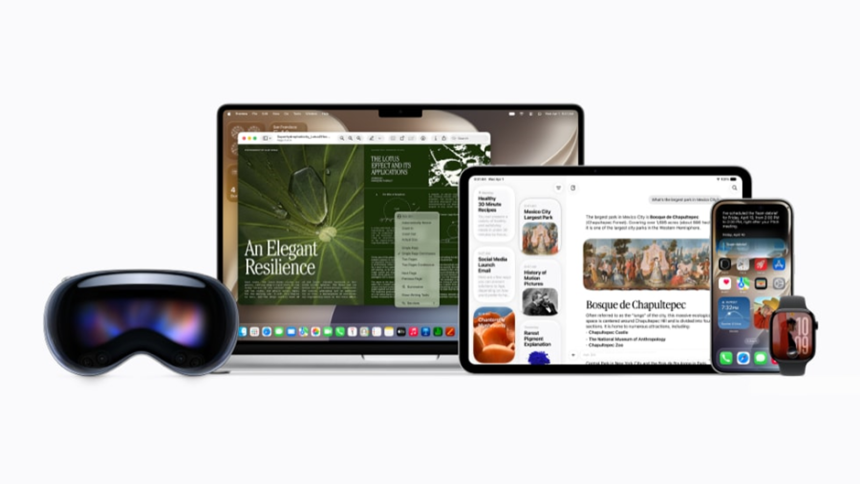
The strategic significance is clear. Apple is attempting to transform Siri from a utility into what technology analysts increasingly describe as a “personal intelligence layer” that sits across the entire Apple ecosystem. Whether on iPhone, iPad, Mac, Apple Watch or Vision Pro, Siri AI is expected to become the primary interface through which users interact with digital services.
Apple’s Distinctive AI Bet: Privacy as a Competitive Advantage
While competitors have focused heavily on the raw capabilities of large language models, Apple’s messaging emphasises privacy and trust.
Company executives repeatedly argued that artificial intelligence should serve users without compromising personal information. Apple maintains that many AI processes will occur directly on devices or through privacy-focused cloud infrastructure rather than relying exclusively on external data centres.
This strategy reflects a broader market reality. As governments in the United States, United Kingdom and European Union intensify scrutiny of AI systems, trust is rapidly becoming an economic asset.
For Apple, privacy is no longer simply a consumer protection issue. It is becoming a competitive differentiator in the global AI marketplace.
The Real Story Is Not Siri. It Is the Battle for the Future of Computing.
Beneath the product announcements lies a much larger strategic contest.
The global technology industry is moving from the era of mobile applications to what many analysts describe as the era of intelligent agents. In this emerging environment, consumers may no longer interact primarily through apps, websites or search engines. Instead, AI assistants will increasingly become the gateway through which people access information, shop, communicate and make decisions.
This transition threatens existing business models across the technology ecosystem.
Search engines face disruption because users can obtain answers directly from AI assistants. E-commerce platforms face disruption because intelligent agents can compare products and make purchasing recommendations automatically. Advertising models face disruption because AI systems may become intermediaries between brands and consumers.
Apple’s Siri AI is therefore not merely a software update. It is a strategic attempt to secure a leading position in the next phase of the digital economy.
Implications for the Global Technology Industry
The announcement sends a clear signal that the AI race is entering a new phase. The first phase was defined by the emergence of powerful foundation models such as ChatGPT, Claude and Gemini. The second phase is now focused on integration. The question is no longer which company possesses the most sophisticated model. The question is which company can seamlessly embed AI into the daily lives of billions of users.
Apple possesses a unique advantage in this competition. With more than two billion active devices globally, it already controls one of the world’s largest consumer technology ecosystems. If Siri AI succeeds, Apple could create an AI experience that millions of consumers use without ever needing to visit a standalone chatbot. That possibility should concern competitors across the technology sector.
What This Means for the United States
For the United States, Apple’s AI push reinforces America’s dominance in the global artificial intelligence economy. The country’s leading technology firms now occupy critical positions across the AI value chain, from semiconductor design and cloud infrastructure to foundation models and consumer platforms.
Apple’s renewed AI ambitions strengthen the strategic position of the U.S. technology sector at a time when global competition, particularly from China, continues to intensify. The development also supports America’s broader objective of maintaining leadership in the technologies likely to shape economic productivity over the next decade.
Why the UK and Europe Are Watching Closely
The United Kingdom and European Union are pursuing a more regulatory approach to AI governance. Apple’s emphasis on privacy and user control aligns closely with European regulatory priorities and may help the company navigate increasingly stringent compliance requirements.
At the same time, European policymakers will continue to scrutinise how AI assistants influence competition, data access and digital markets. The emergence of highly integrated AI ecosystems raises important questions about market concentration and platform dominance that regulators are unlikely to ignore.
Implications for Africa’s Digital Economy
For Africa, the significance of Apple’s AI strategy extends beyond smartphones. The continent is entering a period in which digital inclusion increasingly depends on access to intelligent digital services rather than basic internet connectivity alone. As AI becomes embedded in consumer devices, African businesses, governments and educational institutions will face growing pressure to adapt.
AI-powered assistants could improve productivity, support language translation, enhance access to information and facilitate digital commerce. However, they could also widen the technological gap between countries that actively invest in AI readiness and those that do not.
For Nigeria, South Africa, Kenya, Egypt and other emerging digital economies, the challenge is no longer whether AI will transform society. The challenge is whether local institutions can build the skills, infrastructure and policy frameworks necessary to participate meaningfully in the AI economy.
What Marketers and Brands Should Learn
Perhaps the most overlooked implication concerns marketing and brand communication. If AI assistants become the primary gateway to information and purchasing decisions, traditional digital marketing models may require fundamental redesign. Brands have historically optimised for search engines, social media platforms and websites. In the emerging AI environment, brands may increasingly need to optimise for AI discoverability.
The key question becomes: How does an AI assistant choose one brand recommendation over another? This development has profound implications for public relations, advertising, customer experience and reputation management. Brand trust, structured data and authoritative content could become more valuable than ever.
The BrandiQ Perspective
Apple’s latest announcement should be viewed not as a technology story alone but as a strategic business story. The company is attempting to redefine its position in the AI era by focusing on a simple proposition: making artificial intelligence personal, practical and private.
Whether Siri AI ultimately succeeds remains uncertain. Apple has previously faced criticism for delays in delivering promised AI capabilities. Investors, developers and consumers will closely monitor whether the company can execute on its ambitious vision.
What is certain, however, is that the AI race has moved beyond chatbots. The next battleground is the operating system, the smartphone and the everyday user experience. And with Siri AI, Apple has made it clear that it intends to be a major contender in that future.