
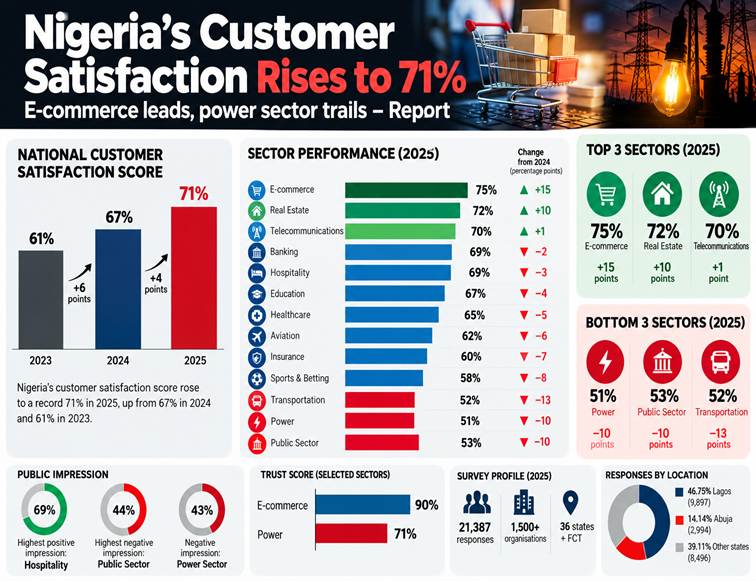

Nigeria’s customer satisfaction score rose to a record 71 per cent in 2025, despite declining performance across nine of the 12 sectors surveyed, according to the latest Nigeria Customer Service Index report.
Nigeria’s national customer satisfaction score increased from 67 per cent in 2024 to 71 per cent in 2025, continuing an upward trend from 61 per cent recorded in 2023. However, the improvement in the national benchmark contrasted with declining scores across most of the sectors assessed.
The findings are contained in the State of Customer Service in Nigeria: 2025 report, released in Lagos by the Nigeria Customer Service Index (NCSI), powered by the West Africa Association of Customer Service Professionals. The third edition of the index assessed customer experiences across 12 major economic sectors, drawing on 21,387 responses covering more than 1,500 organizations across Nigeria’s 36 states and the Federal Capital Territory.
E-commerce emerged as the highest-scoring sector, recording 75 per cent, an increase of 15 percentage points from 2024. Real estate followed at 72 per cent, gaining 10 percentage points, while telecommunications recorded a modest one-point improvement. In contrast, transportation, power and the public sector experienced the steepest declines, losing 13, 10 and 10 percentage points respectively. The power sector recorded the lowest satisfaction score at 51 per cent, followed by the public sector at 53 per cent. According to the report, the national customer satisfaction benchmark stood at 71 per cent, even though nine of the 12 sectors recorded lower scores than in the previous reporting period.
Trust Remains a Priority
The index assessed customer experiences using several indicators, including trust, professionalism, competence, complaint resolution, ease of doing business, processes and procedures, staff engagement, and customer-focused innovation. These measures were combined through a weighted scoring system intended to reflect the relative importance consumers attach to different aspects of service delivery. Trust emerged as the leading priority across all sectors surveyed. E-commerce recorded the highest trust score at 90 per cent, while the power sector had the lowest at 71 per cent.
Hospitality recorded the strongest positive public impression at 69 per cent. Negative sentiment was highest in the public sector, at 44 per cent, followed by the power sector at 43 per cent. The report recommended that organisations prioritise trust-building, faster complaint resolution and more consistent service delivery, particularly in the public and power sectors. It also advocated combining digital customer-service channels with reliable traditional support to accommodate different consumer needs.
Organisations Ranked Across 12 Sectors
The report ranked individual organisations within the sectors surveyed. Slot topped the e-commerce category, ahead of Jumia and Konga, while MTN retained its leading position among GSM operators, followed by Airtel and Globacom. FibreOne led the internet service provider category, ahead of Starlink and Smile. Stanbic IBTC ranked first in banking, followed by FCMB and Wema Bank. OPay led the fintech and microfinance banking category, ahead of Kuda and Paystack.
Reddington Hospital topped the private healthcare category, followed by Lagoon Hospital and Eko Hospital, while Military Hospital Kaduna led public healthcare. Eko Hotels retained its leading position in hospitality, Covenant University topped private education, and Obafemi Awolowo University, Ile-Ife, maintained its position among public universities. Ibom Air retained its leading position in aviation. The Corporate Affairs Commission ranked first among public-sector ministries, departments and agencies, followed by the Nigerian Maritime Administration and Safety Agency and the Federal Inland Revenue Service.
In the power sector, Abuja Electricity Distribution Company ranked first, ahead of Ikeja Electric and Enugu Electricity Distribution Company. ABC Transport led interstate transportation, while Uber topped intra-city transportation, followed by Bolt and the Bus Rapid Transit system.
BetKing led the sports and betting category, then SportyBet and 1xBet.
The report also identified organisations that had featured in all three editions of the index, covering 2023 to 2025. These included Jumia, Konga and Slot in e-commerce; Covenant University and Babcock University in education; OPay and Paystack in financial services; Lagoon Hospital in healthcare; and Eko Hotels in hospitality.
Other organisations featured consistently included Reliance HMO in insurance; Ikeja Electric and Ibadan Electricity Distribution Company in power; the Corporate Affairs Commission in the public sector; Lekki Homes and Gardens and Sujimoto Group in real estate; BetKing and SportyBet in sports and entertainment; and MTN, Spectranet and Airtel in telecommunications.
Survey Profile and Geographical Distribution
Financial services and telecommunications generated the largest volumes of responses, although participation increased year on year across all sectors. Lagos accounted for 9,897 responses, representing 46.75 per cent of the total, while Abuja contributed 2,994 responses, or 14.14 per cent. Together, the two locations accounted for 60.89 per cent of all responses. Enugu, Oyo and Rivers were among the other locations with significant participation. The index acknowledged that the concentration of responses in Lagos and Abuja, uneven participation across sectors and unmet sampling quotas in some categories should be considered when interpreting the findings and planning future surveys.
Respondents aged 30 to 34 constituted the largest active age group. University and polytechnic graduates accounted for 76 per cent of participants, while those with postgraduate or professional qualifications represented 15 per cent. Middle-to-high and lower-middle-income groups made up 63 per cent of respondents, while approximately 15 per cent reported having no income. The report said organisations could use the findings to benchmark their performance against competitors and identify areas requiring improvement. It recommended investments in staff training, transparent processes, improved complaint-handling systems and more responsive customer-service channels. It also called for broader participation from locations outside Lagos and Abuja to strengthen future comparisons and provide a more balanced picture of customer experiences across Nigeria.
BRANDIQ ANALYSIS AND OBSERVATIONS
1. The national improvement conceals a divided customer experience
The headline figure is encouraging: Nigeria’s customer satisfaction score increased from 61 per cent in 2023 to 71 per cent in 2025. But the fact that nine of the 12 sectors recorded declining scores complicates the picture.
The national benchmark and sector-level results measure different things. A national score can rise even when most sectors decline if improvements in a smaller number of sectors, differences in response volumes or the weighting methodology influence the overall result. The published information supplied here does not provide enough detail to establish precisely which factors explain the increase.
For business leaders, the distinction matters. A rising national benchmark should not be interpreted as evidence that the average customer experience is improving uniformly across the economy. The sectoral results suggest a more fragmented picture, with some industries making substantial gains while others struggle to maintain service standards.
The management implication is that companies should benchmark themselves against their own sector and customer segments, rather than relying on the national average as evidence of progress.
2. E-commerce’s improvement is significant, but its causes remain unproven
E-commerce recorded a 15-percentage-point increase to 75 per cent, making it the highest-scoring sector in the report. Real estate also improved substantially, gaining 10 percentage points to reach 72 per cent.
These results deserve attention because both sectors depend heavily on customer confidence and the quality of the overall transaction experience. In e-commerce, consumers must trust product descriptions, payment processes, delivery arrangements, return policies and complaint-handling systems. In real estate, confidence can be influenced by transparency, communication, documentation and the management of customer expectations.
However, the report does not establish which specific operational changes produced the gains. It would therefore be premature to attribute the improvement to faster delivery, better digital platforms, more responsive customer service or any other particular intervention.
For executives, the useful next step is to investigate the underlying drivers. Did customers experience fewer failed transactions? Were complaints resolved more quickly? Did communication improve? Did consumers perceive greater reliability? Answers to these questions would turn the index from a comparative ranking into a practical management tool.
3. The power sector faces a persistent customer-confidence challenge
With a satisfaction score of 51 per cent, the power sector recorded the lowest result in the survey. Its trust score of 71 per cent was also the lowest among the sectors reported, while negative public sentiment stood at 43 per cent.
Electricity distribution companies operate in a service environment where customer satisfaction depends on more than the courtesy of frontline staff. Consumers also evaluate the reliability of supply, billing accuracy, complaint resolution, communication about outages and the perceived fairness of charges.
These factors are important because customers often judge a company through experiences that may involve infrastructure constraints, regulatory arrangements and operational decisions beyond the control of individual customer-service teams.
The report does not break down the reasons for the power sector’s score, so it cannot establish the relative contribution of electricity supply, billing, communication or complaint handling. Nevertheless, the results indicate that customer trust remains an important issue for operators.
For power companies, improving the customer experience requires a connection between operational performance and communication. Customers need accurate information, understandable bills, accessible complaint channels and clear explanations when service problems occur.
Better communication cannot substitute for reliable electricity, but poor communication can compound dissatisfaction when service fails.
4. Public-sector satisfaction is a governance issue
The public sector recorded a customer satisfaction score of 53 per cent, while negative sentiment reached 44 per cent, the highest among the sectors surveyed.
The comparison is significant because public institutions often control services, registrations, permits and administrative processes that citizens and businesses must access. Their customers may have limited alternatives when services are slow, procedures are unclear or complaints remain unresolved.
The Corporate Affairs Commission ranked first in the report’s public-sector category, followed by the Nigerian Maritime Administration and Safety Agency and the Federal Inland Revenue Service. These rankings provide a starting point for examining differences in customer experience among institutions, although the supplied results do not explain the operational factors behind the positions.
For public-sector leaders, customer service should be considered part of institutional effectiveness rather than an isolated communications function. Clear procedures, predictable timelines, accessible information, responsive complaints systems and transparent decisions can reduce friction for citizens and businesses.
This is particularly important where administrative delays impose costs on companies trying to register businesses, obtain approvals or meet regulatory obligations.
5. The survey’s geographical concentration limits national interpretation
The report draws on 21,387 responses from across Nigeria, but Lagos and Abuja together account for 60.89 per cent of the total. Lagos alone contributes 46.75 per cent.
The geographical spread is valuable, but the concentration raises questions about how closely the sample reflects the experiences of consumers in other parts of the country. Customer expectations, service availability, infrastructure and access to digital channels may differ across locations.
The respondent profile also matters. University and polytechnic graduates represent 76 per cent of participants, while respondents aged 30 to 34 constitute the largest active age group. This profile may be particularly informative for businesses serving educated, digitally engaged consumers, but it may not capture other customer groups with equal depth.
These characteristics do not automatically invalidate the findings. Their implications depend on the sampling method, sector-level response distribution, weighting and other methodological details. However, the report itself acknowledges that geographical concentration and unmet sampling quotas should be considered when interpreting the results.
Future editions would be strengthened by publishing clearer methodological information, including sampling procedures, sector-specific response counts, weighting arrangements and measures of uncertainty. Such transparency would help executives distinguish genuine performance differences from variations associated with the survey sample.
6. Rankings are a starting point, not a complete measure of performance
The report names leading organisations across banking, e-commerce, telecommunications, healthcare, education, hospitality and other sectors. These comparisons can help companies identify competitors worth studying and establish questions for further investigation.
However, a ranking does not, by itself, explain why one organisation scored above another. Nor does it establish whether a difference is statistically meaningful or whether the same result would hold across different customer segments.
A business should therefore avoid treating a position in the index as a complete assessment of its customer experience. The more useful approach is to identify the dimensions driving its score, compare them with competitors and link the findings to operational indicators such as complaint-resolution time, repeat purchases, customer retention and service reliability.
The report’s identification of organisations featured across all three editions also offers an opportunity to examine consistency over time. Yet repeated inclusion should not automatically be interpreted as proof of sustained improvement; that conclusion would require comparable scores and supporting evidence across the three years.
BRANDIQ TAKEAWAY
Customer satisfaction is not simply a measure of how customers feel about a brand. It is a signal of how effectively an organisation delivers on its promises.
The 2025 Nigeria Customer Service Index provides a useful snapshot of consumer experiences across major sectors. Its findings show an overall rise in the national benchmark, substantial gains in e-commerce and real estate, and weaker scores in power, transportation and the public sector.
For business leaders, the priority should be to move beyond rankings and understand the operational factors that shape customer trust. That means investing in reliable service, transparent processes, competent employees, effective complaint resolution and communication that keeps customers informed.
The report also highlights the importance of evidence quality. Broader geographical participation, clearer methodological disclosure and more detailed explanations of sector-level changes would make future editions even more useful to executives.
The ultimate competitive advantage is not a high customer-satisfaction score. It is the organisational ability to understand why customers are satisfied or dissatisfied – and to translate that understanding into better service, stronger trust and lasting commercial value.