


Africa’s telecom giant is moving into banking and AI infrastructure – and why the strategy could be more important than the individual businesses it enters
The Strategy Behind the Moves
Africa’s largest telecoms operator MTN Group is exploring banking licences in select markets as the company looks to expand lending from its own balance sheet, CEO Ralph Mupita said.
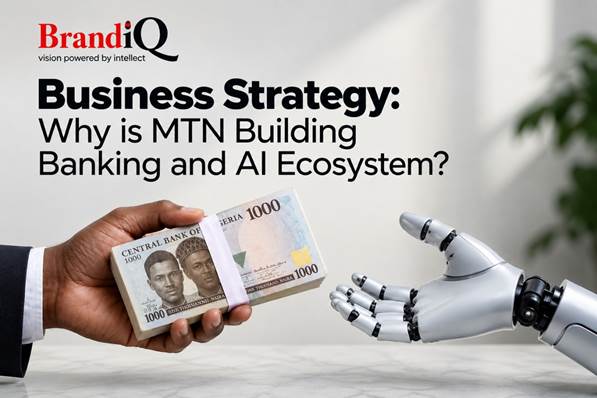
A critical examination of this step clearly shows that MTN’s exploration of banking licences and its planned investment in AI-enabled data-centre infrastructure may appear, on the surface, to be two unrelated diversification decisions. One takes the telecommunications company into financial services; the other takes it deeper into computing infrastructure. Viewed through the lens of business strategy, however, they reveal something considerably more deliberate: MTN is building an ecosystem around its existing customer base, infrastructure and digital capabilities.
That distinction is worth analysing and evaluating for business and brand insight. A company pursuing conventional diversification asks: What other businesses can we enter? An ecosystem strategist asks a more consequential question: What combination of interconnected businesses can we build around the customer so that each strengthens the others?
MTN has been moving in this direction for some time. The company has previously described its ambition to build “the largest and most valuable platforms”, while expanding its fintech ecosystem alongside its core connectivity business. Its latest moves suggest that the ecosystem ambition is becoming increasingly tangible.
The proposed banking licences would potentially deepen MTN’s relationship with customers who already use its mobile-money services. The data-centre strategy, meanwhile, moves the company further upstream into the infrastructure required to power digital services and artificial intelligence. Rather than simply adding unrelated products to the MTN portfolio, both moves extend the company’s position into adjacent parts of the digital value chain. That is the essence of ecosystem strategy.
Why Telecoms Companies are Particularly Suited to Ecosystems
Telecommunications companies possess an unusual strategic advantage in the digital economy: they already sit close to the customer. They know how to distribute services at scale. They possess extensive networks, established brands, millions of customer relationships and, increasingly, sophisticated digital-payment platforms. They also operate infrastructure on which other digital businesses depend. That creates the possibility of moving in several directions simultaneously.
A telecom operator can move downstream towards the consumer through financial services, entertainment, commerce and digital applications. It can move upstream towards infrastructure through fibre, cloud, data centres and computing. And it can use the connectivity layer to connect the different components. MTN’s opportunity is therefore not simply to become a bank or a data-centre operator. It is to make its existing assets more valuable by connecting them.
The customer who uses an MTN network can become a MoMo customer. The MoMo customer can potentially become a borrower. The same ecosystem can provide businesses with connectivity and digital services. And the infrastructure supporting these services can increasingly become part of MTN’s broader technology proposition. The strategic value lies in the connections between the businesses.
The Economics of the Ecosystem
There is a fundamental reason companies pursue this strategy. In a conventional business, every new product has to acquire customers, build distribution and establish trust almost from scratch. An ecosystem can potentially reduce those costs because the company already possesses some of the assets required to launch the next service.
MTN does not have to introduce an entirely unknown brand to millions of African consumers if it expands into another digital service under an established relationship. Its existing distribution, customer base and infrastructure can become strategic assets for the new business.
This creates the possibility of cross-selling, lower customer-acquisition costs, greater customer retention and higher customer lifetime value. More importantly, the businesses can reinforce each other. Connectivity makes digital financial services easier to access. Digital financial activity generates more engagement with the platform. Greater engagement creates more opportunities for other services. Increasing digital activity creates demand for more computing and data infrastructure. The ecosystem therefore has the potential to produce a network of reinforcing businesses rather than a collection of unrelated businesses. That is strategically different from simply becoming bigger.
From Brand Extension to Ecosystem Extension
There is also an important marketing distinction. If MTN launches a financial product, we could describe it as brand extension. The company is taking a familiar brand into a new category. But brand extension describes the customer’s perception of the move; it does not fully explain the corporate strategy behind it. The more powerful strategic concept is ecosystem building.
The question is no longer simply whether consumers believe that MTN has permission to enter banking. The bigger question is whether MTN can create an environment in which connectivity, payments, finance, commerce and digital infrastructure become mutually reinforcing components of one relationship. This is why the distinction matters for marketers.
The strongest ecosystem brands are not necessarily those with the largest number of products. They are those in which customers perceive a meaningful connection between the products. An ecosystem that merely bundles services is a portfolio. An ecosystem in which the services make one another more useful is a strategic system.
Why AI Makes the Strategy Even More Interesting
The planned data-centre investment adds another dimension to MTN’s ecosystem strategy. The AI economy is creating demand for computing infrastructure, storage, connectivity and energy-intensive data centres. MTN’s move into this layer therefore places the company closer to the technological foundation upon which many future digital businesses will operate. This is strategically different from launching another consumer application.
If MTN’s consumer-facing businesses occupy the upper layers of the digital ecosystem, data-centre infrastructure occupies a deeper layer underneath them. That raises the possibility of MTN participating in both sides of the digital economy: the services people consume and some of the infrastructure that makes those services possible. For an African telecommunications company, that is an ambitious strategic position.
But Ecosystems Can Become Strategic Traps
The ecosystem model is not automatically successful. The temptation is to assume that because a company has millions of customers, it can successfully enter every adjacent market. History suggests otherwise. Banking is not simply another telecom service. Financial services bring capital requirements, credit risk, regulatory obligations and a much higher burden of trust. Data centres are not simply another technology product. They require enormous capital expenditure, reliable electricity, sophisticated engineering and sustained demand. The danger is therefore strategic overreach.
The question MTN must answer is not whether it can enter these businesses, but whether it possesses – or can acquire – the distinctive capabilities necessary to compete in them. An ecosystem becomes powerful when the parent company’s existing advantages create an unfair advantage in the new business. If that connection is weak, diversification can simply destroy management attention and capital.
The Bigger African Business Question
MTN’s strategy points towards a broader transformation in African business. The old competitive map was largely organised by industry: banks competed with banks; telecoms competed with telecoms; technology companies competed with technology companies. Digitalisation is making those boundaries increasingly porous.
A telecom company can become a fintech company. A bank can become a technology platform. A technology company can become a payments company. An e-commerce company can become a logistics company. The consequence is that the competitive unit of the future may increasingly be the ecosystem rather than the individual product or category.
For African businesses, this is particularly significant because the continent’s digital markets remain fragmented and millions of consumers are still entering formal digital services for the first time. A company that can build trust, distribution and infrastructure at scale has an opportunity to connect multiple needs around the same customer. MTN appears to be betting that it can be that company.
BrandiQ Analysis
The most interesting thing about MTN’s strategy is therefore not that it wants to become a bank. It is not even that it wants to invest in AI data centres. It is that MTN appears to be asking a much bigger strategic question: what else can we build around the customer and infrastructure we already possess? That is the logic of ecosystem strategy.
And it carries a lesson for African marketers and business strategists. Companies should stop asking only, “What business are we in?” They should increasingly ask, “What customer ecosystem are we capable of owning, orchestrating or participating in?” That is a profound change in strategic thinking.
Gala’s historic success in Nigeria did not come from believing it was merely in the sausage business; it understood itself within the broader snack occasion. Similarly, Coca-Cola has historically understood itself beyond the narrow category of cola.
MTN’s next chapter could represent the digital-era version of that thinking. It is not asking simply how to sell more telecommunications. It is asking how to become more indispensable to the customer’s digital life.
BrandiQ Verdict
MTN’s banking and data-centre moves should therefore be understood as ecosystem strategy in action, supported by related diversification and elements of vertical integration. The strategic prize is not the banking licence. It is not the data centre.
The prize is the relationship between them – and the customer relationship that sits at the centre of the ecosystem. If MTN succeeds, the company may eventually be judged less by the traditional question, “How strong is its telecom business?” and more by a new one:
“How much of Africa’s digital economy can MTN connect, enable and capture within its ecosystem?” That is the real story. And it may be one of the most important strategic questions facing African businesses as digitalisation dissolves the boundaries between industries.