


Recognition places African electric mobility startup on the global innovation map as investors intensify focus on sustainable transport and inclusive entrepreneurship
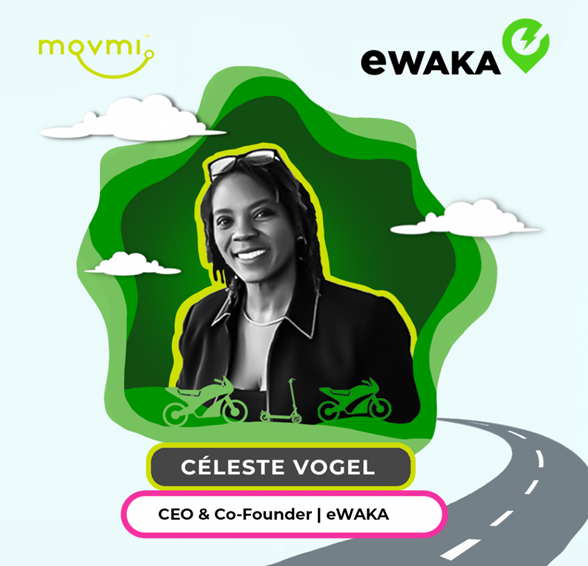
Kenya-based electric mobility startup eWAKA has secured a significant international endorsement after its Co-founder and Chief Executive Officer, Céleste Tchetgen Vogel, was selected as a 2026 Cartier Women’s Initiative Fellow, placing the company among a select group of women-led ventures recognised globally for using business to solve pressing social and environmental challenges.
Vogel was selected from a highly competitive global pool of applicants to represent the Anglophone and Lusophone Africa category of the prestigious Cartier Women’s Initiative Awards, an international entrepreneurship programme that has, for two decades, supported women building businesses with measurable social impact.
For eWAKA, the recognition extends beyond personal achievement. It places the young African mobility company on one of the world’s most respected platforms for impact entrepreneurship at a time when investors, governments and development institutions are increasingly looking to electric mobility as a critical component of Africa’s sustainable economic transformation.
Founded in 2021, eWAKA is pursuing an ambitious mission: making Africa’s last-mile transport cleaner, more affordable and economically empowering. The company provides electric motorcycles and cargo bikes supported by flexible financing that enables riders to gradually own their vehicles rather than lease them indefinitely. The business also operates battery-swapping infrastructure, charging services, fleet management software and merchant delivery platforms that collectively form an integrated electric mobility ecosystem.
Operating across Kenya and Rwanda, the company has already begun expanding into Burundi and the Democratic Republic of Congo, reflecting growing confidence in regional demand for affordable clean transportation solutions.
According to company figures, eWAKA currently supports nearly 1,500 active riders, has completed more than one million deliveries, onboarded over 550 merchants to its digital platform and facilitated approximately KSh25 million (around US$190,000) in rider earnings. The company says its operations have created more than 1,500 jobs, with over 85 per cent of riders aged between 18 and 30 years, while avoiding more than 3,000 metric tonnes of carbon dioxide emissions through its electric vehicle operations.
Unlike many electric vehicle companies that focus primarily on manufacturing or vehicle sales, eWAKA has developed an integrated business model combining mobility assets, financial services, digital technology and logistics operations. The company believes this approach enables it to expand efficiently into new African cities while simultaneously improving delivery services for businesses and creating sustainable income opportunities for riders.
Commenting on the recognition, Vogel described mobility as a powerful tool for economic inclusion. “Mobility should open doors, not close them. When a rider can own a clean vehicle and earn a living with it, a whole family moves forward, and the city breathes a little easier. That is the future eWAKA is building, one electric mile at a time. To be welcomed into the Cartier Women’s Initiative, in its twentieth year, tells us the path is real and gives us the resolve to walk it much further.”
Originally from Cameroon, Vogel brings an unusually diverse background spanning international finance, law and corporate leadership. Before founding eWAKA, she held senior legal and executive positions at Credit Suisse, ABB and Swiss Re. She holds degrees in economics, international relations and law from Ohio Wesleyan University and Northwestern University Pritzker School of Law in the United States.
Her growing international profile has also earned recognition among the Most Influential Women in Mobility (2024) and the Meaningful Business 100 (2025).
The Cartier Women’s Initiative welcomed Vogel into its global community of impact entrepreneurs. “We are delighted to welcome Céleste Tchetgen Vogel to the Cartier Women’s Initiative community. Through eWAKA, she exemplifies how entrepreneurship can drive meaningful, positive change. We look forward to supporting her journey and celebrating the impact she is creating,” said Kiyo Taga-Witkin, Director of the Cartier Women’s Initiative.
Established in 2006, the Cartier Women’s Initiative has become one of the world’s leading entrepreneurship programmes for women founders addressing social and environmental challenges. Beyond financial support, the programme provides leadership development, international networking opportunities and access to a global community of more than 520 entrepreneurs working across multiple sectors and continents.
The BrandiQ Perspective
This announcement is not simply another startup funding or entrepreneurship story. It represents the convergence of three powerful global trends reshaping business across Africa: clean mobility, inclusive finance and impact investing. Electric mobility has often been viewed primarily as an environmental issue. Increasingly, however, it is becoming an economic development strategy.
Across many African cities, motorcycles and small commercial vehicles constitute the backbone of last-mile logistics, informal transportation and urban commerce. Replacing conventional petrol-powered vehicles with electric alternatives has implications far beyond reducing carbon emissions. It lowers operating costs for riders, reduces dependence on imported fossil fuels, improves urban air quality and creates opportunities for new digital business models.
What distinguishes eWAKA is that it is not attempting to become simply another electric vehicle manufacturer. Instead, it is building an ecosystem. By combining vehicle financing, battery-swapping infrastructure, logistics software, merchant platforms and fleet management into one integrated operation, the company is addressing multiple barriers that have historically slowed electric vehicle adoption across Africa.
Equally significant is the role of international recognition.
Global programmes such as the Cartier Women’s Initiative increasingly function as important gateways to international capital, strategic partnerships and institutional credibility. For early-stage African startups, such recognition often proves as valuable as direct financial investment because it enhances visibility among venture capital firms, development finance institutions and multinational partners seeking scalable impact businesses.
The story also highlights an important evolution in African entrepreneurship.
Increasingly, some of the continent’s most promising startups are being built not around copying business models from Silicon Valley but around solving uniquely African problems using locally adapted technology and innovative financing structures.
BrandiQ Analysis: Five Strategic Lessons
1. Africa’s green economy is becoming an investment opportunity
Clean mobility is moving beyond environmental activism into mainstream commercial investment. Companies capable of combining sustainability with profitability are attracting growing international attention.
2. Financing remains the key to electric mobility adoption
Vehicle affordability continues to be one of the biggest obstacles to EV adoption in Africa. eWAKA’s ownership-financing model demonstrates how financial innovation can accelerate technology adoption more effectively than product innovation alone.
3. Ecosystems outperform standalone products
The company’s integrated approach -combining vehicles, financing, battery infrastructure and software – illustrates how platform-based business models are becoming increasingly attractive to investors.
4. International recognition builds brand equity
Selection into globally respected programmes such as the Cartier Women’s Initiative enhances organisational credibility, strengthens investor confidence and expands access to international partnerships.
5. Women entrepreneurs are reshaping Africa’s innovation landscape
The recognition also reflects the growing influence of women founders across Africa’s technology ecosystem. As global investors increasingly prioritise diversity alongside impact, women-led enterprises are becoming important drivers of innovation across sectors ranging from fintech and health technology to renewable energy and sustainable mobility.
BrandiQ Verdict
eWAKA’s inclusion in the Cartier Women’s Initiative is more than a milestone for one entrepreneur. It signals the growing maturity of Africa’s innovation ecosystem, where startups are increasingly building scalable businesses that address both commercial opportunities and societal challenges. As cities across the continent confront rising urbanisation, climate pressures and youth unemployment, integrated mobility platforms like eWAKA suggest that the future of transportation will be shaped not only by cleaner technologies but also by smarter financing, stronger digital ecosystems and more inclusive entrepreneurship.