

By BrandiQ Market Intelligence Unit
For decades, African brands struggled to achieve scale due to infrastructure gaps, fragmented markets, and limited access to capital. But the rise of digital technologies, mobile penetration, fintech innovation, and regional integration through the African Continental Free Trade Area (AfCFTA) is accelerating the growth of homegrown brands.
Today, African companies are not only serving local consumers—they are building global platforms.
According to Partech Africa’s 2024 Africa Tech Venture Capital Report, African startups raised more than $3.5 billion in funding, while McKinsey estimates that the continent’s consumer spending will reach $2.5 trillion by 2030.
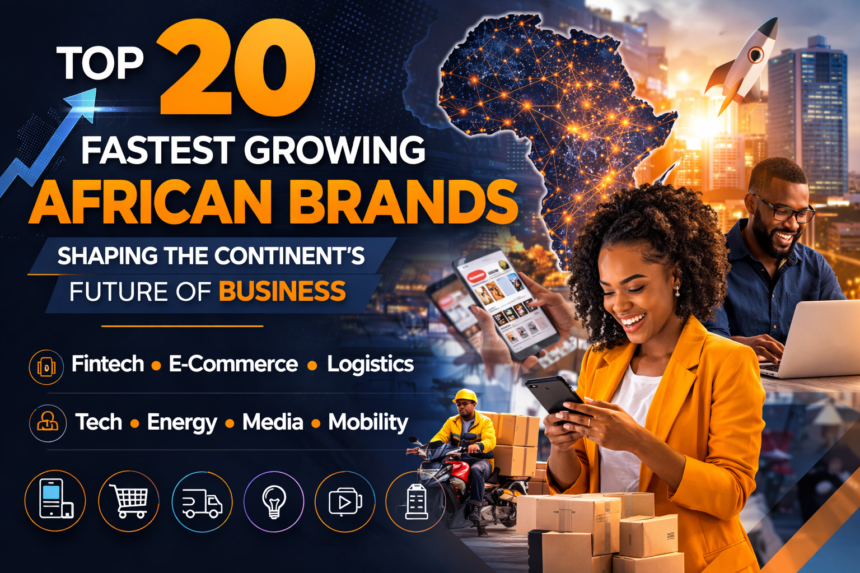
Against this backdrop, BrandiQ Market Intelligence Unit analyzed market performance, revenue growth, innovation impact, geographic expansion, brand visibility, and investment momentum to identify the Top 20 Fastest Growing African Brands in 2026.
These brands are shaping Africa’s digital economy, financial inclusion, logistics networks, energy transition, and creative industries.
What Defines a Fast-Growing African Brand?
To ensure credibility and transparency, BrandiQ’s analysis evaluated brands using five core metrics:
1. Revenue and valuation growth
2. Market expansion across African countries
3. Innovation and technology leadership
4. Investment and funding momentum
5. Brand influence and consumer adoption
The result is a cross-sector list representing fintech, logistics, telecommunications, e-commerce, energy, media, and mobility.
The Top 20 Fastest Growing African Brands
1. Flutterwave (Nigeria)
Flutterwave has emerged as one of Africa’s most influential fintech brands, providing payment infrastructure that enables businesses to accept payments across Africa and globally.
Founded in 2016, the company now operates in more than 30 African countries, supporting transactions for companies like Uber and Microsoft. With a valuation exceeding $3 billion, Flutterwave has become a flagship brand for African fintech innovation.
Its rapid growth reflects the increasing demand for digital payment infrastructure in Africa’s expanding digital economy.
2. M-Pesa (Kenya)
Launched by Safaricom, M-Pesa remains one of the most transformative financial technology brands in the world.
With more than 50 million active users across Africa, the platform processes billions of dollars in transactions every month, enabling mobile banking, remittances, and digital commerce.
M-Pesa’s continued expansion into Ethiopia and other markets keeps it among the fastest growing brands on the continent.
3. Jumia (Pan-African)
Often described as Africa’s Amazon, Jumia operates one of the continent’s largest e-commerce ecosystems.
The company has built an integrated network of logistics, payments, and marketplace services across multiple African countries.
Despite early profitability challenges, Jumia’s investments in logistics and digital payments have positioned it for long-term growth as online retail adoption accelerates.
4. Chipper Cash (Uganda / USA / Africa)
Chipper Cash is rapidly expanding its digital payments platform across Africa and internationally.
Founded by Ugandan entrepreneurs Ham Serunjogi and Maijid Moujaled, the fintech platform enables low-cost cross-border money transfers and has attracted investment from major global investors.
Its mission to simplify cross-border payments has made it one of Africa’s fastest growing financial technology brands.
5. MTN (South Africa)
Telecommunications giant MTN Group continues to grow its brand influence across Africa.
Operating in more than 19 markets, MTN serves over 290 million customers and has expanded aggressively into fintech through MoMo (Mobile Money) services.
Its fintech division alone processes hundreds of billions of dollars annually, reflecting the convergence of telecom and financial services in Africa.
6. OPay (Nigeria)
OPay has become one of Nigeria’s fastest growing fintech brands, providing digital payments, ride-hailing, and financial services.
With millions of users and a network of agents across Nigeria, OPay is helping drive financial inclusion in Africa’s largest economy.
The company has raised hundreds of millions in investment from global investors.
7. Wave (Senegal)
Wave has revolutionized mobile money in Francophone Africa.
Operating primarily in Senegal and Côte d’Ivoire, the fintech platform has gained rapid adoption by offering low-cost digital financial services to millions of users.
Wave’s growth highlights the untapped fintech potential across West Africa.
8. Andela (Nigeria / Global)
Andela is redefining Africa’s role in the global technology talent market.
The company connects software developers from Africa with global companies, helping bridge the global tech talent shortage.
Its global talent marketplace has positioned Africa as a major hub for remote tech talent.
9. Twiga Foods (Kenya)
Twiga Foods is transforming Africa’s agricultural supply chains.
By connecting farmers directly to retailers, the company reduces food waste and improves pricing efficiency.
Its digital platform is helping modernize food distribution networks across East Africa.
10. Zipline (Rwanda / Ghana)
Zipline operates one of the world’s largest autonomous drone logistics networks.
The company delivers medical supplies—including vaccines and blood products—to remote health facilities across Africa.
Its operations in Rwanda and Ghana have become global case studies in health logistics innovation.
11. Paystack (Nigeria)
Acquired by Stripe in 2020 for over $200 million, Paystack remains one of Africa’s most influential fintech platforms.
The company enables businesses to accept online payments easily and has expanded across multiple African markets.
Its developer-friendly infrastructure has accelerated the growth of digital businesses across the continent.
12. Moniepoint (Nigeria)
Moniepoint has rapidly grown into one of Nigeria’s largest digital banking and payments platforms.
With millions of merchants and agents, the fintech company plays a major role in financial inclusion and SME payments.
13. Yoco (South Africa)
Yoco empowers small businesses with digital payment tools.
The fintech company provides point-of-sale solutions, enabling merchants to accept card payments easily.
Its rapid adoption among small businesses has driven strong growth.
14. Moove (Nigeria)
Moove is one of Africa’s fastest growing mobility fintech startups.
Founded in 2020, the company provides vehicle financing for ride-hailing drivers, enabling them to acquire cars and earn income through platforms like Uber.
Moove has expanded rapidly across Africa, the Middle East, and Europe, positioning itself as a key financial infrastructure provider within the global mobility economy.
The company has raised hundreds of millions of dollars in funding, underscoring strong investor confidence in its growth potential.
15. Sendwave (Africa / Global)
Sendwave has become a leading remittance platform connecting African diaspora communities to families back home.
The company enables fast, low-cost money transfers into African countries.
16. MFS Africa (South Africa)
MFS Africa connects mobile money networks across the continent.
Its infrastructure enables interoperability between digital wallets, improving cross-border financial transactions.
17. Kobo360 (Nigeria)
Kobo360 is transforming logistics and freight transport across Africa.
The digital logistics platform connects truck drivers with companies that need cargo transported, improving efficiency in supply chains.
18. Cellulant (Kenya)
Cellulant provides digital payments infrastructure across Africa.
The company powers payments for governments, banks, and businesses, strengthening Africa’s digital financial ecosystem.
19. Qaxum (Pan-African)
Qaxum is an emerging African SaaS platform designed to democratize digital visibility for individuals, entrepreneurs, and small businesses across the continent.
At its core, Qaxum addresses one of Africa’s most pressing digital challenges: the lack of accessible and affordable online presence for millions of creators, freelancers, and micro-entrepreneurs. Through its platform, users can easily create professional online profiles, digital storefronts, and personal brand pages without the technical complexity or high costs traditionally associated with building websites or e-commerce platforms.
In many African markets, small businesses still operate largely offline due to limited resources, digital literacy gaps, and the high cost of web development. Qaxum’s software-as-a-service (SaaS) model removes these barriers by offering a simple, low-cost — and in many cases nearly free — pathway to digital participation.
The platform enables users to:
- Build online profiles that showcase their skills, services, or businesses
- Launch digital storefronts for selling products or services
- Improve online discoverability and digital credibility
- Participate more effectively in the growing African digital economy
As Africa’s internet population continues to expand rapidly—projected to exceed 1 billion users by 2030—platforms like Qaxum are becoming critical infrastructure for the continent’s creator economy, gig economy, and SME ecosystem.
By empowering individuals and small enterprises with tools for digital identity, commerce, and visibility, Qaxum is helping bridge Africa’s digital inclusion gap and enabling more Africans to participate in global online markets.
Industry observers say platforms that simplify digital presence creation will play a major role in unlocking economic opportunity for millions of African entrepreneurs who have historically been excluded from the formal digital marketplace.
In this sense, Qaxum represents a broader shift in Africa’s technology landscape: from technology built for corporations to platforms designed to empower everyday Africans.
20. Interswitch (Nigeria)
Interswitch remains one of Africa’s most established fintech brands.
With decades of payments infrastructure experience, the company continues to expand its digital payments and financial services across Africa.
Why African Brands Are Growing Faster Than Ever
Several powerful trends are accelerating brand growth across the continent.
1. Digital Transformation
Africa has over 600 million internet users, and smartphone adoption continues to rise rapidly.
Digital platforms allow brands to scale quickly across borders.
2. Fintech Innovation
Africa leads the world in mobile money adoption, with over 40% of global mobile money transactions occurring on the continent (GSMA).
3. Youthful Population
Africa has the world’s youngest population, creating massive demand for digital services, entertainment, and financial products.
4. Regional Trade Integration
The AfCFTA agreement is expected to create a $3.4 trillion single market, unlocking new growth opportunities for African brands.
Lessons from Africa’s Fastest Growing Brands
Several key strategic insights emerge from these success stories.
Technology-first business models enable rapid scale.
Strong local market understanding drives adoption.
Strategic investment partnerships accelerate expansion.
Digital infrastructure is replacing traditional business barriers.
The Future of African Brands
The next decade could produce Africa’s first wave of global mega-brands.
With rising venture capital investment, expanding internet access, and stronger regional trade frameworks, African companies are increasingly positioned to compete globally.
Experts believe sectors such as fintech, logistics, renewable energy, digital media, and artificial intelligence will produce the continent’s next billion-dollar brands.
BrandiQ Market Insight
Africa’s fastest growing brands are not simply businesses—they are engines of economic transformation.
They are solving real problems: financial inclusion, food distribution, logistics efficiency, healthcare access, and digital commerce.
More importantly, they are proving that African innovation can scale globally.
For investors, entrepreneurs, and policymakers, the message is clear:
Africa is no longer just an emerging market.
It is an emerging powerhouse of global brand innovation.