
By using this site, you agree to the Privacy Policy and Terms of Use.
Accept
BrandiQBrandiQBrandiQ
  • Brand & Marketing
  • Industry News
  • Market Intelligence
  • Business & Economy
  • Technology & Digital
Reading: Trending Technology: Will AI Replace PR Pros? Why Experts Say – ‘Not So Fast’
Share
0

No products in the cart.

Notification Show More
Font ResizerAa
BrandiQBrandiQ
0
Font ResizerAa
Search
  • Brand & Marketing
  • Industry News
  • Market Intelligence
Have an existing account? Sign In
Follow US
© 2026 Brand IQ. All Rights Reserved.
Market Intelligence

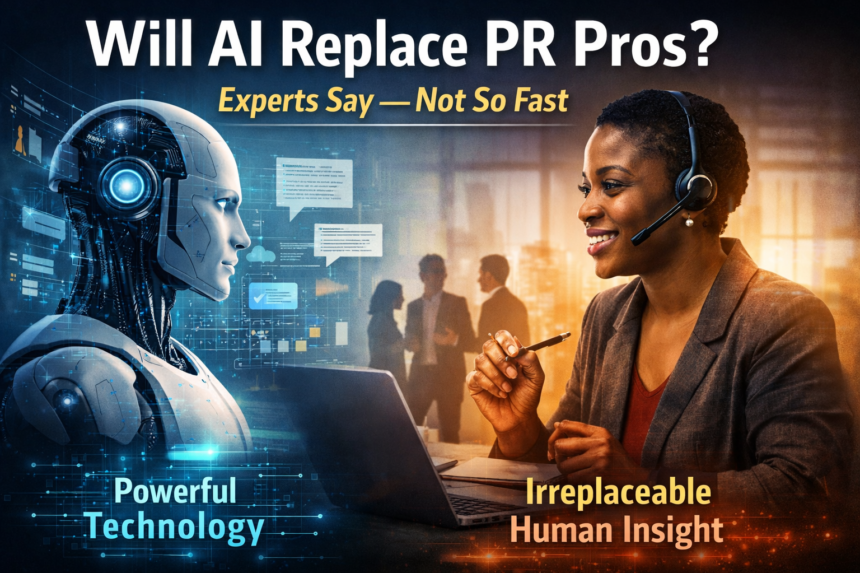
Trending Technology: Will AI Replace PR Pros? Why Experts Say – ‘Not So Fast’

As AI tools like ChatGPT spark both awe and anxiety in marketing circles, PR professionals in Nigeria are confronting a bold new future - one that demands innovation, integrity, and irreplaceable human insight.

BrandiQ Analyst
Last updated: March 10, 2026 6:16 pm
BrandiQ Analyst
March 10, 2026
Share
7 Min Read
ai
SHARE

By BrandiQ Market Intelligence Unit

Over the years, Public Relations (PR) practice appears fractured by enormous assaults and threats. Through the valley of its historical emergence as publicity, and trotting the part of Edward Barney’s press agentry, PR has encountered crisis of identity formation, recognition, reward, and even social acceptance. The volatility in the industry remains unflagging. The productive and positive role of PR in business, politics, governance, and in human existence is yet to be fully appreciated. From generation to generation, the practice of PR suffers lag; but surprisingly, it trudges on in a blaze of glory – thriving from milestone to milestone. At a time, you would think that other professional practices and the emergence of raging technology would snuff breath from its life, it is then that, like the proverbial cat with nine lives, it bounces its back off the ground onto another life sustaining circle. That is PR for you.

This time, there appears to be another threat to the practice. It is called ChatGPT. What is it all about. How does it relate to PR practice? Will it diminish the profession or propel it to a higher height? Will AI spell the end of public relations as we know it? This question, once confined to speculative conferences in Silicon Valley coffee shops, has now entered the offices of PR agencies, boardrooms, and creative studios in Lagos, Abuja, Kano, Enugu, Port Harcourt, and beyond. The rise of generative AI tools like ChatGPT has ignited urgent debates about the future of marketing communication – especially for PR professionals who rely on creativity, culture, and storytelling to shape public perception.

In this article the BrandiQ Intelligence Unit editors set out to uncover how practitioners in Nigeria’s communications industry are responding to the emergence of AI. Is it a threat to their relevance – or a powerful ally in their creative toolkit?

AI: Hype, Help or Hijack?

Tola Odusote
Tola Odusote

No doubt, AI tools like ChatGPT have disrupted the global communications space. With just a few prompts, the software can draft press releases, write social media captions, and even simulate editorial content. It’s fast, fluent, and increasingly accurate. But does speed mean supremacy? Tola Odusote, Partner at CMC Connect – a highbrow perception management agency – urges perspective: “ChatGPT is still at an experimental stage, even in high-tech economies. But we mustn’t be left behind. The world is moving – our industry must evolve with it. We should understand its capabilities, educate our clients, and integrate these tools smartly into our value offerings.”

PR is Not Just Words. It’s Human Insight.

Dr. Nkechi Ali-Balogun

For many industry veterans, AI is a welcome innovation – but not a replacement. It’s a catalyst, not a competitor. Dr. Nkechi Ali-Balogun, CEO, NECCI Consulting – a major PR education and training agency – and Chairman, PRCAN,  sees it as a prompt for deeper creativity rather than lazy dependence: “What ChatGPT should do for a PR practitioner is jump-start you into self-discovery. Use it to generate better ideas, not to copy and paste. AI can’t replace the cultural insight, emotional intelligence, and intuition that true PR demands.”

Ali-Balogun warns, however, that over reliance on AI could lead to professional decline. “We risk neglecting research and original thinking. If used well, though, AI can even mentor new entrants into the field – where human mentors are scarce or inaccessible.”

Ethics, Originality & Ownership

Across the board, PR leaders agree: embracing AI must come with ethical guardrails. Yomi Badejo-Okusanya, MD/CEO, CMC Connect, and former President of the African Public Relations Association (APRA), and John Ehiguese, CEO of MediaCraft Associates, have echoed the same concern: innovation without integrity can harm the profession’s credibility. They advocate for an ethical framework – where AI enhances originality but doesn’t override it.

John Ehiguese

The ‘Voice’ Question: Can AI Really Sound Like You?

One of the growing fears is that AI will eventually mimic your tone, your thinking – even your brand voice. But some professionals remain unfazed. A top Nigerian author who prefers anonymity told BrandiQ:

“ChatGPT can reflect your voice, but only superficially. What it produces is what a decent research assistant might offer – not your best, publish-ready work. The soul is missing.” This sentiment is echoed by global experts including Robert Rose, Chief Strategy Advisor at the Content Marketing Institute. While AI may eventually match a brand’s tone, it still lacks the empathy, context, and cultural nuance that human professionals bring to the table.

AI Can Analyse. You Humanize.

Rather than fearing AI, many see its best use as an analytical partner. ChatGPT and similar digital tools such as Hootsuite, Meltwater, BrandTalker, etc, can quickly process data, track media trends, and segment audiences – empowering PR teams to make sharper, faster decisions. But machines can’t feel. They can’t decode cultural tension or read a room. They can’t pivot mid-interview, or negotiate a media crisis with nuance. That’s the irreplaceable core of PR – and why the human practitioner isn’t going anywhere anytime soon.

So, Will AI Replace PR Professionals?

In a word: No. Not unless PR professionals allow it to. The consensus is clear – AI is a powerful tool, but not the craftsman. The future belongs to those who can combine tech-savvy with emotional intelligence, strategic thinking, and cultural fluency. As Ali-Balogun sums it up:

“AI is here. But only those who adapt without losing their essence will thrive. The question isn’t whether AI will replace you. It’s whether you can evolve fast enough to stay irreplaceable.”

BrandiQ Takeaway:

In the hands of the lazy, AI may be a crutch. In the hands of the curious, it’s a lever for greatness. Either way, the future of PR will not be written by algorithms – but by those who understand how to wield them with purpose.


You Might Also Like

Why Uber Advertising Poached ASOS Media Executive and What it Means for Nigerian Brands
Why African Businesses Must Invest in Brand Strategy
Revealed: How Social Media Became the New Court of Public Accountability for Brands
Culture Intelligence Emerges as the New Competitive Advantage as Studio 545 Launches Across Africa and Emerging Markets
X3M Report: Nigerian GenZ Consumers Are Rewriting Alcohol Culture
Share This Article
Facebook Whatsapp Whatsapp LinkedIn Telegram Email Copy Link Print
What do you think?
Love0
Sad0
Happy0
Sleepy0
Angry0
Dead0
Surprise0
Wink0
Previous Article Staatsolie Staatsolie to Chart Suriname’s Offshore Future at Caribbean Energy Week 2026
Next Article African Brands Top 20 Fastest Growing African Brands Transforming the Continent’s Economy (2026)
Leave a Comment

Leave a Reply Cancel reply

Your email address will not be published. Required fields are marked *

Africa’s Aviation Connectivity Gap Widens Despite Rising Passenger Demand, Embraer Report Finds
Business & Economy
Omnicom Retires Kinesso and Annalect Brands in Global Media Restructure
Industry News
M&C Saatchi Reshapes UK Creative Leadership with Guy Bradbury as Chief Creative Officer
Industry News
World PR Day 2026: The Golden Age of Strategic Public Relations in the Era of Convergence.
Industry News
- Advertisement -

You Might Also Like

world bank loans

Why IMF and World Bank Loans Cost Developing Countries More: Nigeria, Debt Markets and the High Cost of Weak Institutions

April 22, 2026

AI Is Not the Problem – Your Operating Model Is

June 9, 2026

Global Brand Pitches Intensify as Consumer Giants Reshape Agency Alliances

May 12, 2026
african digital economy

African Cloud Economy: Nigerian Brands Risk Consequences of Over-reliance on Foreign Infrastructure

April 9, 2026
cultural intelligence

Why Africa’s Cultural Intelligence Is Key To Global Branding

March 3, 2026
How to evaluate a business

From Idea to Empire: A Simple but Powerful Framework to Evaluate Any Business

May 6, 2026
African Brands

Top 20 Fastest Growing African Brands Transforming the Continent’s Economy (2026)

March 11, 2026
AI Advertising Shake-Up: Meta Surges, YouTube Lags as Data Power Reshapes Global Ad Economy By Desmond Ekeh The first quarter of 2026 delivers a clear verdict on the future of digital advertising: scale alone is no longer enough. In a data-driven economy increasingly shaped by artificial intelligence, performance-not presence-is now the defining currency. Fresh analysis from WARC shows a widening divergence among Big Tech platforms, with Meta Platforms outperforming expectations, Amazon holding steady, and YouTube struggling to convert attention into revenue. At stake is more than quarterly earnings. These shifts are redefining how data, AI, and platform economics interact across Nigeria, Africa, and the global marketplace. The Data Behind the Divergence Below is a simplified analytical snapshot of Q1 2026 performance relative to projections: Platform Actual Ad Revenue Forecast Variance Strategic Signal Meta $55.0bn $54.1bn +2.3pp AI translating directly into monetisation Google Search $60.4bn +13.7% growth expected +5.4pp Search remains dominant, AI enhances usage Amazon Ads $17.2bn $17.3bn est. -0.4pp Stable, full-funnel dominance YouTube $9.98bn $10.05bn -1.9pp Engagement not converting to revenue Google Display Network Decline Decline expected -1.6pp worse Structural weakness in open web Meta and the Economics of Intelligent Attention Meta’s outperformance is not accidental; it reflects a deeper structural advantage. By embedding AI into content ranking, ad targeting, and optimisation, the company has effectively closed the loop between attention and monetisation. The implication is profound: AI is no longer a support tool - it is now the core infrastructure of revenue generation. For emerging markets like Nigeria, where platforms such as Instagram and Facebook dominate digital consumption, this signals a future where: • Advertising efficiency improves dramatically • Smaller businesses gain access to precision targeting • Platform dependency deepens Amazon and the Rise of Transactional Advertising Amazon continues to redefine advertising by collapsing the distance between exposure and purchase. Its retail media model - built on first-party data and purchase intent - remains one of the most powerful propositions in modern marketing. For the global economy, this signals a shift toward closed-loop ecosystems, where: • Every ad impression is measurable • Attribution becomes near-perfect • Marketing budgets increasingly migrate to platforms closest to transaction This has direct implications for African e-commerce ecosystems such as Jumia and Konga, which must now evolve beyond marketplace models into data-driven advertising platforms. YouTube and the Monetisation Paradox Despite massive engagement, YouTube continues to underperform expectations. The challenge is structural: short-form video (driven by platforms like TikTok) captures attention at scale but monetises less efficiently. This exposes a critical tension in the digital economy: • Attention is abundant • Monetisable attention is scarce For content creators across Africa and globally, this suggests that visibility does not equal value unless supported by strong monetisation frameworks. Global Implications: A Data-Centric Advertising Order With Meta, Amazon, and Alphabet collectively controlling over 58% of global ad spend (excluding China), their performance sets the tone for the global economy. United States The US remains the epicentre of AI-driven advertising innovation. The ability of firms like Alphabet Inc. and Meta to convert AI into revenue reinforces America’s dominance in the digital economy. United Kingdom The UK advertising industry, one of the most mature globally, faces increasing pressure to adapt. Agencies must now transition from creative-first models to data-led, AI-enabled strategy firms or risk obsolescence. Africa (Nigeria in focus) Africa stands at a critical inflection point: • Digital ad spend will grow, but largely captured by global platforms • Local platforms risk marginalisation without investment in data infrastructure • Governments must confront issues of data sovereignty and digital taxation For Nigeria, this reinforces the urgency of building indigenous data ecosystems - from fintech to media - to avoid becoming merely a consumption market. Global Economy The broader implication is the emergence of a data hierarchy: • Platforms with first-party data dominate • AI capability determines growth trajectory • Traditional media continues structural decline The Strategic Inflection Point What this quarter ultimately reveals is a shift from digital advertising to intelligent advertising systems. Meta’s success shows what happens when AI enhances both engagement and monetisation simultaneously. Amazon demonstrates the power of proximity to purchase. Alphabet proves search remains resilient, even as its broader ecosystem fragments. And YouTube’s struggle offers a cautionary lesson: in the age of AI, attention alone is no longer enough. BrandiQ Insight The future of advertising will not be decided by who captures the most users, but by who understands them best. Data is no longer an asset; it is infrastructure. AI is no longer innovation; it is execution. For businesses, governments, and institutions - from Lagos to London, New York to Nairobi - the message is clear: Those who control data, design algorithms, and own the customer journey will define the next phase of the global economy.

AI Advertising Shake-Up: Meta Surges, YouTube Lags as Data Power Reshapes Global Ad Economy

May 8, 2026

Subscribe to BrandiQ Newsletter

Subscribe to our newsletter to get our latest articles instantly! Don't worry, we don't spam.
Brand IQ

BrandiQ is Africa’s leading digital platform for brand strategy, business innovation, marketing insights, and data-backed intelligence shaping African markets.

  • About Us
  • Contact Us
  • Privacy Policy
  • Terms & Conditions

Copyright 2013 – 2026 BrandiQ. All Rights Reserved

Welcome Back!

Sign in to your account

Username or Email Address
Password

Lost your password?