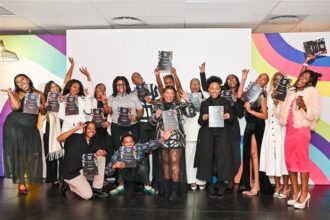




What This Win Signals for Global Creative Education and Innovation
The qualification of Team So’ Réal from the AAA School of Advertising for the Paris finals of the L’Oréal Brandstorm 2026 is more than a student achievement. It is a case study in how creative education is increasingly aligning with global industry expectations.
Comprising Zaiba Goolam (21), Joel Arreington (22), and John Garside (21), the team secured the South African leg of the competition with a solution that demonstrates not only creative strength, but also commercial awareness, scalability, and behavioural insight.
Their success reflects a broader shift in how advertising education is evaluated globally: not by ideas alone, but by ideas that can function in real markets.
Beyond Creativity: The Rise of Commercially Intelligent Ideas
At the core of Team So’ Réal’s winning concept is a simple but powerful human insight: in a high-pressure modern environment, small, everyday emotional “pick-me-ups” can significantly influence wellbeing and daily performance.
What distinguished the entry in the L’Oréal Brandstorm 2026 was not just the originality of the idea, but its transformation into a viable, scalable concept grounded in feasibility, cost thinking, and consumer relevance.
This reflects a growing expectation in global brand innovation challenges: creativity must now coexist with business logic. Ideas are no longer judged only on imagination, but on whether they can survive contact with real-world constraints.
Education That Mirrors Industry Reality
According to the AAA School of Advertising, the success of Team So’ Réal is a direct reflection of an educational model that prioritises industry realism.
Head of Department for Creative Brand Communication, Nkosiyapha Msomi, emphasised that the team’s strength came from their disciplined process of breaking down briefs, interrogating brand problems, and grounding ideas in research before execution.
This structured approach signals a wider transformation in creative education:
- Students are trained to think like strategists, not just creatives
- Ideation is anchored in research and consumer behaviour
- Iteration and feedback loops are embedded in the creative process
- Commercial thinking is introduced as early as concept development
In this model, creativity is not separated from business – it is shaped by it.
Iteration as Competitive Advantage
A defining element of Team So’ Réal’s journey was their iterative process. Their idea was not developed in a single breakthrough moment, but refined over months of continuous testing, feedback, and restructuring.
As described by Msomi, the team repeatedly presented work, absorbed critique, and returned with stronger versions of the same concept.
This iterative discipline is increasingly becoming a defining feature of globally competitive creative talent. In high-level innovation environments such as L’Oréal Brandstorm 2026, the ability to evolve an idea is often more valuable than the initial idea itself.
Creativity vs Data: A Shifting Industry Equation
One of the most significant insights from this success story is the evolving relationship between creativity and data-driven marketing.
While data continues to inform decision-making, the differentiator in modern brand communication is increasingly the ability to combine:
- Human insight
- Strategic interpretation
- Emotional resonance
- Creative execution
Msomi notes that as tools and technology become more accessible, execution alone is no longer enough. Instead, the competitive edge lies in connecting insight and strategy into ideas that feel deeply human.
This reflects a broader global trend: marketing is moving from optimisation-led thinking to meaning-led thinking.
Preparing for Paris: A Live Evolution of the Idea
As Team So’ Réal prepares for the global finals in Paris, their concept will continue to evolve in collaboration with L’Oréal’s Johannesburg team and global mentors.
This phase is critical. In competitions like L’Oréal Brandstorm 2026, ideas are not treated as finished outputs but as living systems that must be refined under global scrutiny.
The ability to adapt, expand, and strengthen an idea in real time is part of what prepares students for entry into global brand ecosystems.
Why This Win Matters Beyond South Africa
The achievement of Team So’ Réal carries significance beyond the walls of AAA School of Advertising. It positions South African creative education within a global pipeline of innovation talent feeding into multinational brand systems.
More broadly, it highlights three key shifts:
- African creative institutions are producing globally competitive strategic thinkers
- Student innovation is increasingly aligned with real business environments
- Global brands are actively sourcing ideas from emerging markets, not just established hubs
In this context, the L’Oréal Brandstorm 2026 becomes more than a competition. It functions as a global testing ground for future brand builders.
Conclusion: A Signal of Where Creative Talent Is Heading
The success of Team So’ Réal is not an isolated academic milestone. It is an indicator of how creative education, particularly at institutions like the AAA School of Advertising, is evolving to meet the demands of a globalised, commercially complex advertising industry.
As they move toward the Paris finals of the L’Oréal Brandstorm 2026, their journey reflects a larger truth about modern creativity: the strongest ideas are no longer just imaginative – they are engineered, tested, refined, and built to perform in the real world.