


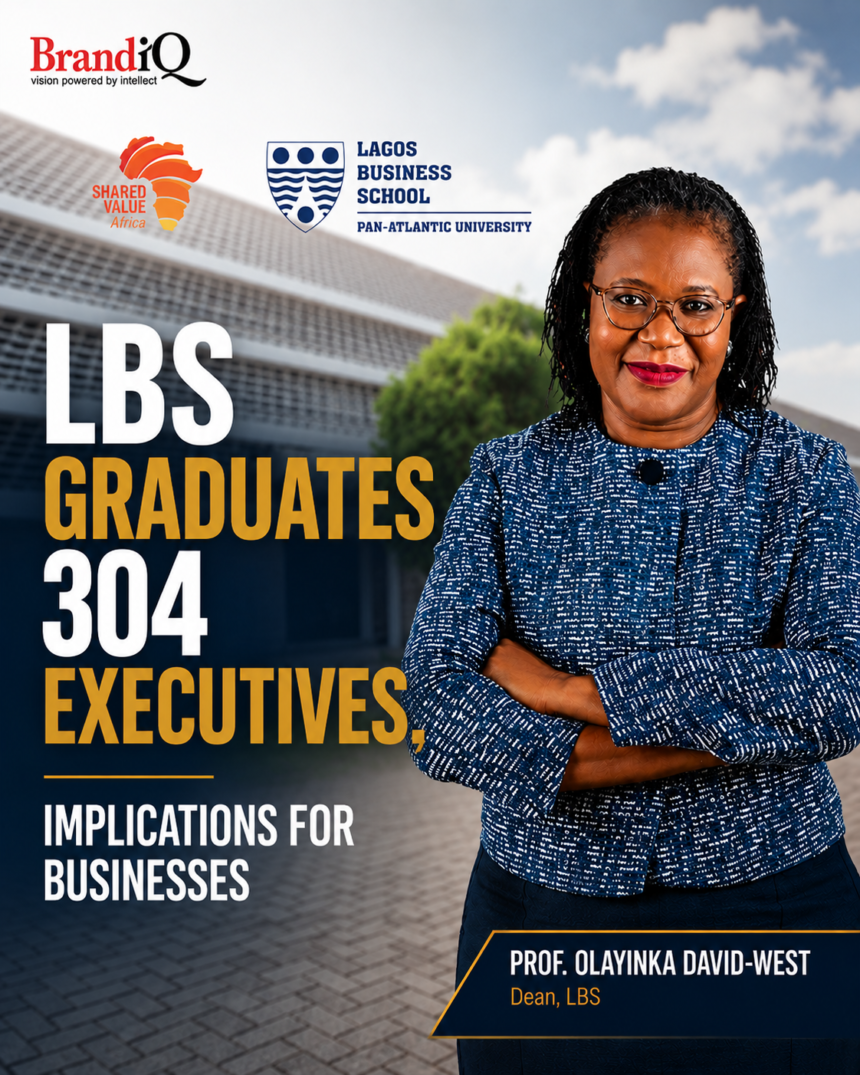

Africa’s leading business school urges executives to build trust, create sustainable value and lead with integrity amid growing economic and technological disruption
Lagos Business School (LBS), Pan-Atlantic University, has graduated 304 executives from its Executive Education programmes, urging business leaders to embrace ethical leadership, strengthen institutional trust and create sustainable value as organisations navigate an increasingly volatile global business environment.
The graduation ceremony, held at the school’s Honeywell Auditorium in Lagos, brought together business leaders, faculty members, alumni and participants who completed various executive development programmes designed to prepare senior managers for leadership in Africa’s evolving business landscape.
Delivering the keynote address, Founder and Director of LeadCapital Plc, Abimbola Olashore, challenged the graduates to view leadership not merely as a pathway to personal achievement but as a responsibility to society, organisations and future generations. “This moment is a commissioning. You are being commissioned into a higher level of responsibility. You are in roles where your decisions will shape organisations, influence markets and impact lives. The question, therefore, is whether you will be leaders who extract value or leaders who create lasting value.”
Speaking on the theme, “Beyond Profit: Building Ethical Enterprises, Sustainable Systems and Enduring Legacies in Emerging Economies,” Olashore argued that trust has become one of the most valuable assets available to modern organisations as confidence in institutions continues to decline globally.
He noted that shrinking tolerance for poor corporate governance and unethical conduct makes integrity, sound judgement and responsible stewardship indispensable qualities for today’s business leaders. Olashore also urged participants to see executive education as a process that develops character and purpose alongside technical competence.
Drawing from his own experience as an alumnus of the school’s Advanced Management Programme (AMP), he encouraged graduates to become ambassadors of principled leadership within their organisations and communities.
Earlier, Dean of Lagos Business School, Professor Olayinka David-West, congratulated the graduates and reminded them that leadership is ultimately measured by responsibility, integrity and positive impact rather than organisational position. “Leadership is not defined by position; it is defined by responsibility, integrity and impact.”
She also announced that Lagos Business School retained its position as Africa’s leading provider of customised executive education in the 2026 Financial Times Executive Education Rankings, marking the second consecutive year the institution has achieved the distinction.
The graduating class completed programmes including the Owner-Manager Programme (OMP), Senior Management Programme (SMP), Human Resources Academy, Management Acceleration Programme (MAP) and Agribusiness Management Programme (AgMP).
According to the school, the programmes combine classroom instruction, faculty engagement, peer learning and international exposure to equip executives with the strategic capabilities required to lead organisations across Africa and the global marketplace.
The ceremony concluded with the presentation of certificates and the formal induction of the graduates into the Lagos Business School Alumni Association.
BrandiQ Insight
Business schools are redefining leadership for a more complex world. The message from Lagos Business School reflects a significant shift in executive education. For many years, business schools concentrated on developing competencies in finance, marketing, strategy and operations.
Today’s business environment demands much more.
Artificial intelligence, geopolitical uncertainty, climate risks, digital disruption, cybersecurity and stakeholder expectations have transformed leadership into a multidisciplinary responsibility requiring ethical judgement alongside commercial expertise. The emphasis on integrity is therefore not simply philosophical – it is becoming a strategic business necessity.
Trust Is Emerging as a Corporate Asset
One of the most compelling observations from the keynote address is that trust has become a form of business capital. Consumers increasingly reward transparent organisations. Investors place greater emphasis on governance and accountability. Employees seek purpose-driven workplaces. Regulators expect stronger corporate responsibility.
In this environment, trust directly influences brand reputation, customer loyalty, investor confidence and long-term organisational resilience. Companies that consistently earn stakeholder trust are generally better positioned to navigate economic uncertainty and sustain competitive advantage.
Leadership Beyond Profit
The graduation theme also reflects a broader transformation in corporate thinking. Modern organisations are increasingly expected to balance financial performance with social responsibility, environmental sustainability and ethical governance. This does not diminish the importance of profitability.
Rather, it recognises that enduring business success increasingly depends on creating value for a wider ecosystem of stakeholders, including employees, customers, investors and communities. For executives operating in emerging economies such as Nigeria, balancing commercial growth with societal impact has become an essential leadership capability.
Implications for Nigerian Businesses
Nigeria’s rapidly changing business landscape requires leaders capable of responding to technological disruption while maintaining strong ethical standards.
As organisations embrace artificial intelligence, digital transformation and new operating models, the quality of leadership will become an even more significant determinant of long-term performance.
Institutions such as Lagos Business School therefore play an increasingly important role in developing executives who can combine strategic thinking with ethical decision-making and responsible governance.
The Bigger Picture
The graduation of 304 executives represents more than the completion of another executive education programme. It reflects a broader evolution in how leadership itself is being defined.
In an era characterised by uncertainty, rapid technological change and declining public trust in institutions, the executives who will shape the future are unlikely to be those who simply maximise short-term profits.
They will be those who combine competence with character, innovation with integrity and commercial success with long-term value creation. For Africa’s business community, that may be one of the most important leadership lessons of our time.