


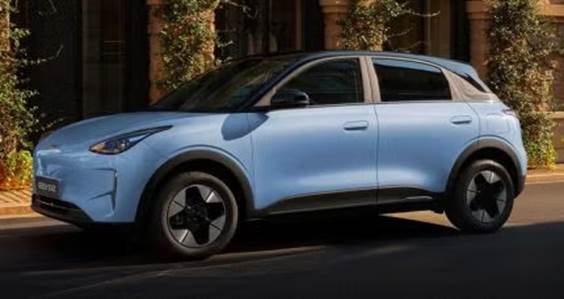

The Geely EX2 campaign by Joint is less interested in shouting about electric-car technology than in making consumers discover it. That shift from specification-led advertising to curiosity-led brand communication offers a useful lesson in how automotive brands can make innovation feel human.
Geely Auto UK has launched its first campaign with creative agency Joint, using out-of-home and social media to draw attention to features of its Geely EX2 electric car that consumers might otherwise overlook. Campaign reports that the work is built around the idea of uncovering the car’s “hidden features”, turning product discovery itself into the creative proposition.
The campaign is significant not simply because it introduces another electric vehicle to an increasingly crowded market, but because of the communication problem it attempts to solve. Automotive advertising has traditionally relied heavily on the language of specifications—range, horsepower, acceleration, battery capacity, safety systems and price. Electric vehicles have intensified that tendency because consumers are often required to understand a new vocabulary of batteries, charging and digital functionality before they can appreciate the product.
Joint’s approach appears to move in the opposite direction. Rather than presenting the EX2 as a technical catalogue, the campaign makes discovery part of the brand experience. That is a subtle but potentially powerful distinction: consumers are not merely being told what the car can do; they are being invited to notice what they did not know it could do.
Why the EX2 Gives the Campaign Something to Work With
The communication is supported by a product with a relatively broad technology and practicality proposition. The EX2 is an electric city car built on Geely’s GEA platform, and independent reporting confirms features including a 39.4kWh LFP battery, rear-wheel drive, a 116hp electric motor and an Inmetro-rated range of 289km in Brazil.
Its appeal is not restricted to electrification. Depending on specification, the EX2 offers a 14.6-inch infotainment screen, digital instrumentation, wireless charging, advanced driver-assistance systems and a 360-degree camera. The car also has a 375-litre boot that can expand to 1,320 litres with the rear seats folded, alongside a 70-litre front storage compartment.
That breadth gives the campaign an important strategic advantage. “Hidden features” can mean more than a gimmick when a product contains a collection of capabilities that are not immediately apparent from its exterior. The communication can therefore turn the product’s complexity into a source of intrigue.
Geely’s own international positioning reinforces the broader proposition. The company describes the EX2 as an affordable electric vehicle designed around intelligent, connected mobility, while the model has been expanding into international markets.
The Marketing Idea: Make Consumers Discover Rather Than Receive
The most interesting aspect of the campaign is therefore not the individual executions but the underlying behavioural insight. People pay greater attention to information they discover than information they are simply handed.
This connects with a longstanding principle in consumer psychology: curiosity creates an information gap. When people realise that they do not know something they believe they should know, they become motivated to close that gap. In advertising, this can make an otherwise ordinary product demonstration more involving.
For an automotive brand, this is particularly useful. A car is an unusually information-heavy product. Consumers can easily become overwhelmed by specifications, while manufacturers are under constant pressure to demonstrate technological superiority. The result can be advertising that is technically accurate but emotionally interchangeable.
The EX2 campaign attempts to make technology interesting before making it impressive.
That is a smart move for an emerging automotive brand competing for attention against established manufacturers and increasingly sophisticated Chinese EV competitors.
BrandiQ Analysis: From Product Features to Brand Behaviour
There is a broader lesson here for marketers. Brands frequently confuse having many features with having a compelling proposition. A product may contain dozens of useful innovations, but unless consumers understand why those innovations matter, the features remain trapped inside the product.
Good brand communication performs a translation function. It converts engineering into experience, technology into usefulness and specifications into human benefit.
The “hidden features” idea potentially performs that translation elegantly because it creates a narrative around the product. Instead of saying here are 10 things our car does, the brand effectively asks: What else can this car do?
That question changes the consumer’s psychological position. The audience becomes an explorer rather than a recipient of advertising.
It also gives the campaign greater potential for social media. Hidden features naturally lend themselves to sequential storytelling: one feature can be revealed, discussed and shared before another is introduced. The campaign can therefore generate multiple pieces of content from a single strategic idea rather than treating social media as a distribution channel for a conventional advertisement.
A Chinese Brand Learning the Language of Discovery
There is another strategic dimension worth watching. Geely is not simply selling an electric car; it is continuing the internationalisation of a Chinese automotive brand in markets where perceptions of Chinese vehicles are evolving rapidly.
The EX2 provides an interesting example. In Brazil, where it launched in November 2025, the model has performed strongly enough for Renault Geely do Brasil to begin local production. Independent reporting says Geely and Renault began production of the EX2 at Renault’s Paraná plant in 2026, following demand for the model.
That matters because brand-building in international markets involves more than product distribution. The brand has to establish a distinctive meaning in consumers’ minds.
Geely therefore has a potentially valuable communication challenge: How does an automotive company known primarily through its products become a brand people actively want to know?
Curiosity is one possible answer.
The Authenticity Test
There is, however, a condition attached to the strategy. Hidden-feature advertising works only when the discovery produces a genuine payoff. If consumers are promised something extraordinary and discover merely conventional equipment presented as revolutionary, curiosity quickly turns into scepticism.
That makes brand authenticity particularly important.
Authenticity in this context does not mean being old-fashioned or avoiding technological innovation. It means ensuring that the brand’s communication is consistent with the actual experience of the product. If Geely says the EX2 has surprising capabilities, those capabilities must genuinely improve the driver’s experience.
This is where product truth becomes the foundation of creative effectiveness.
A campaign can create attention; only the product can validate the attention.
The BrandiQ Verdict
Geely’s first campaign with Joint is interesting because it demonstrates a useful evolution in technology advertising: the feature does not necessarily have to be the message; the discovery of the feature can become the message.
That distinction may become increasingly important as automotive products become more software-driven, connected and feature-rich. When virtually every manufacturer can advertise screens, cameras, intelligent driving systems and connectivity, the competitive advantage increasingly shifts from what the product has to how the consumer experiences what it has.
The EX2 campaign’s smartest proposition may therefore be hidden in plain sight. In a market crowded with brands telling consumers what their technology can do, Geely is asking consumers to discover what its technology means. That is not merely a creative device. It is a potentially powerful way of turning product complexity into consumer curiosity – and curiosity into brand engagement.