


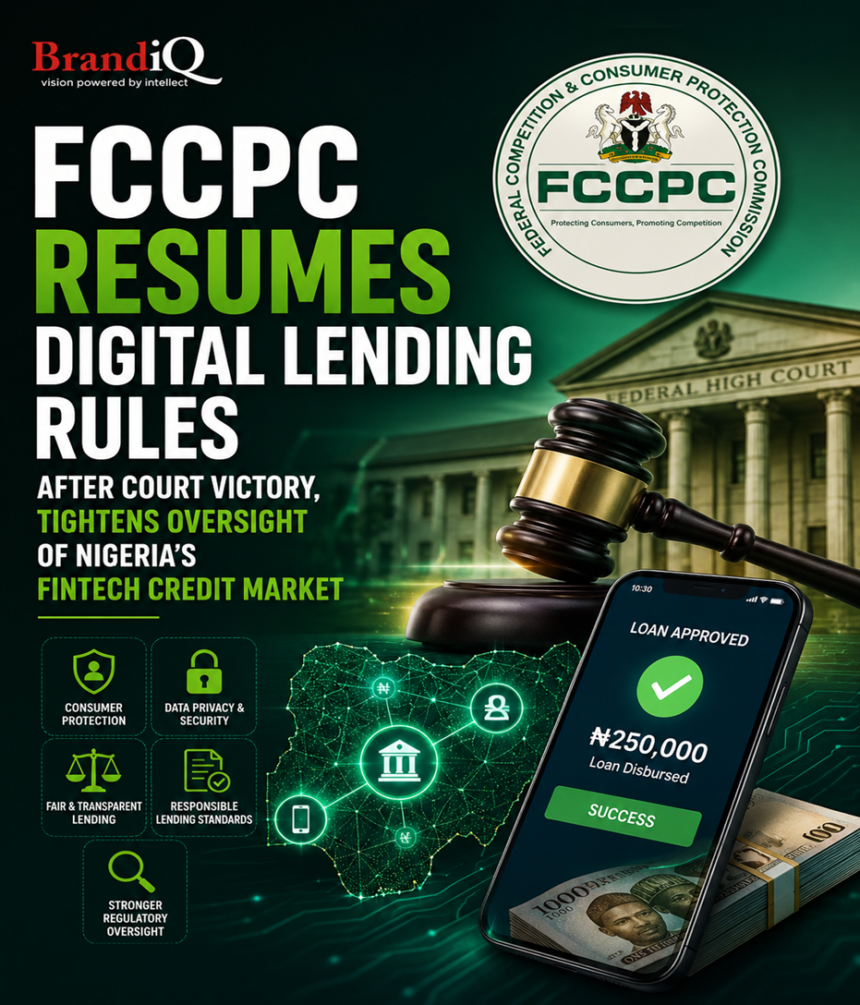

Federal High Court affirms regulator’s powers as consumer protection takes centre stage in Nigeria’s fast-growing digital lending industry
Nigeria’s digital lending industry is entering a new regulatory phase following a landmark Federal High Court judgment affirming the authority of the Federal Competition and Consumer Protection Commission (FCCPC) to enforce its Digital, Electronic, Online or Non-Traditional Consumer Lending Regulations, 2025 (DEON Regulations). The ruling clears the way for the Commission to resume implementation of the framework after months of legal uncertainty, reinforcing the government’s determination to strengthen oversight of one of the country’s fastest-growing financial services sectors.
The judgment, delivered by Justice A. L. Allagoa of the Federal High Court, Lagos, dismissed in its entirety a suit instituted by the Wireless Application Service Providers Association of Nigeria (WASPAN), which had challenged both the legality of the regulations and the FCCPC’s authority to implement them. The court rejected all the reliefs sought by the association, upheld the validity of the regulations and discharged the interim order that had temporarily restrained the Commission from enforcing the rules.
Announcing the development, the FCCPC said the legal obstacle that necessitated the suspension of the regulations had now been removed, making the framework fully operational once again. According to the Commission, the court’s decision affirms that the regulations were issued within its statutory and constitutional mandate to protect consumers and regulate emerging markets.
In a statement, Director of Corporate Affairs, Ondaje Ijagwu, described the judgment as an important affirmation of the Commission’s regulatory responsibilities and its commitment to operating within the rule of law.
“The Commission has always maintained that the rule of law is fundamental to effective regulation and good governance. When the Court issued its interim order, we immediately suspended implementation of the Regulations in full compliance with the Court’s directive. Now that the Court has affirmed the validity of the DEON Regulations, we will continue to discharge our statutory responsibilities faithfully, professionally and in accordance with the law,” he said.
The Commission reiterated that the regulations are intended to improve transparency, strengthen accountability and protect consumers without discouraging innovation or restricting access to digital credit. According to the FCCPC, the objective is to ensure that financial inclusion continues to expand within a framework that promotes responsible lending and fair market conduct.
Nigeria’s digital lending industry has expanded rapidly over the past decade as mobile applications and online lending platforms have made short-term credit more accessible to individuals and small businesses traditionally underserved by commercial banks. However, the sector has also attracted widespread criticism over aggressive debt recovery tactics, excessive charges, privacy violations, unauthorised access to borrowers’ personal contacts and inadequate disclosure of loan terms.
The DEON Regulations were introduced to establish clearer operational standards for digital lenders while providing stronger safeguards against exploitative lending practices. The framework seeks to improve regulatory accountability, enhance consumer confidence and create a more transparent marketplace for both borrowers and responsible operators.
Following the court’s decision, digital lenders operating within Nigeria are expected to face renewed regulatory scrutiny as the FCCPC resumes enforcement of licensing requirements, consumer protection obligations and operational standards prescribed under the regulations.
The ruling also reinforces the Commission’s broader mandate to regulate emerging digital markets at a time when financial technology continues to reshape Nigeria’s financial services landscape.
The BrandiQ Perspective
The significance of this judgment extends well beyond digital lending. It represents another important milestone in Nigeria’s gradual effort to establish effective governance over the country’s rapidly expanding digital economy.
For several years, innovation has moved much faster than regulation. Fintech companies introduced new lending models that dramatically improved access to credit for millions of Nigerians. Yet the same technological advances also created opportunities for unethical practices that traditional financial regulations were never designed to address. The court’s decision therefore reflects an emerging reality: innovation alone is no longer enough. Innovation must now be accompanied by governance.
This is particularly important because digital lending depends fundamentally on trust. Unlike conventional banks that rely heavily on physical branches and long-standing customer relationships, digital lenders operate almost entirely through mobile applications and automated decision-making systems. Consumers often share sensitive personal information, financial records and behavioural data with these platforms within minutes of applying for credit.
That makes responsible governance indispensable. Effective regulation benefits not only borrowers but also responsible fintech companies. By removing unethical operators from the market and establishing uniform standards, stronger regulation can increase consumer confidence and create a healthier competitive environment where legitimate businesses are rewarded for responsible conduct rather than aggressive practices.
The judgment also signals a broader evolution in Nigeria’s regulatory philosophy. Rather than reacting to technological disruption after harm occurs, regulators are increasingly attempting to develop proactive frameworks capable of balancing innovation, competition and consumer protection. Similar regulatory debates are already taking place globally around artificial intelligence, digital payments, cryptocurrencies, platform governance and data privacy.
For Nigeria’s fintech sector, this ruling provides greater regulatory certainty. Investors generally favour markets where the legal environment is clear, predictable and consistently enforced. While compliance obligations may increase operating costs for some digital lenders, the resulting stability could strengthen long-term investor confidence in the sector.
BrandiQ Analysis: Why This Judgment Matters
1. Consumer trust becomes a competitive advantage
Digital lending is fundamentally a trust business. Companies that demonstrate transparent pricing, ethical debt recovery practices and responsible data management are likely to enjoy stronger customer loyalty as regulatory expectations rise.
2. Governance is becoming a strategic business asset
The decision reinforces a growing global trend in which governance, compliance and risk management are becoming competitive differentiators rather than regulatory burdens. Fintech firms that invest early in compliance systems are likely to be better positioned for long-term growth.
3. The era of regulatory arbitrage is narrowing
For years, some digital lenders operated in grey regulatory spaces. The court’s affirmation of the FCCPC’s authority suggests that regulators are becoming more assertive in supervising digital markets, reducing opportunities for operators to exploit regulatory gaps.
4. Nigeria’s digital economy is maturing
As digital finance expands, regulation must evolve alongside innovation. This judgment demonstrates that Nigeria is gradually developing the institutional frameworks required to support a more mature and sustainable digital economy.
5. AI governance will be the next frontier
Many digital lenders increasingly rely on artificial intelligence and machine learning to assess creditworthiness, detect fraud and automate lending decisions. As AI becomes more deeply integrated into lending operations, future regulatory attention is likely to extend beyond licensing and consumer protection to include algorithmic transparency, bias, explainability and ethical AI governance.
BrandiQ Verdict
The Federal High Court’s decision represents far more than a legal victory for the FCCPC. It marks an important step in the evolution of Nigeria’s digital financial ecosystem, affirming that technological innovation must be matched by effective governance, consumer protection and institutional accountability. For digital lenders, the message is clear: sustainable growth in the fintech era will depend not only on faster technology and easier credit, but also on transparency, ethical conduct and regulatory compliance. In the digital economy, trust is becoming the most valuable currency of all.