


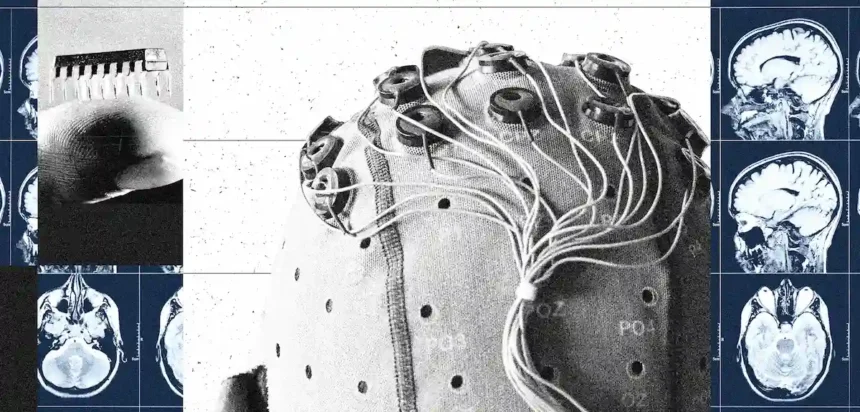

In a policy document released this month, China has signaled its ambition to become a world leader in brain-computer interfaces, the same technology that Elon Musk’s Neuralink and other US startups are developing.
Brain-computer interfaces, or BCIs, read and decode neural activity to translate it into commands. Because they provide a direct link between the brain and an external device, such as a computer or robotic arm, BCIs have tremendous potential as assistive devices for people with severe physical disabilities.
In the US, Neuralink, Synchron, Paradromics, and others have sprung up in recent years to commercialize BCIs. Now, China boasts several homegrown BCI companies, and its government is making the development of the technology a priority.
Jointly authored in July by seven departments within the Chinese government—including the Ministry of Industry and Information Technology, the National Health Commission, and the Chinese Academy of Sciences—the new policy document lays out a road map for China to achieve breakthroughs in BCI technology by 2027 and build an internationally competitive industry by 2030.
“We know that China is strong at translating basic research into practical uses and commercialization. We’ve seen that in other industries, such as photovoltaics and electric cars. Now BCI is another area where that’s going to be critical,” says Max Riesenhuber, a professor of neuroscience and codirector of the Center for Neuroengineering at Georgetown University Medical Center, who has published research on China’s BCI developments.
“The document really lays out this whole umbrella of activities needed to become a leader in BCI, not just in research, but in actually getting it into the mainstream,” he says.
Research on BCIs dates back to the 1970s, but for decades, the technology was too cumbersome and unreliable for practical applications. Neuralink and its US competitors are all aiming to improve on the design and performance of early BCIs to make useful products for patients.
China’s foray into BCI research came later, but the country is quickly catching up to the US. Several companies and research institutions in China have successfully tested BCI implants in patients, showing that people with paralysis can move a cursor on a computer screen, operate a robotic arm, and type out their thoughts. Last year, the Chinese government released ethical guidelines for the use of BCIs. Now, its policy document lays out a road map for speeding up the development of these devices. It outlines 17 specific steps, which include creating better chips to capture brain signals, improving software to decode those signals, standardizing BCI technology, and establishing manufacturing capabilities.
“The Chinese government has always been supportive of disruptive technologies,” says Phoenix Peng, cofounder and CEO of NeuroXess, a BCI company based in Shanghai. “I think, from the government’s point of view, this policy means that BCI technology has already passed from a concept level into the product level.”
He says NeuroXess has implanted six paralyzed patients with its device. In three of those patients, it was used to accurately decode Chinese speech. For the others, it allowed thought control of digital devices.
Given these and other recent milestones, Peng says it’s realistic to think that at least one BCI system could gain approval in China by 2027.
Minmin Luo, director of the Chinese Institute for Brain Research (CIBR) in Beijing, agrees that the country is well on its way to meeting the goals set out by the new policy document. “It is basically an engineering project, with not so ambitious goals. Already, there are so many people working on it,” he says.
Luo is the chief scientist at NeuCyber NeuroTech, a spinoff of CBIR, which has developed a coin-sized brain chip called Beinao-1 and so far implanted it in five people. “We have observed excellent safety and stability in our clinical assessments,” he says.
The recipients, who are paralyzed, are now able to move a computer cursor and navigate to smartphone apps, Luo says. The team plans to implant a sixth patient by the end of August.
“We believe there is a significant unmet need for assistive BCI technology in China,” he says. He estimates that at least 1 to 2 million patients in the country could benefit from BCIs for assistive and rehabilitative purposes.
Beyond those uses, the policy document lays out other medical applications. It says BCIs could be used to monitor and analyze brain activity in real time to potentially prevent or reduce the risk of certain brain diseases. It also endorses consumer applications, such as monitoring driver alertness. The document says a wearable BCI could provide timely alerts for drowsiness, lack of attention, and slow reaction times, helping to reduce the probability of traffic accidents.
“I think noninvasive BCI products will get a huge market boost in China, because China is the biggest consumer electronics manufacturing country,” Peng says.
A few US companies, including Emotiv and Neurable, have started selling consumer wearables that use electroencephalography, or EEG, to capture brain waves through the scalp. But the devices are still expensive and have yet to take off more broadly.
China’s policy document, meanwhile, is promoting the mass production of non-implantable devices in various forms—forehead-mounted, head-mounted, ear-mounted, ear buds, and helmets, glasses, and headphones. It also proposes piloting BCIs in certain industries for safety management, such as hazardous materials handling, nuclear energy, mining, and electricity. The document suggests that BCIs could provide early warnings for workplace events such as low oxygen levels, poisoning, and fainting.
While the new policy guidance sets up a China-US rivalry in the BCI space, Peng sees room for cross-country collaboration among entrepreneurs. “We can cooperate as a society to build something for the patients, because they are desperate for this technology to have a better life,” he says. “We don’t want to be involved in any geopolitical issues. We just want to build something useful for patients.”