
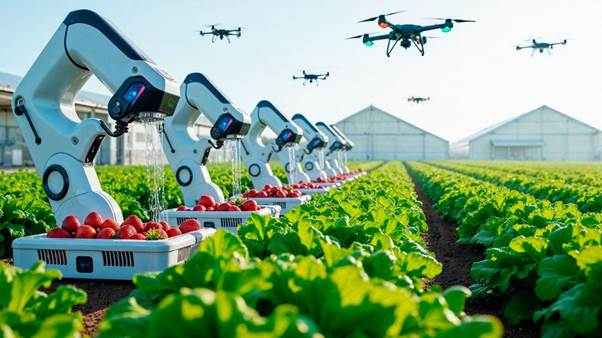

A coalition of academic institutions, engineers, and government agencies in Akwa Ibom State has launched an ambitious initiative aimed at deploying robotics and artificial intelligence across agricultural value chains in a move that reflects Africa’s growing shift toward technology-driven food systems.
The initiative, known as Transforming Agriculture Through Artificial Intelligence, was unveiled through a Memorandum of Understanding signed by six institutions, including University of Uyo, Akwa Ibom State University, the Technology Incubation Centre Uyo, the Nigerian Institution of Mechanical Engineers, and the Ibom Innovation Network.
The programme seeks to modernise farming systems through precision agriculture, mechanised harvesting, climate intelligence, robotics, and AI-powered post-harvest management.
President of the Ibom Innovation Network, Hanson Johnson, said the initiative represents a transition from traditional agricultural practices toward predictive and data-driven production systems.
“We are moving beyond the era of farming by chance. By integrating AI with mechanical engineering, we are providing farmers with the tools to predict, adapt, and scale,” he said.
According to the organisers, the project will specifically target two major weaknesses within Nigeria’s agricultural ecosystem: labour-intensive harvesting and post-harvest losses.
The initiative plans to deploy autonomous harvesting technologies alongside IoT-enabled storage systems capable of monitoring climate conditions and reducing spoilage across supply chains.
Industry estimates referenced at the launch showed that pests, diseases, and post-harvest inefficiencies account for up to 40 per cent of annual agricultural losses globally, with climate change expected to intensify the challenge.
Director of the TETFund Centre for Computational Intelligence at the University of Uyo, Uduak Asuquo, said precision agriculture technologies have become critical to global food security systems.
“With the adoption of precision agriculture, there is a turning point in the agricultural landscape. IoT and AI are no longer experimental approaches. They are essential technologies for global food security,” he stated.
The project will adopt a “Lab-to-Land” framework aimed at transferring innovations developed within universities into practical field deployment across farms.
BrandiQ Analysis
The Akwa Ibom initiative reflects a much larger global economic transition in which agriculture is increasingly evolving from a labour-intensive industry into a data-intensive industry.
Globally, the future of food production is being shaped by:
- Artificial intelligence
- Robotics
- Predictive analytics
- Satellite mapping
- Climate intelligence
- Precision agriculture systems
For decades, African agriculture has suffered from low productivity, poor storage systems, climate vulnerability, and fragmented supply chains. The introduction of AI into agriculture signals a strategic attempt to reposition Africa from subsistence farming toward intelligent food production ecosystems.
The implications are enormous for Nigeria and Africa.
The continent possesses approximately 60 per cent of the world’s uncultivated arable land, yet remains a net importer of food. This contradiction represents one of the biggest structural inefficiencies in the global economy.
If AI-driven agriculture scales successfully across Africa, it could:
- Reduce food inflation
- Improve food security
- Increase export competitiveness
- Expand agro-industrialisation
- Improve rural incomes
- Attract agritech investments
For investors in the US, UK, and Europe, African agritech increasingly represents a frontier growth market similar to fintech a decade ago.
The strategic importance is also geopolitical. Food security is rapidly becoming a national security issue globally due to:
- Climate shocks
- Population growth
- Supply chain disruptions
- Rising geopolitical tensions
Countries and regions capable of building resilient, technology-enabled food systems may gain substantial long-term economic advantages. Most importantly, the project signals an emerging convergence between engineering, data science, and agriculture in Africa. This interdisciplinary model could become central to the continent’s future economic transformation.