


By BrandiQ Analyst
Africa Finance Corporation (AFC) has achieved financial close on a landmark €65 million green bond to fund a major solar project in Côte d’Ivoire – marking the first project finance green bond not only in the country but across the West African Economic and Monetary Union.
More than a financing milestone, the transaction signals a structural shift in how Africa mobilises capital for infrastructure: from dependence on external funding to the emergence of African-led financial innovation.
The Deal: Structuring a New Capital Model
The Poro Power Green Bond, structured as a dual-currency facility (EUR/XOF), has already seen €43 million disbursed, with AFC acting as Lead Underwriter and Co-Arranger.
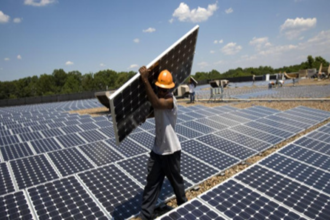
The proceeds will finance a 66MW solar plant in the Korhogo region, developed by Poro Power, and projected to become the country’s largest solar facility when completed in 2027.
Key features of the transaction include:
- Dual-Currency Structuring: Mitigating foreign exchange risk while aligning with local market realities
- Project Finance Backbone: Linking funding directly to asset performance and cash flows
- African Capital Mobilisation: Fully funded by regional institutions, reducing reliance on international lenders
This combination creates a replicable financing template for infrastructure development across the continent.
Infrastructure Meets Sustainability: Energy Transition in Action
Beyond financial engineering, the project delivers tangible development outcomes:
- Power supply to over 100,000 households
- Annual avoidance of approximately 72,000 tonnes of CO₂ emissions
- Contribution to Côte d’Ivoire’s target of 45% renewable energy by 2030
The initiative reflects a growing convergence between infrastructure development and climate strategy, positioning renewable energy as both an economic and environmental imperative.
Strategic Shift: From Foreign Dependence to Local Capacity
Historically, long-term infrastructure projects in Africa have been heavily dependent on international capital markets, often exposing countries to currency volatility and external financing constraints.
The Poro Power transaction disrupts that pattern.
By being African-led, African-structured, and African-funded, it demonstrates:
- The maturation of regional capital markets
- The growing sophistication of African financial institutions
- The viability of homegrown solutions to the continent’s infrastructure gap
For policymakers and investors, this marks a transition from capital scarcity to capital strategy.
AFC’s Expanding Role: From Financier to Market Architect
Under the leadership of Samaila Zubairu, AFC continues to position itself not just as a lender, but as a market-maker shaping Africa’s infrastructure financing architecture.
Its track record in Côte d’Ivoire reinforces this role, spanning:
- Transport infrastructure, including the Henri Konan Bédié Bridge in Abidjan
- Power generation projects such as the Singrobo-Ahouaty hydropower plant
- Advisory support on major road development programmes
This multi-sector engagement reflects a broader strategy: building integrated infrastructure ecosystems, not isolated assets.
Policy Alignment and Private Sector Enablement
The success of the bond also highlights the role of government policy and private sector participation.
Support from the Ministry of Energy, led by Mamadou Sangafowa Coulibaly, created an enabling environment for private developers like Poro Power to lead large-scale renewable projects.
This alignment between policy, capital, and execution is increasingly becoming the defining formula for successful infrastructure delivery in Africa.
BrandiQ Insight
The AFC-led green bond is more than a transaction – it is a signal of intent. It shows that Africa is beginning to finance its future on its own terms, leveraging local capital, institutional expertise, and innovative structuring.
For countries like Nigeria, the lesson is immediate and actionable: the future of infrastructure development will depend less on access to foreign capital and more on the ability to structure bankable, locally anchored financial instruments.
As the continent navigates energy transition, urbanisation, and industrial growth, scalable models like this will define the next phase of Africa’s economic transformation.