

A giant melting ice block gives Hunter’s a simple product launch an important experiential twist, turning outdoor advertising from a message consumers see into an event they can watch, photograph and share.
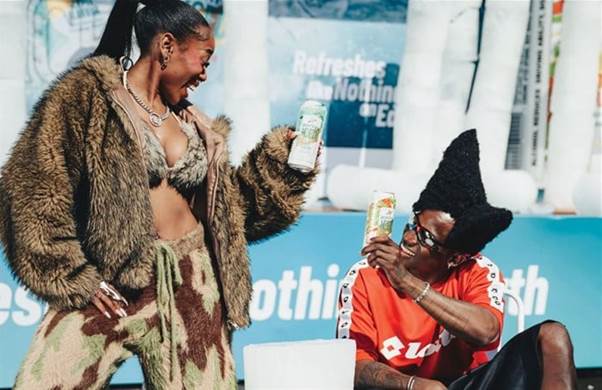
Hunter’s has taken an unconventional route to launch its new Iced range, using a giant block of ice in Johannesburg’s Jewel City to introduce Hunter’s Iced Watermelon and Hunter’s Iced Apple. Rather than relying on a conventional product display, the brand turned the physical environment into part of the campaign, placing the products inside a large block of ice and allowing the installation to gradually melt throughout the day.
The activation, held on Friday, 31 July 2026, was designed to create curiosity among commuters and pedestrians in one of Johannesburg’s busy public spaces. As the ice melted, the products were progressively revealed, giving passers-by a reason to stop, observe and photograph the installation. The campaign therefore made the physical launch itself part of the brand experience.
For Hunter’s, the idea was intended to communicate refreshment without relying solely on conventional advertising language. Nontsikelelo Gumede, brand manager at Hunter’s, said the brand wanted to create “a moment of chill” in the city rather than simply tell consumers about a new drink. “Watching the public’s curiosity grow as the ice melted was incredible. It was a simple invitation to just slow down and enjoy the moment,” she said.
The activation introduces the latest addition to the Hunter’s portfolio at a time when brands increasingly compete not merely for consumers’ attention but for experiences that are memorable enough to be photographed, shared and discussed. In that sense, the Jewel City installation functioned simultaneously as an outdoor advertisement, product demonstration and experiential activation.
BrandiQ Analysis: When Outdoor Advertising Becomes the Content
The cleverness of the Hunter’s activation lies in its simplicity. There is no particularly complicated technological layer to the idea. Instead, the brand has taken a familiar physical property-ice-and turned it into a mechanism for suspense.
That matters because traditional outdoor advertising has an inherent limitation: people usually see it and move on. A billboard can be visually striking, but the consumer’s interaction with it is often measured in seconds. Hunter’s has attempted to alter that relationship by creating something that changes over time. The advertisement is not static; it is an unfolding event.
The ice therefore performs several jobs simultaneously. It communicates coldness and refreshment, creates visual spectacle, conceals the product and generates anticipation about when the products will be revealed. The audience does not simply receive the message. It watches the message develop.
This is a useful principle for experiential marketing: curiosity can be more powerful than information. Instead of announcing the two new variants immediately, Hunter’s gives consumers a reason to discover them.
From OOH to Social Content
The activation also illustrates how the boundaries between outdoor advertising and social media are becoming increasingly porous. A physical installation can now be designed with a second audience in mind: the people who will encounter photographs and videos of the installation online.
The pedestrians in Jewel City were therefore not merely an audience. They could also become distributors of the campaign.
That is particularly important for younger consumers, whose relationship with brands increasingly involves creating, sharing and remixing brand experiences rather than simply consuming advertisements. An activation that generates a photograph can potentially extend beyond the physical location and acquire a second life across social platforms.
The strongest experiential campaigns consequently do not ask only, “What will people see?” They ask, “What will people want to capture and share?” Hunter’s appears to have understood that distinction.
The Power of Contextual Relevance
There is another lesson in the choice of the creative device. Ice is not merely decorative; it is directly connected to the product proposition.
The campaign therefore achieves a degree of creative congruence between the medium and the message. The physical execution reinforces what the product promises: something cold, refreshing and suitable for a moment of escape from the pressures of a busy city.
That connection makes the activation more meaningful than simply placing a large branded object in a public space. The environment becomes an extension of the product idea.
The brand’s statement that Johannesburg consumers are “always on the move” also gives the activation a behavioural context. Hunter’s is positioning the product as an interruption—a moment in which people can “slow down and enjoy the moment”. The campaign is consequently selling not only two flavours but a state of mind.
BrandiQ Verdict
Hunter’s has demonstrated that an effective OOH activation does not necessarily require technological complexity or enormous spectacle. Sometimes the strongest idea is one that makes the product itself the mechanism of the experience.
The giant ice block works because it is simple, visible, relevant and inherently temporal. It creates curiosity, communicates refreshment and gives consumers something worth stopping for. Most importantly, it turns the advertisement into an event and the audience into potential participants and content creators.
For African marketers, the broader lesson is worth noting: experiential advertising does not have to be expensive to be memorable. It has to give people a reason to pause.
In an attention economy in which consumers can scroll past thousands of messages in a day, the brands that create moments people instinctively want to photograph, discuss and remember may have discovered something more valuable than another impression. They have created an experience.