

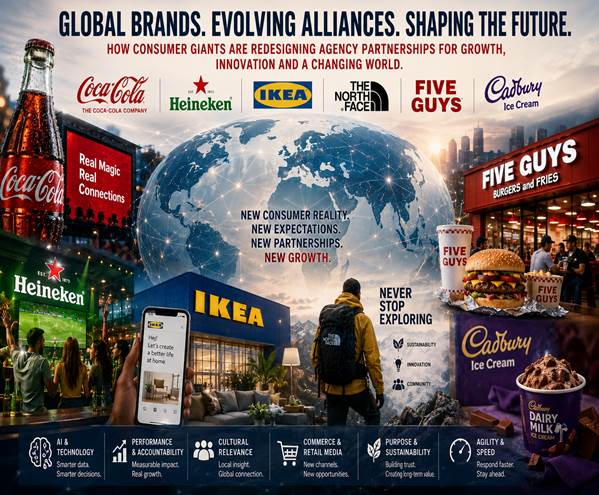
The global marketing and communications industry is entering another cycle of strategic realignment as some of the world’s biggest consumer brands including The Coca-Cola Company, Heineken, IKEA, The North Face, Five Guys and Cadbury Ice Cream review creative, media and integrated communications mandates amid mounting pressure for growth, digital transformation and cultural relevance.
Industry executives familiar with ongoing global pitch movements say the current wave of reviews reflects deeper structural changes within international marketing rather than routine agency reshuffling. The shift is increasingly being driven by artificial intelligence, fragmented consumer attention, retail media expansion, performance accountability and rising geopolitical uncertainty affecting supply chains and consumer spending patterns.
For BrandiQ’s core audience of brand owners, investors, marketing executives and communications professionals, the emerging pitch landscape signals how global corporations are redesigning their agency ecosystems for a more volatile and data driven marketplace.
Coca-Cola’s Expanding Multi-Agency Model
The Coca-Cola Company continues to evolve its global marketing architecture beyond the traditional “one holding company dominance” model that previously characterised large multinational accounts.
Industry analysts note that the beverage giant’s increasing use of specialist agencies, regional creative partnerships and project-based assignments demonstrates a broader trend among multinational advertisers seeking flexibility, speed and cultural localisation.
The company’s recent campaign reallocations suggest a deliberate strategy of balancing global consistency with market specific creativity. This follows growing concerns among multinational brands that oversized agency structures sometimes struggle to respond quickly to rapidly changing consumer behaviour across digital platforms.
For investors, the implication is significant.
Global advertisers are no longer evaluating agencies purely on creative excellence. Increasingly, agencies are being judged on:
- AI integration capabilities
- First party data management
- Commerce and retail media expertise
- Social influence strategy
- Cultural intelligence
- Speed to market
- Measurement and attribution systems
This explains why independent agencies and agile creative boutiques are increasingly winning assignments traditionally dominated by global holding groups.
Heineken and the Battle for Premium Consumer Attention
Heineken is also understood to be reassessing parts of its communications and experiential marketing ecosystem as global beer and lifestyle brands compete aggressively for younger consumers whose media consumption habits continue to shift toward creator led platforms and immersive digital experiences.
The global beer market is undergoing structural repositioning as brands attempt to maintain premium identity while adapting to health-conscious trends, moderation culture and Gen Z consumption patterns.
Communications experts say alcohol and beverage brands now require agencies capable of combining entertainment, sports partnerships, influencer ecosystems and data analytics into integrated growth engines.
The implication for agencies is profound: traditional advertising alone is no longer sufficient for retaining global beverage accounts.
IKEA’s Marketing Evolution and Retail Reinvention
IKEA remains one of the most closely watched global advertisers because its agency decisions often mirror wider retail transformation trends.
As retail media networks grow globally, furniture and lifestyle brands are increasingly prioritising customer experience design, digital commerce storytelling and sustainability communication.
Industry observers believe IKEA’s evolving agency relationships reflect the need for integrated partners capable of blending:
- E-commerce marketing
- Sustainability storytelling
- AI powered customer personalisation
- Community engagement
- Physical and digital retail integration
The company’s marketing evolution also reflects how global retailers are repositioning stores from transactional spaces into experiential brand ecosystems.
Five Guys and Fast Casual Globalisation
Five Guys represents another important trend in global brand communications: the international expansion of premium fast casual dining brands.
As restaurant competition intensifies worldwide, brands are increasingly seeking agency partners capable of localising global narratives without diluting brand consistency.
Marketing consultants say fast growing restaurant chains now prioritise agencies with expertise in:
- Hyperlocal digital targeting
- Delivery platform integration
- Youth culture marketing
- Community based engagement
- Social commerce storytelling
This reflects the growing convergence between hospitality, entertainment and digital lifestyle branding.
North Face and the Future of Purpose Driven Branding
The North Face operates in a category where sustainability, environmental ethics and lifestyle identity increasingly shape brand value.
Global apparel and outdoor brands are facing mounting pressure to align commercial messaging with climate responsibility, ethical sourcing and social credibility.
Industry insiders suggest that agencies competing for outdoor and lifestyle accounts must now demonstrate competence in sustainability communication and purpose branding alongside traditional creative execution.
This represents a major shift in the economics of global advertising.
Today, reputation management and ESG storytelling are becoming central revenue drivers for communications firms serving multinational clients.
Why Global Pitch Activity Is Accelerating
Several structural forces are driving the current surge in global pitch reviews.
AI Disruption in Advertising
Artificial intelligence is transforming media planning, creative production, audience targeting and consumer analytics. Global brands are reviewing agency partnerships to ensure technological competitiveness.
Economic Pressure
Slower consumer spending in several advanced economies is forcing multinational brands to demand measurable returns on marketing investment.
Retail Media Growth
Retail platforms are increasingly becoming advertising ecosystems, fundamentally reshaping how brands allocate budgets.
Fragmented Consumer Attention
Younger audiences consume content differently from previous generations, forcing brands to diversify communications strategies across multiple platforms and creators.
Geopolitical and Supply Chain Uncertainty
Global instability is increasing the importance of reputation management, localisation and agile market communication.
Implications for Global Agencies
The latest pitch movements suggest that the traditional dominance of large holding companies may continue facing pressure from specialist firms, AI enabled consultancies and culturally agile independents.
However, holding groups still retain major advantages in:
- Global infrastructure
- Data scale
- Cross market coordination
- Integrated media buying
- Enterprise level technology investment
The likely future is not the disappearance of holding companies, but the emergence of hybrid agency ecosystems where brands combine large global networks with specialist independent partners.
What African Agencies Should Learn
For African agencies and communications firms, the global pitch environment offers important lessons.
International clients increasingly seek partners capable of delivering:
- Cultural intelligence
- Regional consumer insight
- Data driven strategy
- Digital storytelling
- Sustainability communication
- Youth engagement
- AI enabled creativity
African agencies that invest early in technology, analytics and cross border capabilities may become more competitive within the global communications value chain.
The evolving pitch landscape also reinforces a broader reality: in the new global economy, marketing is no longer simply about advertising products. It is increasingly about managing ecosystems of culture, technology, trust and consumer identity.