

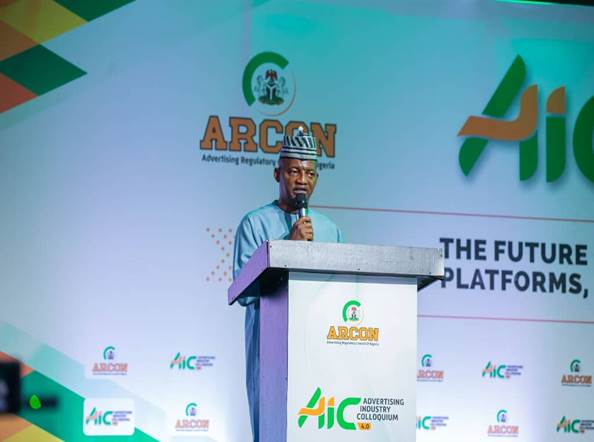

DG says advertising must reflect national cultural values even as AI, digital technology and global platforms redefine marketing communications
The Advertising Regulatory Council of Nigeria (ARCON) has declared that protecting Nigeria’s cultural identity will remain a central pillar of advertising regulation, even as artificial intelligence, global digital platforms and emerging technologies reshape the future of marketing communications.
Speaking exclusively with BrandiQ on the sidelines of the Advertising Industry Colloquium, ARCON Director-General, Dr. Olalekan Fadolapo, said the Council is determined to ensure that technological innovation does not erode Nigeria’s cultural values or weaken the country’s national identity.
According to him, while Nigeria remains one of the world’s most culturally diverse societies, advertising regulation must strike a careful balance between celebrating that diversity and promoting a shared national identity.
“We are culturally diverse, but we must ensure that our advertising framework aligns with our national cultural objectives while respecting that diversity,” he said.
Dr. Fadolapo explained that because advertisements approved by ARCON are intended for national audiences rather than individual ethnic or regional communities, regulatory decisions must consistently reflect Nigeria’s broader cultural policy.
His comments suggest that future advertising regulation may increasingly extend beyond traditional concerns such as misleading claims or ethical compliance to include questions surrounding cultural representation, national values and the influence of global digital platforms on local creative expression.
The Director-General said these cultural considerations would evolve alongside ARCON’s broader efforts to strengthen oversight of emerging technologies.
As artificial intelligence rapidly transforms advertising production, content creation, media buying and consumer engagement, he disclosed that the Council is already collaborating with technology providers and industry stakeholders to develop regulatory platforms capable of responding to increasingly sophisticated digital marketing practices.
“As technology continues to evolve, that is why we must continue to engage,” he said. “ARCON is working with relevant stakeholders and technology service providers to build the right regulatory platforms and gateways that will ensure the space is effectively managed and properly supervised.”
Beyond technology regulation, Dr. Fadolapo outlined plans to deepen collaboration across Nigeria’s entire marketing communications ecosystem, bringing agencies, advertisers, media organisations, academics and professional bodies into what he described as “one conversation.”
He said the objective is to create a unified regulatory framework capable of accommodating the industry’s diverse interests while encouraging shared standards, professional responsibility and sustainable industry development. “We are bringing everyone into one conversation. Agencies, media, advertisers, academics and professionals all have important roles to play. Our responsibility is to create a framework that accommodates every stakeholder.”
The Director-General also identified stronger collaboration between academia and industry as a strategic priority, acknowledging that research has not been sufficiently integrated into professional practice. According to him, ARCON intends to work more closely with universities and researchers to ensure evidence-based policymaking strengthens ethical advertising practice and industry development.
“We want to bridge the gap between academia and professional practice. We will continue engaging researchers and applying research findings in promoting ethical practice across the industry.”
His remarks reinforce ARCON’s ambition to evolve beyond its traditional regulatory role into an institution that actively shapes the future direction of Nigeria’s advertising industry through policy, research, collaboration and technological preparedness.
BrandiQ Analysis
The most significant message from Dr. Fadolapo’s interview is not only artificial intelligence. It is culture.
While global regulators are preoccupied with AI safety, algorithmic transparency and platform accountability, ARCON appears to be signalling that Nigeria’s primary concern is ensuring technological progress does not dilute national cultural identity. That is an important distinction. It suggests Nigeria may pursue a uniquely African model of advertising regulation – one that combines digital governance with cultural governance.
This is especially significant because generative AI systems are largely trained on datasets dominated by Western languages, values and cultural references. Left unchecked, AI-generated advertising could gradually normalise foreign narratives while reducing the visibility of Nigerian languages, symbols and indigenous creative expression. In that context, ARCON’s emphasis on cultural alignment is not merely a regulatory issue; it is a strategic response to the growing challenge of digital cultural sovereignty.
Equally noteworthy is the Council’s intention to bridge the longstanding divide between academia and professional practice. Modern advertising regulation increasingly depends on interdisciplinary research spanning communication, artificial intelligence, behavioural science, law, ethics and economics. By drawing universities into the policy process, ARCON acknowledges that future regulation must be informed by evidence rather than administrative experience alone.
The interview also reflects a subtle shift in regulatory philosophy. Instead of positioning itself solely as an enforcement agency, ARCON is increasingly presenting itself as a convener capable of bringing advertisers, agencies, media owners, technology companies and researchers into a common governance framework. That collaborative approach will become increasingly important as digital platforms continue to blur the traditional boundaries of advertising practice.
BrandiQ Verdict
Many regulators around the world are asking how artificial intelligence should be governed. ARCON appears to be asking a different – and perhaps more profound – question: How can Nigeria embrace AI without losing its cultural identity?
That question could define the next decade of advertising regulation in Africa.
If successfully implemented, ARCON’s evolving framework may become one of the continent’s earliest attempts to integrate AI governance, cultural policy, professional ethics and academic research into a single regulatory philosophy. For agencies, brands and content creators, the message is becoming increasingly clear: the future of advertising will not be judged solely by creativity or technology, but by how responsibly innovation serves society, culture and national development.