


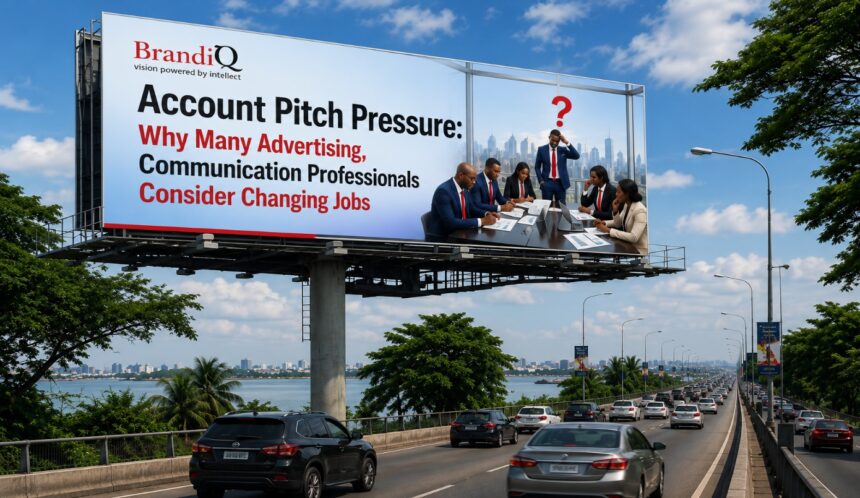

Pitch Pressure Is Crushing Ads Professionals as 73% Consider Leaving the Industry, Survey Finds
The Great Pitch Poll 2026 exposes rising burnout, mounting client demands and an agency business model under increasing strain. The relentless pursuit of new business is placing unprecedented pressure on advertising professionals, with nearly three-quarters now contemplating leaving the communications industry altogether because of the demands associated with pitching, according to findings from The Great Pitch Poll 2026, with further analysis from the Marketing Communication News
The annual survey, conducted by international business development consultancy The Great Pitch Company, paints a sobering picture of an industry where commercial growth is increasingly being achieved at considerable human cost. Covering agencies across the media, creative, public relations, digital, healthcare, performance marketing and design sectors, the survey examined business development practices, agency culture, mental wellbeing and the evolving nature of competitive pitching.
Its findings suggest that pitching – long regarded as the engine of agency growth – has become one of the industry’s greatest sources of stress. More than 80 per cent of respondents said the pressure associated with business development had made them seriously consider changing jobs, while 73.13 per cent admitted they had considered leaving the advertising and communications industry entirely because of pitching-related stress.
The survey also reveals the wider organisational consequences of increasingly demanding business development practices. More than 70 per cent of respondents said they or someone they knew had taken sick leave or experienced illness caused by pitching pressure. Nearly three-quarters believed clients had become significantly more demanding in their pitch requests, while over 60 per cent reported an increase in compressed assignments requiring agencies to respond to complex briefs within as little as forty-eight hours.
Weekend working remains deeply embedded in agency life during competitive pitches. More than 42 per cent of respondents said they were always or frequently expected to work weekends when preparing presentations, with that figure rising to more than half among agencies reporting moderate pitch conversion rates.
The survey also highlights a paradox emerging around artificial intelligence. While AI has been widely promoted as a productivity tool capable of reducing workload, respondents increasingly believe the technology is having the opposite effect. Around 40 per cent said AI is leading clients to ask more questions within briefs, request additional pitch content and expect faster turnaround times, suggesting that technological efficiency is being offset by rising client expectations.
Despite these concerns, the research identifies encouraging signs that agencies are becoming more conscious of employee wellbeing. More than 84 per cent of respondents agreed that positive mental wellbeing is essential to successful pitching, reinforcing the growing recognition that commercial performance and employee welfare are closely interconnected. The survey further found that agencies demonstrating greater discipline in declining unsuitable opportunities also reported healthier workplace cultures and stronger openness around mental health.
Commenting on the findings, Marcus Brown, Founder and Chief Executive Officer of The Great Pitch Company, warned that the industry must confront difficult questions about the sustainability of its current approach to winning new business.
Brown argued that while pitching remains the lifeblood of agency growth, the industry’s dependence on excessive personal sacrifice is becoming increasingly unsustainable. He called for business development to become better qualified, better resourced and more strategically managed, urging agency leaders to have more honest conversations about profitability, organisational capacity and the true cost of competitive pitching. He described the issue as extending well beyond new business, characterising it instead as a leadership, wellbeing and talent retention challenge.
The BrandiQ Perspective
For decades, the advertising industry has celebrated the culture of the “heroic pitch.” Late nights. Weekend work. Impossible deadlines. Creative teams pulling miracles together at the last minute. These stories have become part of agency folklore.
The Great Pitch Poll 2026 suggests that what was once celebrated as commitment is increasingly being experienced as exhaustion. The industry’s competitive advantage has never been technology, office space or software. It has always been human creativity.
When almost three-quarters of professionals begin questioning whether they should remain in the profession because of the way agencies pursue growth, the problem is no longer operational. It becomes existential.
BrandiQ Analysis
The findings expose a structural weakness within the traditional agency business model. Competitive pitching remains essential for securing new clients, yet the process increasingly appears to impose significant financial and human costs that are rarely reflected in discussions about agency profitability. Winning new business may generate revenue, but the survey suggests that the methods used to pursue that revenue are contributing to burnout, declining morale and growing talent attrition. In the long term, these hidden costs could prove more damaging than agencies currently recognise.
Equally revealing is the survey’s indication that client behaviour is changing. The growth of increasingly complex briefs, shorter deadlines and expanding presentation requirements suggests that competitive pitching has evolved from a straightforward evaluation of strategic thinking into an intensive procurement exercise demanding ever greater agency resources. As procurement expectations increase, agencies may need to rethink how they qualify opportunities, allocate resources and negotiate realistic timelines without compromising competitiveness.
The findings surrounding artificial intelligence are particularly instructive. Much of the industry’s narrative has focused on AI as a productivity accelerator capable of reducing repetitive work and improving efficiency. Yet respondents indicate that AI may be encouraging clients to demand more rather than settle for less. When technology enables faster production, expectations often rise correspondingly. Instead of simplifying pitching, AI may be contributing to an escalation in scope, complexity and speed. This illustrates an important principle of technological transformation: efficiency gains do not automatically translate into reduced workload unless accompanied by disciplined project management and realistic client expectations.
Perhaps the survey’s most important lesson concerns leadership. Agencies reporting healthier cultures were also more likely to demonstrate disciplined business development practices, including the willingness to decline opportunities that overstretched teams or offered poor commercial value. This finding challenges the long-standing belief that agencies should pursue every available opportunity. Sustainable growth increasingly depends not on chasing every pitch, but on selecting the right opportunities, protecting organisational capacity and recognising that employee wellbeing is itself a strategic business asset.
The survey also has significant implications for African agencies. As communications consultancies across Africa compete for multinational accounts, government contracts and regional business, many face similar pressures to deliver increasingly sophisticated strategic work within compressed timelines and constrained budgets. The temptation to accept every invitation to pitch is understandable in highly competitive markets. However, the experiences reflected in The Great Pitch Poll suggest that long-term competitiveness depends as much on protecting talent as on acquiring clients. Agencies that institutionalise healthier pitching disciplines, invest in business development capability and establish clearer boundaries with clients are likely to build stronger organisations than those relying indefinitely on extraordinary individual sacrifice.
BrandiQ Verdict
The Great Pitch Poll 2026 delivers a warning that extends far beyond the business development function. It suggests that the industry’s traditional approach to winning business is approaching a point where commercial ambition and human sustainability are increasingly in conflict. Agencies that continue to romanticise relentless pitch pressure risk losing the very people upon whom their future depends. The firms that will define the next generation of agency leadership are unlikely to be those that simply win the most pitches, but those that build business development systems capable of delivering growth without exhausting the talent that makes growth possible. In today’s communications industry, protecting people is no longer separate from protecting profit – it is becoming one of its most important determinants.