


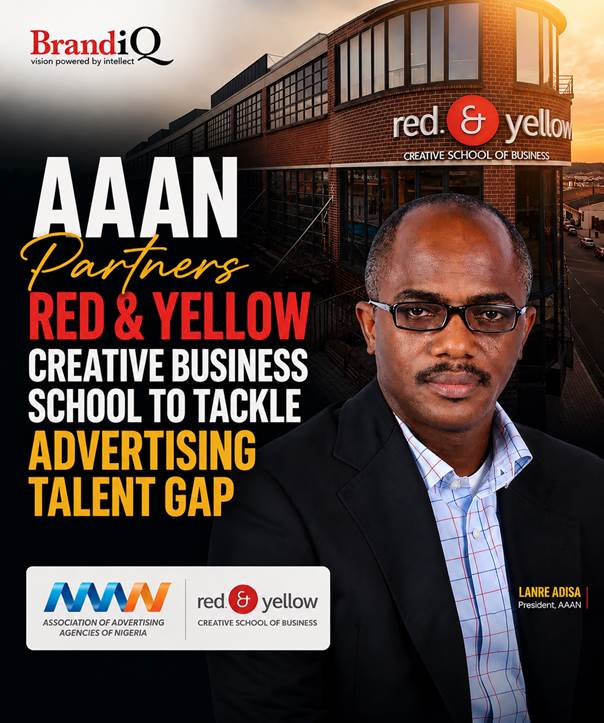

Nigerian advertising association partners South Africa’s Red & Yellow Creative School of Business to strengthen industry skills, leadership and AI readiness
The Association of Advertising Agencies of Nigeria (AAAN) has entered into a strategic partnership with South Africa’s Red & Yellow Creative School of Business in a move aimed at addressing the growing talent shortage confronting Nigeria’s advertising and marketing communications industry.
The collaboration, announced in Lagos, forms part of AAAN’s broader strategy to strengthen professional capacity, develop future industry leaders and equip practitioners with the skills required to navigate an increasingly technology-driven communications landscape.
Under the agreement, Red & Yellow – one of Africa’s leading creative business schools – will provide specialised training programmes for Nigerian advertising professionals beginning in August, focusing on leadership development, creative excellence, emerging technologies and future-of-work competencies.
Speaking at the signing ceremony, AAAN President Lanre Adisa described the initiative as a strategic response to mounting pressures confronting advertising agencies, including an increasingly limited pool of experienced professionals, aggressive talent poaching and the disruptive impact of artificial intelligence on the communications industry.
According to him, the partnership represents a long-term investment in rebuilding the industry’s human capital rather than a short-term training intervention. “For our industry to be future-ready, we need to tackle our talent challenge head-on. This is the reason we have sought out a partner with the experience and pedigree,” Adisa said.
He noted that Red & Yellow Creative School of Business is currently ranked among the leading advertising schools in Africa and the Middle East according to the latest Loeries rankings. “Our intention is long-term. We believe this will, over time, help Nigeria pull its weight on the continent as we all expect,” he added.
As part of the initiative, AAAN will also organise an industry webinar later this month to introduce the partnership and facilitate conversations around talent development, leadership and the changing demands of the marketing communications profession ahead of the commencement of the training programme.
Managing Director of Red & Yellow Creative School of Business, Verusha Maharaj, said the collaboration provides an opportunity to strengthen professional capabilities across Africa’s communications industry at a time when agencies are adapting to rapid technological and commercial transformation.
“Across Africa, agencies and marketing teams are dealing with similar pressures around talent, technology, leadership and competitiveness. This partnership allows us to support a practical industry conversation about what creative businesses need now, and how education can respond more directly to those needs,” Maharaj said.
Founded in 1994 and headquartered in Cape Town, South Africa, Red & Yellow Creative School of Business is a Council on Higher Education (CHE)-accredited institution specialising in marketing, advertising, design, digital business and corporate learning. AAAN said the initiative reinforces its commitment to raising professional standards, strengthening agency capabilities and preparing Nigerian advertising practitioners for the future of marketing.
BrandiQ Insight
Nigeria’s advertising industry is finally confronting its human capital challenge. Perhaps the most important aspect of AAAN’s announcement is not the partnership itself. It is the industry’s public acknowledgement that Nigeria’s advertising business faces a growing talent challenge.
For years, agencies have quietly struggled with the migration of experienced professionals to client organisations, consulting firms, multinational companies, technology businesses and entrepreneurship. The emergence of remote work has further intensified the competition, enabling highly skilled Nigerian creatives, strategists and digital specialists to work directly for international organisations without leaving the country.
At the same time, artificial intelligence is reshaping the skills agencies require. Routine production tasks are increasingly automated, while greater emphasis is being placed on strategic thinking, creativity, data interpretation, consumer insight and integrated problem-solving. These developments mean that traditional agency training models are no longer sufficient.
The Future of Agencies Will Depend on Talent, Not Technology Alone
Artificial intelligence has changed the conversation, but it has not replaced human creativity. Instead, it has elevated the importance of professionals capable of combining strategic thinking with technological competence.
The agencies that succeed over the next decade will not necessarily be those with access to the most advanced AI tools. They will be those capable of attracting, developing and retaining people who know how to use those technologies to solve complex business problems. In that sense, human capital is becoming one of the industry’s most valuable competitive assets.
A Shift Towards Continental Collaboration
The partnership also reflects a broader trend within Africa’s creative economy. Rather than relying exclusively on training models imported from Europe or North America, African institutions are increasingly collaborating to develop solutions tailored to the continent’s business realities.
As African markets become more integrated under the African Continental Free Trade Area (AfCFTA), such partnerships could contribute to a more connected creative economy, facilitate knowledge exchange and raise professional standards across the region.
What This Means for Nigeria’s Marketing Industry
For Nigeria, the initiative arrives at a critical moment. The communications industry is simultaneously navigating economic uncertainty, digital transformation, artificial intelligence and changing client expectations. Preparing practitioners for that environment requires more than technical training. It demands leadership development, continuous learning and a culture of innovation.
AAAN’s partnership with Red & Yellow therefore represents more than an educational collaboration. It signals a recognition that the future competitiveness of Nigeria’s advertising industry will depend not only on the quality of its creative ideas but also on the strength of its talent pipeline.
Ultimately, the industry’s greatest competitive advantage may no longer be its campaigns, but its ability to develop people capable of creating the next generation of ideas, brands and business solutions.