
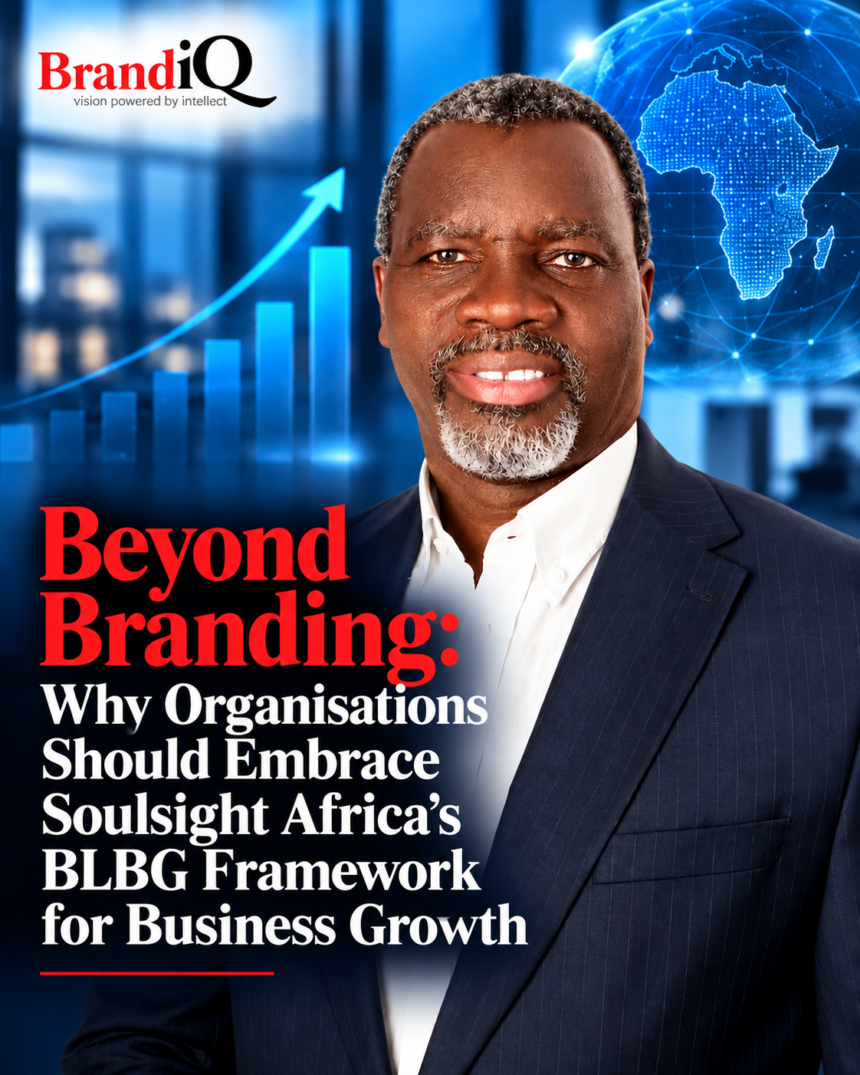

After more than three decades in branding, brand management and marketing, Soulsight Africa’s CEO, Joko Okupe, has developed the BLBG framework, which challenges organisations to connect brand promises with business strategy, organisational capabilities and measurable performance.
Table of Contents
For decades, business leaders have searched for management frameworks capable of helping organisations translate strategy into performance, improve productivity and sustain competitive advantage. From Total Quality Management, TQM, to the Balanced Scorecard, influential management approaches have reshaped how organisations think about operational excellence, strategic execution and business performance.
Yet one challenge continues to confront many organisations: the disconnect between the value a brand promises and the value the business is equipped to deliver.
Companies invest in brand identity, advertising, public relations, digital marketing and customer acquisition. They develop ambitious growth strategies, communicate compelling value propositions and compete aggressively for market attention. But visibility does not necessarily translate into customer loyalty, stronger margins, operational efficiency or sustainable growth.
It is this gap between brand promise and business performance that Joko Okupe, chief executive officer of Soulsight Africa, seeks to address through the Brand-Led Business Growth (BLBG) framework.
Unveiled recently in Lagos to members of the business community and the media, the BLBG framework represents an attempt to bring brand strategy and business management into a more integrated relationship. Its central proposition is straightforward: a brand should not merely communicate what an organisation stands for; it should help shape how that organisation operates, creates value, serves customers and pursues growth.
For Okupe, whose professional experience spans more than three decades in branding, brand management and marketing, the BLBG framework reflects a broader question about the role of branding in contemporary business: what happens when organisations build powerful brands but fail to align their internal capabilities with the promises those brands make? His answer is to reposition the brand from a marketing asset into a strategic reference point for the entire organisation.
Lessons from Management Frameworks That Changed Business
The development of the BLBG framework comes against a long history of management innovation. Some frameworks have fundamentally changed how organisations approach quality, productivity, strategic planning and performance measurement. Total Quality Management (TQM), for instance, helped popularise the principle that quality should be embedded across organisational processes rather than left to a single department. Its emphasis on continuous improvement, employee participation and customer satisfaction influenced manufacturing, services and wider management practice. The significance of TQM was not simply that organisations should produce better products. It was that quality depended on the entire operating system: leadership, processes, people, measurement and continuous improvement.
The Balanced Scorecard, developed by Robert Kaplan and David Norton, addressed another management challenge: the limitations of measuring business performance through financial results alone. It encouraged organisations to consider financial outcomes alongside customer perspectives, internal processes, and learning and growth. Together, these approaches helped reinforce an important management principle: business performance is shaped by interconnected organisational capabilities, not isolated activities.
The BLBG framework approaches a related challenge from the perspective of brand-led growth. It asks organisations to examine whether their strategic positioning, people, processes, products and customer experiences are aligned with the value they promise to the market.
The comparison is not that the BLBG framework replaces these established frameworks. TQM focuses on quality and continuous improvement, while the Balanced Scorecard provides a system for translating strategy into performance measures. The BLBG framework places particular emphasis on the relationship between brand promise, business strategy, organisational delivery and growth. Its proposition is that the brand can serve as a connecting principle across these areas, helping leaders consider whether the organisation is equipped to deliver the value that differentiates it in the market. For businesses that already use established management systems, the BLBG framework could complement existing approaches by bringing the brand promise more explicitly into strategic and operational decisions.
Three Decades of Experience Behind the Framework
Management frameworks often emerge when experienced practitioners begin to question the limitations of established ways of working. In Okupe’s case, more than three decades in branding, brand management and marketing provide the professional context for his attempt to connect brand strategy with business productivity. Brand management traditionally concerns how an organisation develops, positions and sustains its identity and value in the market. Marketing helps translate that value into customer demand, while communications shape the messages through which organisations engage their audiences.
These disciplines remain essential. But they operate within a wider business system that determines whether the organisation can deliver what it promises. A company may develop an effective positioning strategy, execute successful campaigns and build strong awareness, yet still experience weak customer retention because its service delivery is inconsistent. Another may have an attractive value proposition but lack the operational capabilities, distribution systems or internal alignment required to deliver it at scale. These situations reveal a fundamental distinction between communicating value and delivering value.
The BLBG framework reflects the idea that brand management should not end when the organisation has established its positioning or launched its communications. Instead, the brand promise should inform business strategy, product development, organisational culture, operating processes and customer experience.
Okupe’s professional journey has therefore provided the context for a broader management proposition: brand strategy can be more useful to an organisation when it is connected to the decisions and capabilities that determine business performance. The BLBG framework’s significance will ultimately depend on how effectively organisations apply it. Nevertheless, its introduction raises a relevant question for contemporary management: should businesses evaluate brand performance separately from the systems responsible for delivering the brand promise? The BLBG framework argues that the two should be considered together.
The Brand–Business Growth Gap
At the heart of the BLBG framework is what Soulsight Africa describes as the Brand–Business Growth Gap: the disconnect between what a brand promises, what the business delivers, what customers experience and what the market rewards. The gap can emerge in different ways.
A financial services company may promise convenience but operate digital platforms that frustrate customers. A manufacturer may promote innovation while maintaining product development processes that are slow to respond to changing customer needs. A professional services firm may promise exceptional expertise but fail to align employee development and service delivery with that positioning. In each case, the brand promise creates expectations that the organisation’s capabilities may not consistently fulfil.
The consequences can extend beyond reputation. Depending on the circumstances, inconsistent delivery can weaken customer confidence, increase customer attrition, undermine differentiation and reduce the effectiveness of marketing investment. Nigerian shoppers illustrate the point: BrandiQ’s report on Nigerian consumers rethinking brand loyalty found that poor customer experience was the leading driver of disloyalty, with price second.
The BLBG framework encourages leadership teams to investigate these disconnects rather than assume that every growth problem can be solved through additional advertising or promotional activity.
The diagnostic question becomes: is the organisation’s growth being constrained by insufficient market awareness, or is there a deeper problem involving the relevance of its offering, the effectiveness of its operations, the behaviour of its people or the quality of the customer experience? That distinction matters because different problems require different solutions.
If customers do not understand a relevant offering, stronger communication may help. If customers understand the offering but encounter poor service, the organisation may need to improve its processes, systems or employee capabilities. If the product itself does not meet market needs, the solution may require product development or a revised value proposition. The BLBG framework seeks to help organisations examine these relationships within a unified strategic approach.
Six Stages of the BLBG Framework from Strategy to Growth
The BLBG framework is organised around six stages: Discover, Define, Design, Align, Activate and Grow. Together, they provide a structured pathway for understanding the business, clarifying its value proposition, developing the capabilities required to deliver it and pursuing growth objectives.
1. Discover: Understand the Business Before Prescribing Solutions
The Discover stage focuses on understanding the organisation, its market, customers, opportunities and performance challenges. This involves examining the business’s current position and identifying factors that may be preventing it from achieving its objectives. The questions could include whether the organisation understands its customers, whether its products remain relevant, where its competitive advantages lie and whether its internal capabilities support its ambitions. For executives, the principle is important: effective strategy should begin with diagnosis rather than assumptions.
2. Define: Establish the Value Proposition
Define establishes the business opportunity, positioning, value proposition and brand promise. An organisation must be clear about the value it intends to create, the customers it seeks to serve and the basis on which it intends to compete. Without that clarity, different departments may pursue conflicting priorities, while investments in marketing, product development and operations may fail to reinforce a coherent strategic direction.
3. Design: Build the Capabilities to Deliver
Design focuses on developing the brand, customer experience initiatives and organisational capabilities required to translate the value proposition into practical action. This stage connects the promise made to the market with the products, services, systems and experiences through which the promise must be fulfilled. For example, a company positioning itself around convenience may need to examine its distribution model, digital platforms, payment systems and customer-support processes.
4. Align: Bring the Organisation Together
Align addresses the relationship between leadership, people, culture, processes and systems. It recognises that strategy can fail when the organisation is not equipped to execute it. Employees may not understand the brand promise, departments may work at cross-purposes, or performance incentives may encourage behaviours that contradict the intended customer experience. The Align stage seeks to connect these internal elements with the organisation’s strategic priorities.
5. Activate: Translate Strategy into Action
Activate focuses on implementing the agreed strategy and associated initiatives. This is where strategic intentions must become operational priorities, defined responsibilities and coordinated action. Effective implementation requires leadership commitment, resources, accountability and communication across the organisation.
6. Grow: Pursue the Desired Outcomes
Grow focuses on advancing the organisation’s growth objectives. The precise outcomes will differ by organisation. They may include customer retention, market expansion, product adoption, improved customer experience or stronger financial performance. The important consideration is whether the initiatives introduced are contributing to the objectives they were designed to support. Organisations must therefore establish relevant indicators and evaluate progress rather than assume that adopting a framework will automatically generate results.
Taken together, the six stages connect strategic diagnosis with organisational alignment and execution. The BLBG framework seeks to move brand management beyond identity and communication towards a more integrated approach to value creation and business performance.
Why CEOs and Boards Should Pay Attention to the BLBG Framework
The BLBG framework has implications for chief executives, directors, founders and senior management teams because the relationship between brand promise and business performance extends across organisational boundaries.
Marketing may define and communicate the value proposition, but operations must deliver it. Human resources must support the required employee capabilities and behaviours. Technology must enable the intended operating model, while leadership must ensure that resources, processes and performance priorities reinforce the organisation’s direction.
This makes brand-led growth a management issue rather than a responsibility that can be delegated entirely to the marketing department.
For boards, the approach raises questions about strategic coherence, organisational capabilities and the effectiveness of investments intended to strengthen market position. For CEOs, it provides a lens through which to examine whether the organisation’s operating model supports its strategic ambition.
For marketing and brand professionals, it creates an opportunity to connect their work more explicitly with business objectives. Their contribution can be assessed not only through campaign reach and awareness, but also through the relationship between brand initiatives, customer behaviour and organisational performance. The call for a single organising idea is not unique to Soulsight: Dentsu has argued that brands need a unifying idea to stand out in the age of AI.
This does not mean that brand awareness, reputation or communications effectiveness have become unimportant. Rather, these measures should be considered alongside the outcomes the organisation is seeking to achieve.
Depending on its priorities, a business might monitor customer acquisition costs, retention rates, conversion, product adoption, customer satisfaction, market penetration, revenue growth and customer lifetime value. Financial and operational indicators would remain essential to determining whether the strategy is delivering the intended results.
The BLBG framework’s potential value lies in helping leadership teams connect these measures to the strategic promise that differentiates the business.
Relevance to Nigerian Businesses
For Nigerian businesses operating amid changing customer expectations, economic pressures and intense competition, the ability to create and deliver relevant value remains central to long-term performance. Customer experience is already a competitive lever across sectors, as BrandiQ’s coverage of customer satisfaction shows.
Organisations must continually assess whether their offerings meet market needs, whether their operating models remain effective and whether customers have compelling reasons to choose them over competitors. A clear brand promise can help guide these decisions, but it must be supported by the capabilities required to fulfil it.
The BLBG framework may be particularly relevant to businesses repositioning established brands, launching new products, entering new markets or seeking to strengthen customer relationships. In each case, management must consider not only how the organisation wants to be perceived, but also whether its people, systems, products and processes support that position.
Its principles may also inform conversations about institutional effectiveness, although public-sector applications would require adaptation to public mandates, accountability structures and policy objectives.
For commercial organisations, the test remains practical: can the business deliver the value it promises, can customers recognise that value, and can the organisation sustain it in a way that supports its objectives?
From Brand Visibility to Business Productivity
Soulsight Africa’s wider service offering includes brand and business strategy, business and brand transformation, customer and market growth, brand experience and activation, product design and market entry, stakeholder engagement, and executive brand and growth advisory.
The BLBG framework provides an overarching approach for connecting these capabilities with organisational priorities. Its introduction represents an attempt to extend the role of brand strategy beyond market perception and into the systems responsible for delivering value. In that sense, it joins a continuing tradition of management innovation: identifying a persistent organisational challenge and proposing a more structured way to address it.
However, the BLBG framework’s ultimate credibility will depend on its application. Organisations adopting it will need to establish clear objectives, assess their starting position, identify the gaps they intend to address and measure whether implementation improves performance. The distinction between a promising management concept and an effective business tool lies in the results organisations can demonstrate.
For Okupe, the proposition behind the BLBG framework is that the work of building brands should be connected to the work of building businesses. The brand defines the value an organisation promises; its strategy establishes how it intends to create that value; and its people, processes and systems determine its ability to deliver.
In a business environment where visibility alone is rarely sufficient to secure lasting competitive advantage, the BLBG framework asks leaders to look beyond what their organisations say about themselves and examine what they are equipped to deliver. The strategic challenge is no longer simply to build a recognisable brand. It is to build an organisation capable of turning its brand promise into consistent customer value and sustainable business performance.