


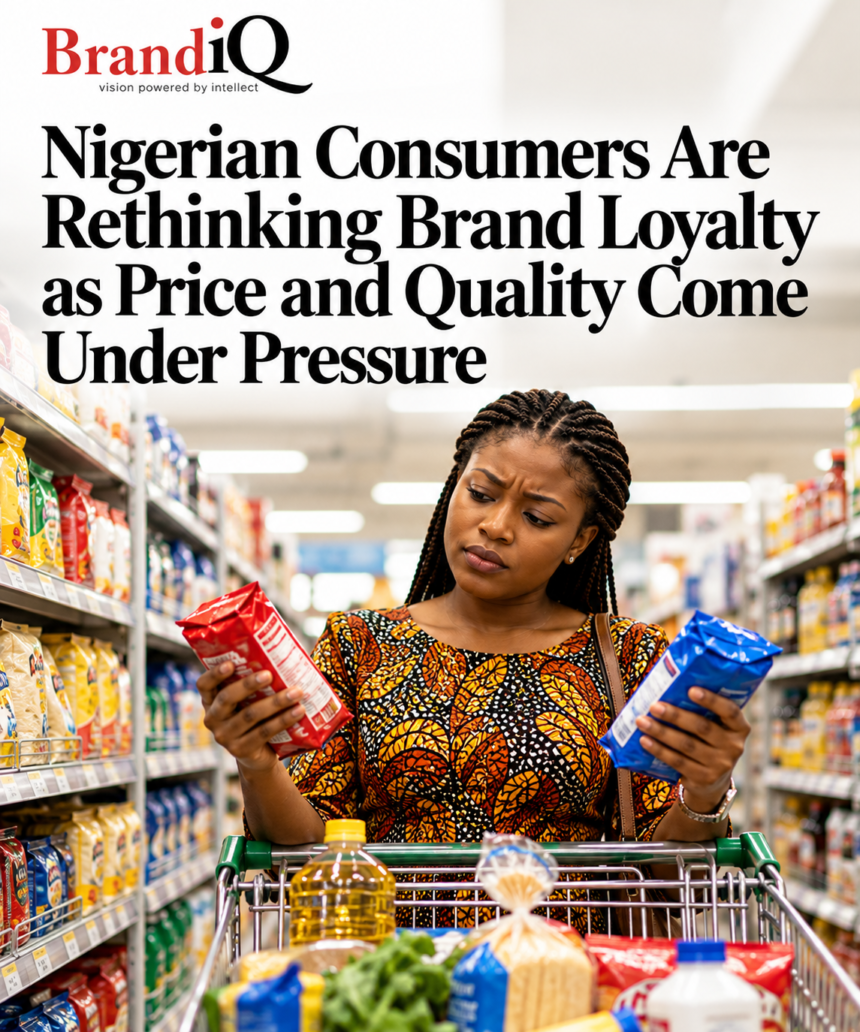

Rising household expenses are forcing consumer-goods brands to prove their value through affordability, product performance, availability and customer experience – not advertising alone.
Nigerian brands are facing a more demanding consumer market as rising household expenses and changing purchasing habits force shoppers to reconsider the products they buy. For manufacturers of everyday essentials, including detergents, cooking oil, powdered milk, beverages and personal-care products, maintaining customer loyalty increasingly depends on demonstrating that products justify their prices.
A report published by Independent Newspaper on October 14 highlights the growing pressure on familiar brands as consumers weigh price against quality, availability and perceived value. The report cites NielsenIQ research presented in 2025 indicating that nearly six in 10 Nigerian shoppers had switched brands in the preceding year, with price sensitivity identified as a major factor. It also references a more recent NielsenIQ analysis, published on September 23, 2026, which reported that Nigerian consumers were becoming more deliberate about spending, alongside a 1.5 per cent decline in fast-moving consumer goods volumes.
Price matters, but customer experience can determine loyalty
The pressure on brands extends beyond affordability. Research by Pan-Atlantic University’s Lagos Business School and the National Institute of Marketing of Nigeria, cited in the report, identified poor customer experience as the leading driver of disloyalty, with price ranking second. The research drew on discussions involving more than 300 brands, companies and customers across Nigeria’s six geopolitical zones.
The implication is significant. A consumer may initially abandon a brand because of a price increase but remain dissatisfied with a competitor if the product performs poorly, is difficult to find or comes with inadequate customer support. Conversely, a brand that consistently delivers on its promise may retain customers even when cheaper alternatives exist.
This creates a strategic challenge for marketing leaders. Cutting prices or introducing smaller packs may help consumers manage immediate spending pressures, but these measures will not necessarily secure long-term loyalty if product quality and customer experience deteriorate. Brands must understand the trade-offs consumers are making across different product categories rather than treating all shoppers as either premium buyers or bargain hunters.
The report also references a study of 191 supermarket shoppers in Ikeja, Ilupeju and Somolu examining promotional strategies in the powdered-milk market. Its findings indicated that both price discounts and free samples were significantly associated with brand loyalty, with free samples showing a stronger relationship in the researchers’ statistical analysis. The limited geographical coverage means the findings cannot be generalised to every Nigerian consumer, but they suggest that enabling consumers to experience a product can be valuable alongside price incentives.
BrandiQ Analysis: The battle is for value, not just visibility
For marketers, the central issue is whether their brands continue to earn a place in household budgets. Advertising can maintain awareness and stimulate demand, but it cannot indefinitely compensate for poor product performance, unreliable distribution or disappointing service.
Smaller pack sizes, carefully designed promotions and accessible distribution may help brands respond to consumers facing tighter budgets. However, these tactics need to be supported by a clear understanding of product profitability, consumer behaviour and repeat-purchase patterns. A promotion that attracts one-time buyers but fails to generate repeat purchases may increase short-term sales without strengthening the brand.
The report also notes the importance of traditional retail, which remains central to grocery shopping in Nigeria. Brands therefore need to consider the neighbourhood shops where many consumers make everyday purchases, not just supermarkets, digital platforms and major retail chains.
BrandiQ Takeaway: In today’s Nigerian market, brand loyalty cannot be assumed simply because a product is familiar. Brands must continually justify their prices through quality, availability, customer experience and credible value. The strongest competitors will be those that understand what consumers are prepared to pay for – and consistently deliver it.