
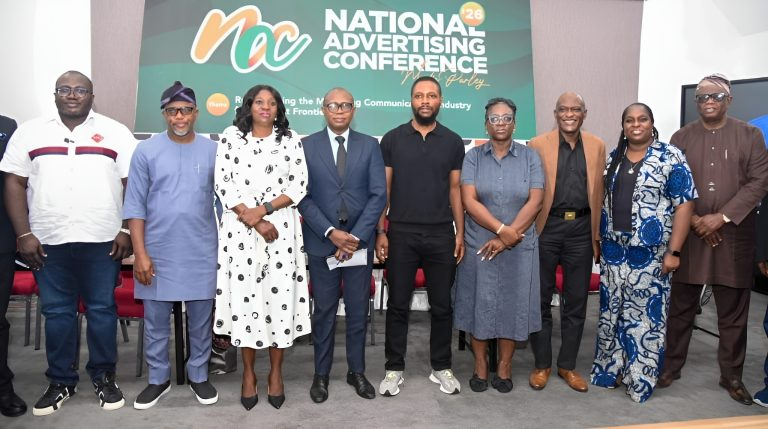

Industries rarely get to choose whether they will be regulated. What they occasionally get to choose is who writes the rules first. That choice is the real subject buried inside the Advertising Regulatory Council of Nigeria’s press briefing last week announcing the sixth National Advertising Conference (NAC), even though none of the announcements framed it that way. Read past the agenda items – artificial intelligence, a new television audience measurement system, the African Continental Free Trade Area, the price of political billboards – and a single thread connects them: Nigeria’s marketing communications industry is racing to draft its own answers to a set of disruptions before those answers get imposed on it from outside, whether by global AI platforms, foreign regulatory templates, or a 2027 election cycle that has already begun testing the limits of who can afford to communicate at all.
NAC 2026 will hold at the Continental Hotel in Abuja from November 11 to 13, under the theme “Repositioning the Marketing Communications Industry for the Next Frontier,” organised by ARCON in partnership with the industry’s sectoral associations. It is expected to draw more than 700 participants, up from roughly 500 at the previous edition – a growth curve that, on its own, is commendable.
Writing the AI Rulebook Before Someone Else Does
The most consequential item on the agenda is also the one framed most cautiously in ARCON’s own language: a cross-functional committee, working with the Council and the Heads of Advertising Sectoral Groups, has spent months examining the regulatory challenges posed by artificial intelligence and digital platforms, with recommendations to be discussed with regulators and stakeholders before being presented as a workable model. NAC 2026 Planning Committee chairman Tunji Adeyinka described this as one of the conference’s central presentations, noting the committee’s work would be discussed extensively so that what emerges is an amended model for regulating digital marketing and AI in Nigeria.
The significance of that process is easy to miss if the AI conversation is filed alongside every other industry’s anxious AI panel this year. Most sectors confronting AI disruption are reacting to rules being written elsewhere – by platform companies, by foreign regulators, by international standards bodies – and adapting after the fact. Nigeria’s advertising industry, through this committee structure, is attempting the harder and rarer manoeuvre of producing its own regulatory position before a rulebook is handed down to it. Whether that model survives contact with ARCON’s formal regulatory process intact is an open question the conference itself will only partly answer in November. But the attempt matters regardless of outcome, because an industry that authors its own compliance framework retains far more say over its economics than one that spends the next five years litigating a framework designed by people who have never bought a media plan.
Adjacent to the AI conversation sits a related, more immediate concern: audience measurement. Delegates are expected to review early findings from the DeepMove Meter, a new television audience measurement system, and weigh its implications for media planning, investment and accountability – a conversation ARCON explicitly linked to the wider question of data protection as advertisers increasingly rely on consumer information for targeting and personalisation. Measurement and AI regulation are, in effect, the same conversation from two directions: one is about what data an industry is permitted to collect, the other about what infrastructure it uses to make sense of that data credibly. An industry that gets a proprietary measurement standard wrong, or lets a global platform’s measurement methodology become the default, cedes a currency-setting function that is difficult to reclaim later.
The AfCFTA Test: Expansion or Exposure
If the AI committee represents Nigeria’s advertising industry defending its regulatory autonomy, the conference’s AfCFTA agenda item represents the opposite instinct: expansion. A dedicated committee is expected to present findings and a proposed action plan on what the African Continental Free Trade Area means for Nigeria’s marketing communications sector, with discussions centred on opportunities for Nigerian agencies and creative businesses to extend their expertise across the continent and compete inside an increasingly integrated African market.
This is worth reading alongside the AI regulation thread rather than as a separate line item, because both are ultimately about the same underlying anxiety: whether Nigeria’s advertising industry will be a rule-taker or a rule-shaper in the markets that matter to it next. A continental trade framework that opens African markets to Nigerian agencies is only an opportunity if those agencies are prepared to compete on standards, measurement credibility and regulatory sophistication comparable to the international networks already operating across the continent. An industry that spends this period getting its own AI and data governance house in order is, whether or not the connection is made explicit at NAC, also building the institutional credibility it will need to make a serious AfCFTA push. An industry that treats regulation purely as compliance overhead, by contrast, risks discovering that continental competitors have already set the standard it is now expected to meet.
The Cost of Being Heard
The briefing’s most pointed warning came from an unexpected corner of the agenda. Dr Sola Akinsiku, president of the Out-of-Home Advertising Association of Nigeria, raised concerns over what he described as excessive government-imposed charges for political outdoor advertising in some states, warning that high fees risk making political communication prohibitively expensive, discouraging candidates who cannot meet the financial demands, and creating an uneven playing field ahead of the 2027 general elections. It is a narrower complaint than the AI or AfCFTA agenda items, but it belongs in the same frame: it is another instance of an industry association trying to get ahead of a policy decision – in this case, state-level pricing power over political speech – before it hardens into a structural disadvantage nobody chose deliberately.
A Fireside Chat With Something to Prove
The conference’s opening fireside chat, featuring Access Holdings chairman Aigboje Aig-Imoukhuede, was framed by Adeyinka as a deliberate choice: someone who has managed industry disruption from inside Nigerian banking, brought in to speak to an industry now facing its own version of the same disruption. Panels on Nigeria’s economic outlook, featuring Lagos Business School’s Olu Akanmu and Nairametrics chief executive Ugochukwu Obi-Chukwu, and a leadership panel titled “The Future is Female,” featuring MIPAN’s Brenda Nwagwu, EXMAN’s Tolulope Medebem and NIMN’s Bolajoko Bayo-Ajayi, round out a programme that treats regulation, economics and representation as parts of one repositioning exercise rather than separate conference tracks.
Taken together, the picture that emerges from Abuja in November is not a trade conference debating whether AI, continental trade and election-cycle politics will change Nigeria’s marketing communications industry. All three are already changing it. The question NAC 2026 has set itself is narrower and more consequential: whether the industry writes its own response to that change, through its own committees and its own proposed frameworks, or waits to be told what the rules will be by regulators, platforms and political actors who have no particular reason to prioritise the industry’s interests when they do.