

Refinery giant’s dual-listing ambition could redefine African capital markets, regional industrialisation and the continent’s quest for economic integration
Nigeria’s Dangote Group is preparing to deepen its footprint in African capital markets following indications that its flagship Dangote Petroleum Refinery could pursue a secondary listing on the Johannesburg Stock Exchange (JSE) after completing its planned initial public offering in Nigeria.
The development was confirmed by the JSE, which disclosed that it has engaged with the Dangote Group regarding the possibility of listing the refinery in South Africa after its Nigerian public offering. “They will list in Nigeria first but with strong intent to hopefully bring the listing to South Africa,” a JSE spokesperson told Reuters.
According to Reuters, the company is seeking to raise approximately US$5 billion through the refinery’s IPO. Sources familiar with the transaction indicated that Dangote Group has already made a preliminary filing with Nigeria’s securities regulator, with an October listing being targeted.
Reuters also reported that the company intends to broaden participation beyond Nigeria by inviting investors from regional capital markets. Kenya is expected to contribute approximately US$500 million towards the fundraising, according to one of the sources.
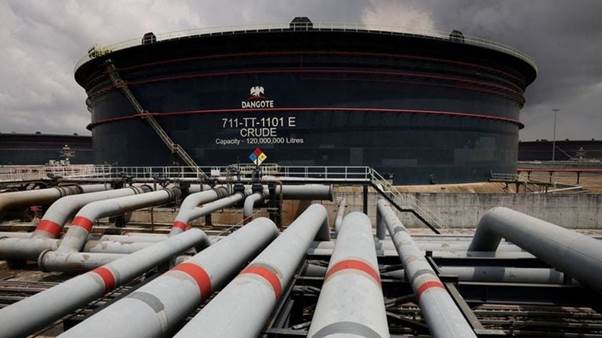
Built at an estimated cost of US$20 billion, the 650,000 barrels-per-day Dangote Refinery commenced fuel production in 2024 and reached full operational capacity earlier this year, making it Africa’s largest refinery.
The facility has already begun reshaping petroleum product supply across West Africa by reducing Nigeria’s dependence on imported refined fuels while positioning the country as a potential exporter of petroleum products to African and international markets.
BrandiQ Analysis
This Is Bigger Than an IPO
Most investors will naturally focus on the proposed US$5 billion fundraising. That would be a mistake. The real story is not the capital being raised.
It is where Africa is choosing to raise it.
For decades, Africa’s largest corporations have primarily sought listings in London, New York, Paris or Toronto whenever they required significant international capital. Dangote’s emerging strategy signals something fundamentally different.
Rather than exporting Africa’s biggest companies to global exchanges, the refinery could become one of the first mega-industrial assets financed substantially through African capital markets themselves. That represents a quiet but profound shift in the continent’s financial architecture.
From National Champion to Pan-African Asset
The refinery has often been described as a Nigerian project. Economically, it is rapidly becoming something much larger. Fuel from Dangote already serves multiple African markets. Now, ownership itself may become increasingly continental.
If investors in Nigeria, South Africa, Kenya and eventually other African countries become shareholders, the refinery evolves from being a Nigerian industrial project into a Pan-African strategic asset. That is precisely the type of continental integration envisioned under the African Continental Free Trade Area (AfCFTA). Instead of merely moving goods across borders, Africa would also be moving capital, investment ownership and wealth creation across national boundaries.
A New Model for African Capital Markets
For years, African stock exchanges have struggled to attract globally significant listings.
Many of the continent’s biggest companies preferred overseas exchanges because they offered greater liquidity and larger pools of institutional investors. A successful Dangote listing across multiple African exchanges could begin changing that narrative.
It demonstrates that African exchanges can potentially finance world-class infrastructure projects without relying exclusively on Western financial centres. If replicated by other African industrial champions, the continent’s capital markets could become significantly deeper and more interconnected.
The Political Economy Behind the Deal
Viewed through the lens of political economy, this transaction reflects a broader transformation occurring across Africa. Historically, Africa exported raw materials while importing finance, technology and industrial products. The Dangote Refinery already challenges one part of that equation by refining African crude within Africa.
A regional listing challenges another by mobilising African savings to finance African industrialisation. This represents an important movement towards financial sovereignty, where African pension funds, insurance companies, sovereign wealth funds and retail investors increasingly finance the continent’s own development rather than relying predominantly on foreign capital.
What It Means for South Africa
For the Johannesburg Stock Exchange, attracting Dangote would be strategically significant. The JSE remains Africa’s largest stock exchange but faces increasing competition from emerging financial centres across the continent.
Securing one of Africa’s most valuable industrial companies would reinforce Johannesburg’s position as the continent’s premier financial marketplace.
It would also deepen commercial relations between Africa’s two largest economies – Nigeria and South Africa – which have historically experienced periods of both cooperation and rivalry.
Implications for the African Economy
If successfully executed, the proposed listing could generate several continent-wide benefits.
1. Stronger African Capital Markets
The transaction could increase liquidity, attract institutional investors and encourage cross-border investment throughout Africa.
2. Greater Regional Financial Integration
African investors would gain opportunities to own strategic industrial assets beyond their national borders.
3. Reduced Dependence on External Capital
Mobilising African savings for African infrastructure strengthens economic resilience and reduces vulnerability to fluctuations in international capital markets.
4. Industrialisation Beyond Oil
Success could encourage similar financing models for manufacturing, renewable energy, mining, telecommunications, logistics and digital infrastructure.
5. AfCFTA in Practice
Rather than remaining largely a trade agreement, AfCFTA begins to evolve into a platform for integrated production, investment and capital formation.
Global Implications
The implications extend well beyond Africa. The refinery is already altering global petroleum trade flows by reducing Africa’s dependence on imported refined products from Europe, Asia and the Middle East.
A successful regional listing would add another dimension. Global investors may increasingly view Africa not merely as a destination for commodity extraction but as an emerging centre for industrial production and capital formation.
It could also encourage multinational companies operating in Africa to consider regional African listings instead of automatically seeking Western exchanges. Such a shift would gradually strengthen Africa’s financial autonomy within the global economy.
The Risks
The ambition nevertheless faces important challenges. Cross-border listings require regulatory harmonisation, investor protection, currency stability and efficient settlement systems.
Differences in taxation, disclosure requirements and capital market regulations across African jurisdictions remain significant obstacles.
The refinery itself must also demonstrate sustained operational performance, profitability and corporate governance expected of publicly listed companies.
Investor confidence will ultimately depend less on the symbolism of the listing than on the refinery’s financial performance.
BrandiQ Verdict
The proposed Dangote listing is not simply another corporate fundraising exercise. It may become one of the most consequential financial events in modern African economic history.
If successful, it signals that Africa is beginning to finance its own industrial revolution using its own capital markets. That changes the narrative from resource extraction to wealth creation, from national industrial policy to continental economic integration, and from dependence on foreign finance to African investment in African infrastructure.
The larger question is no longer whether Dangote can transform Africa’s energy landscape. It is whether the refinery can become the catalyst for a new generation of African multinational companies that raise capital across African markets, build continental value chains and redefine Africa’s position in the global economy.
If that happens, the IPO will be remembered not merely as a stock market listing, but as a milestone in Africa’s long journey toward economic sovereignty.