

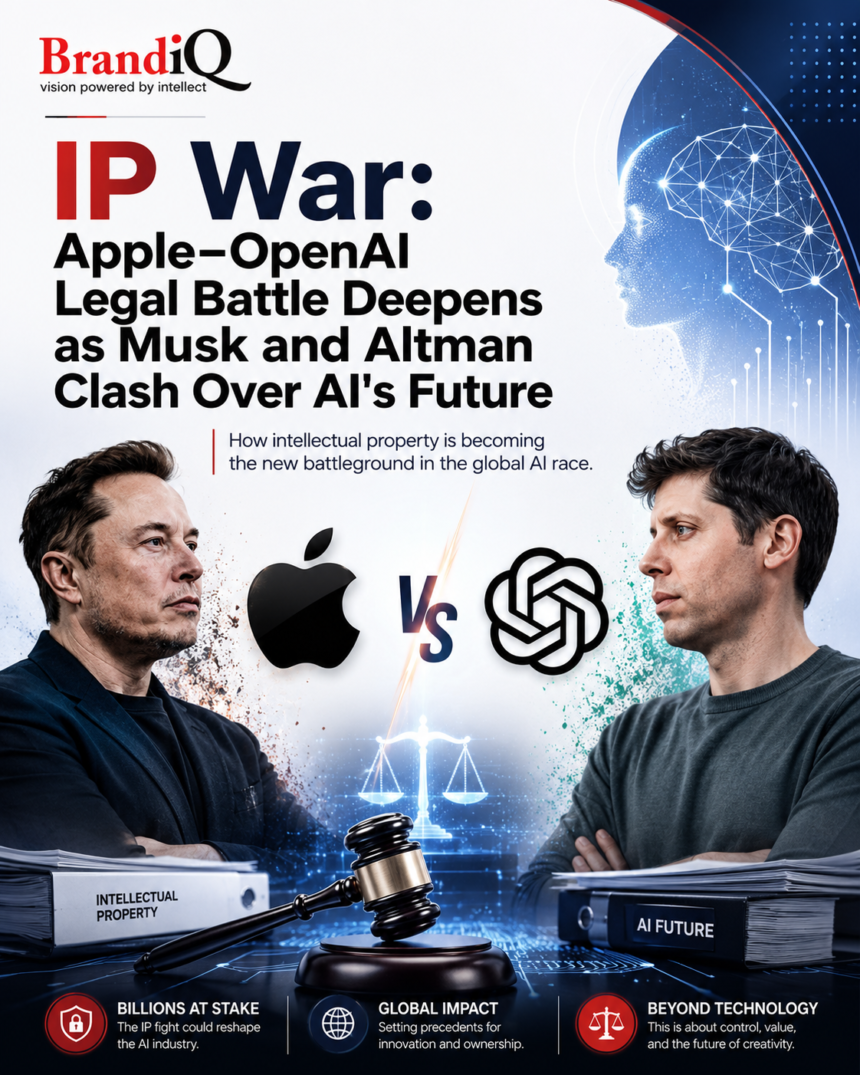

How intellectual property is becoming the new battleground in the global AI race
A legal dispute between Apple and OpenAI has rapidly evolved into one of the technology industry’s most closely watched confrontations, exposing the growing strategic importance of intellectual property, executive talent, corporate trust and artificial intelligence leadership.
The dispute intensified after Apple filed a lawsuit in the United States alleging that a former engineer unlawfully retained access to confidential company systems after leaving to join OpenAI and subsequently downloaded proprietary engineering information.
Apple also alleges that the former employee encouraged another Apple engineer to copy confidential materials while preparing to join OpenAI. The company further claims that former senior Apple executive Tang Tan, now associated with OpenAI’s hardware ambitions following the acquisition of io Products, participated in activities involving Apple’s confidential information. These allegations remain unproven, and the defendants have not yet responded in court.
OpenAI has rejected suggestions that it seeks competitors’ trade secrets. In a public statement, the company’s Director of Strategic Communications, Drew Pusateri, said: “We have no interest in other companies’ trade secrets. We remain focused on building innovative technology that empowers people everywhere.”
The legal confrontation has drawn renewed attention because it comes as OpenAI continues expanding beyond software into AI-powered hardware while reportedly preparing for a future public listing. The dispute also reignited the long-running rivalry between OpenAI Chief Executive Sam Altman and Elon Musk, one of OpenAI’s original founders who now leads competing artificial intelligence company xAI.
Following news of Apple’s lawsuit, Musk publicly criticised Altman on social media, accusing him of taking “scamming to a whole new level” while suggesting OpenAI had moved from appropriating open-source innovation to attempting to appropriate Apple’s technology. Altman responded by mocking Musk’s ambitions around space-based AI data centres while defending OpenAI’s technological leadership.
Although the public exchange generated significant online attention, industry observers believe the real contest extends far beyond social media. It reflects an increasingly intense global competition among technology companies seeking dominance in the rapidly expanding artificial intelligence economy. The lawsuit also illustrates how AI development has become deeply intertwined with hardware engineering, semiconductor design, proprietary manufacturing techniques and specialised engineering talent.
As companies race to develop next-generation AI devices, competition for experienced engineers has intensified across Silicon Valley. The dispute follows Apple’s longstanding partnership with OpenAI, which integrated ChatGPT into Apple’s ecosystem before the relationship became increasingly competitive as OpenAI accelerated its hardware ambitions.
Legal proceedings are expected to continue, with Apple seeking damages and court orders to prevent any alleged misuse of confidential information.
BrandiQ Insight
Artificial Intelligence Has Entered the Era of Corporate Warfare
The Apple-OpenAI dispute represents far more than another Silicon Valley lawsuit. It signals that artificial intelligence has become one of the world’s most strategically contested industries. The early phase of AI competition centred on developing larger language models.
Today’s competition extends to proprietary chips, specialised hardware, engineering talent, manufacturing processes, cloud infrastructure and intellectual property. In this new environment, competitive advantage increasingly depends not only on innovation but also on protecting innovation.
The New Currency Is Intellectual Property
Historically, corporate competition focused on market share. Today, intellectual property has become one of the most valuable strategic assets any technology company possesses. Engineering designs, manufacturing techniques, source code, training methodologies and research data now represent billions of dollars in commercial value.
As companies compete for technological leadership, protecting proprietary knowledge has become a boardroom priority rather than simply a legal function. Whether Apple’s allegations are ultimately upheld or rejected by the courts, the case illustrates how aggressively global technology companies now defend their innovation ecosystems.
The Talent War Has Become More Intense Than the Technology Race
Artificial intelligence has also transformed the global labour market. The world’s leading AI companies are recruiting from the same limited pool of elite engineers, researchers and product designers. This intense competition has driven unprecedented compensation packages while increasing legal disputes involving confidentiality agreements, trade secrets and employee mobility. Companies must therefore balance attracting top talent with respecting the intellectual property rights of competitors.
Brand Reputation Is Now a Strategic Asset
One of the most overlooked dimensions of this dispute is its impact on corporate reputation. Technology companies depend heavily on trust. Customers trust them with personal information. Investors trust their governance. Governments trust them to develop responsible technologies.
Employees trust them to uphold ethical standards. Even unproven allegations involving intellectual property can influence public perception, investor confidence and regulatory scrutiny. For brands operating in high-technology sectors, reputation has become inseparable from governance.
Lessons for African Technology Companies
Africa’s technology ecosystem is expanding rapidly, particularly in artificial intelligence, fintech, digital health and cloud services. The Apple-OpenAI dispute provides an important lesson for emerging technology companies across the continent.
As African startups scale internationally, they must establish strong governance around intellectual property, cybersecurity, employee confidentiality, responsible recruitment and AI ethics. Innovation alone is no longer sufficient. Competitive advantage increasingly depends on institutional integrity.
The Musk-Altman Rivalry Is Becoming a Brand Competition
Beyond technology, the increasingly public exchanges between Elon Musk and Sam Altman demonstrate how corporate leaders themselves have become extensions of their brands.
Their statements shape investor expectations, influence customer perceptions and attract worldwide media attention. In the AI economy, leadership communication has become part of competitive strategy.
The courtroom may ultimately determine the legal merits of Apple’s allegations. But the marketplace is already judging how each organisation responds under pressure.
The Bigger Picture
Artificial intelligence is no longer simply transforming industries. It is transforming the very nature of competition. The next generation of market leaders will not be determined solely by who develops the most powerful AI models.
They will also be defined by who best protects intellectual property, attracts world-class talent, governs innovation responsibly and preserves public trust.
The Apple-OpenAI dispute is therefore more than a lawsuit. It is an early glimpse into how competition will increasingly unfold in the global AI economy – where innovation, governance, reputation and ethics have become inseparable drivers of corporate success.