



By BrandiQ Analyst
In an industry often preoccupied with spectacle, Bernini has chosen restraint. Its latest campaign, Last To Leave, does not rely on celebrity faces, elaborate storytelling, or digital manipulation. Instead, it leans into something far more enduring in marketing: a sharply observed human truth.
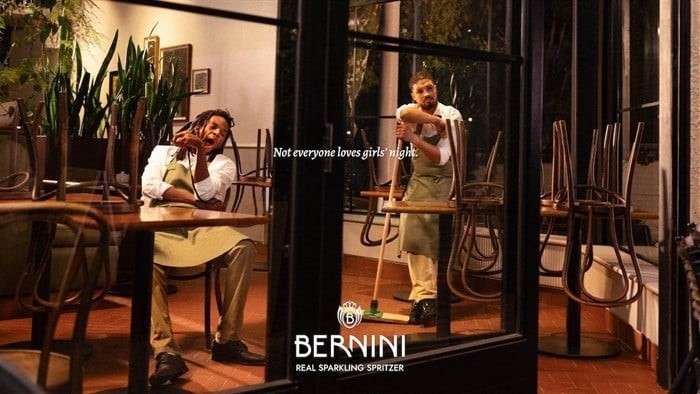
At first glance, the premise is deceptively simple. A restaurant at closing time. Chairs stacked. Lights dimmed. Staff waiting. And one table that refuses to empty. The women at the centre of the story are never shown. Yet their presence dominates the frame.
This absence is precisely the point.
Reframing the Familiar
The Last To Leave campaign marks a deliberate shift in perspective. Rather than portraying the conviviality of a girls’ night directly, it captures its consequences. The lingering. The delay. The quiet tension between closing time and connection.
By doing so, Bernini transforms a familiar social ritual into a subtle narrative device. The campaign’s line, “Not everyone loves girls’ night,” is less a critique than a clever inversion. It invites the audience to see the experience from the viewpoint of those outside it, particularly restaurant staff waiting for the night to end.
This reframing achieves two things at once. It creates humour through recognition, and it deepens the emotional resonance of the moment. The longer the night stretches, the more valuable it appears.
The Power of What Is Not Seen
In a media environment saturated with visuals, Bernini’s decision to omit its central characters is striking. The women are never shown, yet their presence is unmistakable. It is conveyed through the body language of waiters, the stillness of the room, and the subtle cues of a space that should have emptied but has not.
This technique reflects a more mature approach to brand storytelling. Rather than presenting the experience explicitly, the campaign allows the audience to reconstruct it mentally. In doing so, it engages imagination, not just attention.
It is also consistent with the brand’s broader positioning around “realness.” The campaign is shot using real photography and real people, avoiding artificial enhancement. This commitment reinforces authenticity, a quality increasingly valued by consumers navigating a landscape of curated and often synthetic content.
Extending a Brand Platform
The campaign builds on Bernini’s earlier Breathe It In platform, introduced in late 2025. That initiative encouraged consumers to slow down and appreciate the present moment. Last To Leave extends this idea from the individual to the collective.
Where Breathe It In focused on personal mindfulness, Last To Leave explores shared experience. It suggests that the most meaningful moments are not just felt individually but created in connection with others. Time, in this context, becomes elastic. It stretches in the presence of genuine engagement.
This evolution is strategic. It moves the brand from a product narrative to a lifestyle narrative, embedding it within the rituals of social interaction.
Distribution as Reinforcement
The campaign’s rollout across multiple channels reinforces its intent. Print placements in mainstream publications, outdoor executions on digital billboards, and in-store visibility through retail outlets ensure that the message is encountered in varied contexts.
Yet the creative remains consistent across these touchpoints. The same restrained imagery, the same quiet tension, the same understated humour. This coherence strengthens recall and reinforces the campaign’s central insight.
In an age where campaigns often fragment across platforms, Bernini’s approach demonstrates the value of disciplined execution.
A Study in Cultural Observation
At its core, Last To Leave succeeds because it is grounded in observation rather than invention. The scenario it depicts is widely recognisable. Anyone who has worked in hospitality, or simply stayed too long at a restaurant, understands the dynamic.
This universality is what gives the campaign its reach. It does not depend on niche references or complex narratives. Instead, it taps into a shared social experience, making it both accessible and memorable.
For a brand positioned around connection, this is a logical extension. It situates Bernini not just as a beverage, but as a participant in moments that matter.
Implications for African Brand Communication
The campaign offers broader lessons for marketing across Africa, where audiences are increasingly discerning and less responsive to overt persuasion.
First, insight is replacing intensity. Rather than louder messaging, brands are finding impact through sharper observation. A well-chosen moment can carry more weight than an elaborate storyline.
Second, authenticity is becoming non-negotiable. In a landscape shaped by digital manipulation, the use of real people and real settings signals credibility. It aligns with a growing preference for the tangible and the genuine.
Third, absence can be as powerful as presence. By choosing not to show its protagonists, Bernini creates intrigue and invites participation. The audience fills in the gaps, making the experience more personal.
The Brand as Ritual
Perhaps the most significant aspect of the campaign is how it positions the brand within a ritual. Bernini is not presented as the centre of attention, but as part of the environment in which connection unfolds.
This is a subtle but important distinction. It shifts the brand from being an object of consumption to being an enabler of experience. In doing so, it aligns itself with moments that consumers value, rather than competing for attention within them.
The closing idea of the campaign captures this succinctly. Some moments are too good to leave. The implication is clear: Bernini belongs in those moments.
A Quiet Confidence
In choosing restraint over spectacle, Bernini demonstrates a quiet confidence. It trusts the strength of its insight and the intelligence of its audience. It does not over-explain or over-produce. It simply observes and reflects.
In a crowded market, this approach stands out precisely because it does less.
And in doing so, it reveals a broader truth about contemporary marketing. The most effective campaigns are not always the loudest. They are the ones that recognise something real and present it with clarity.
Last To Leave does exactly that.