

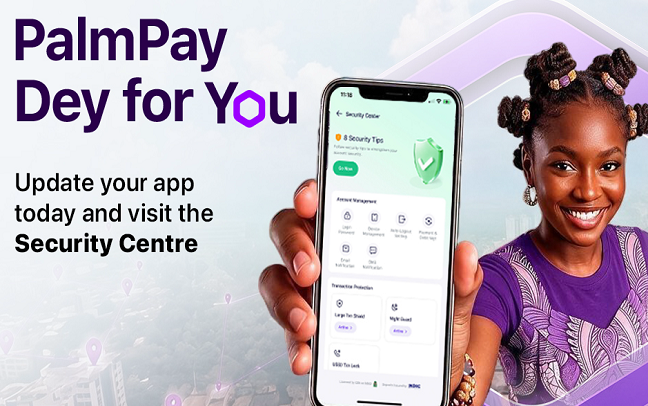

PalmPay Dey For You’ arrives just as national fraud data shows losses falling in aggregate but concentrating into fewer, larger, more damaging incidents – a nuance the campaign’s reassurance narrative glosses over
Trust, in Nigerian fintech, has become the product as much as the payment rail itself. This week, PalmPay formalised that reality with the launch of “PalmPay Dey For You,” a customer-facing campaign built entirely around account security, fraud awareness, and giving users visible control over their money – at a moment when public conversation about the safety of digital financial platforms in Nigeria has rarely been louder.
The Report
PalmPay, which operates under a Central Bank of Nigeria (CBN) licence with eligible customer deposits insured by the Nigeria Deposit Insurance Corporation (NDIC), unveiled the campaign as part of a broader effort to reassure its user base amid heightened scrutiny of digital financial services. The company’s regulatory standing has, in fact, strengthened recently: the CBN upgraded PalmPay to a full national mobile money operating licence – the highest tier available to an operator of its kind – in January 2026, a fact the company is now leaning on directly in its messaging.
Speaking on the initiative, PalmPay Nigeria’s Managing Director, Chika Nwosu, framed the campaign around institutional trust as the foundation of the banking relationship. Customers, he said, need certainty that the institution holding their money is regulated, secure, dependable, and reachable when something goes wrong. He described the campaign as reinforcing PalmPay’s commitment to protecting customers while giving them greater command over their own banking experience, and said the company wants users to understand the security tools available to them, use those tools with confidence, and see PalmPay as a dependable financial partner for everyday needs.
The campaign centres on PalmPay’s in-app Security Centre, a consolidated set of tools for protecting accounts and monitoring risk. Among the newer features is Location Guard, which lets customers designate up to six trusted locations and flags account activity originating outside them, and NightGuard, which layers additional protection over hours the customer selects – an implicit acknowledgment that late-night hours are a disproportionate window for unauthorised access attempts. The company has also built out self-service recovery tools for lost devices: dialling 86112# locks a PalmPay account outright, while 8617*5# locks a linked card, both without needing app access. A dedicated Dispute Page inside the app now lets customers file and track transaction complaints directly, rather than relying solely on call-centre escalation.
PalmPay described the underlying philosophy as “security by design” – protection built into the customer experience from the outset rather than bolted on reactively after an incident. The campaign itself blends these product features with educational content, FAQs, and customer forums intended to raise practical fraud awareness, echoing an anti-fraud sensitisation drive the company ran in Kano in 2025, which similarly focused on warning customers against sharing OTPs or account details with unsolicited callers.
The push lands against a backdrop of intensifying competition and complaint volume across Nigeria’s mobile money sector. Independent coverage of the campaign’s launch has noted that PalmPay, despite its scale as one of Nigeria’s largest fintech platforms by user count, continues to face a familiar tension: broad, fast-growing adoption paired with persistent customer complaints about failed transfers, unauthorised deductions, and support responsiveness -precisely the friction points this campaign is designed to visibly address.
BrandiQ Analysis
Strip away the campaign language and what remains is a company making a calculated bet that trust, not features, is now the scarcest resource in Nigerian digital finance – and the national fraud data explains exactly why that bet is rational.
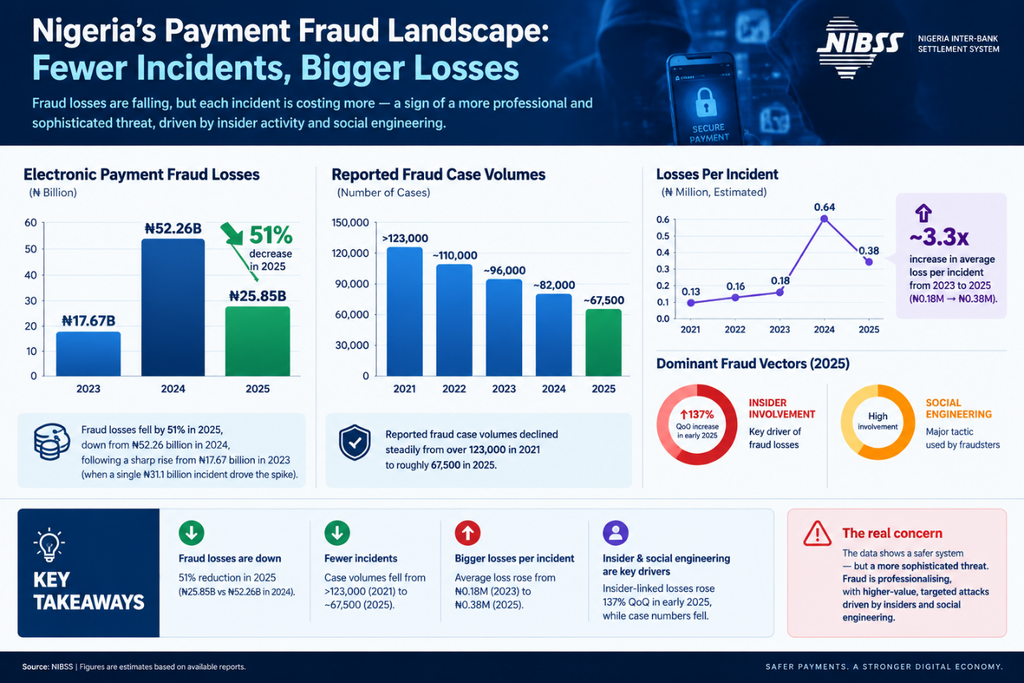
The headline fraud numbers are genuinely improving, which makes the anxiety more interesting, not less. According to the Nigeria Inter-Bank Settlement System (NIBSS), industry-wide electronic payment fraud losses fell 51 percent in 2025, to roughly ₦25.85 billion, down from ₦52.26 billion in 2024 – itself a sharp jump from ₦17.67 billion in 2023, driven largely by a single ₦31.1 billion incident. Reported fraud case volumes have also declined steadily, from over 123,000 in 2021 to roughly 67,500 in 2025. On paper, the system is getting safer. But the deeper trend inside that data is the one that should worry both operators and customers: fewer incidents are producing sharply larger losses per incident, meaning fraud is professionalising. NIBSS and industry analysts increasingly point to insider involvement and social engineering, rather than blunt technical breaches, as the dominant vector staff-linked fraud losses reportedly rose 137 percent quarter-on-quarter in early 2025 even as the number of such cases fell. That is a distinction consumer-facing security messaging like Location Guard and NightGuard does not fully address, because insider fraud does not care what location or time window a customer sets – it originates from inside the institution’s own access controls.
Trust-branding is also a competitive necessity, not just a public-relations exercise. Nigeria’s mobile money and digital banking market has consolidated around a small number of dominant platforms – PalmPay, OPay, Moniepoint and the traditional banks’ own apps chief among them – competing for the same finite pool of increasingly fraud-literate customers. In a market this concentrated, a single high-profile fraud story involving any major platform tends to depress confidence across the category, not just for the platform involved, because most retail customers cannot easily distinguish one fintech’s security architecture from another’s. That dynamic creates an incentive for the market leader to invest disproportionately in visible reassurance, since the downside of a trust collapse – mass withdrawal, regulatory scrutiny, slowed customer acquisition is asymmetric to the cost of a well-produced awareness campaign. PalmPay’s timing, upgrading its regulatory tier in January and launching a trust campaign mid-year, reads as a company sequencing its compliance credentials before it needs them defensively.
Geographic concentration data suggests the campaign’s real audience may be narrower than the national framing implies. NIBSS figures show Lagos alone accounted for over 63 percent of reported fraud activity in 2025, with Abuja, Ogun, Rivers and Delta trailing far behind. A national campaign is, in practice, disproportionately a Lagos-commercial-corridor campaign, reflecting where transaction density, smartphone penetration and fraudster targeting are all highest simultaneously. For BrandiQ’s readers assessing similar campaigns from competitors, this is a useful diagnostic: national security messaging in Nigerian fintech is frequently calibrated to protect the market segment generating the most transaction value, not necessarily the segment facing the highest personal risk exposure – often lower-income, less digitally literate users in secondary cities, who NIBSS data suggests remain disproportionately vulnerable to social-engineering tactics regardless of which platform they use.
The regulatory subtext is doing real commercial work. Nwosu’s framing – that customers need to know an institution is “regulated, secure, dependable” – is not incidental language; it is a direct response to a documented consumer anxiety in a market where unlicensed or loosely regulated digital lenders and wallets have previously collapsed or defrauded users at scale. Explicitly foregrounding the CBN licence and NDIC deposit insurance functions as a credibility signal that substitutes for the kind of institutional history traditional banks can lean on but a decade-old fintech cannot. Expect this pattern – regulatory-status-as-marketing – to intensify across Nigerian fintech as the CBN continues tightening licensing tiers and as customers, having lived through several high-profile platform failures, learn to price regulatory legitimacy into their choice of provider.
The unresolved question is whether product features can outrun customer behaviour. Every fraud-prevention tool PalmPay is promoting – Location Guard, NightGuard, instant lock codes – assumes a customer who is already alert enough to notice something is wrong and technically comfortable enough to act on it quickly. Yet the same data these campaigns implicitly respond to shows social engineering, not technical exploitation, as the industry’s dominant fraud technique, meaning the weakest link is frequently not the platform’s architecture but a customer persuaded to hand over credentials voluntarily. Awareness content genuinely helps here, but its effectiveness depends on reach and repetition in a market where fraud tactics evolve monthly. The real test of “PalmPay Dey For You” will not be how the campaign is received this quarter, but whether PalmPay’s own reported fraud and complaint volumes measurably decline over the following two, which so far remains an open — and unverified – question.
For brand strategists and fintech operators alike, the lesson generalises well beyond PalmPay: in a market where the underlying product (moving money) is close to commoditised, the brand that most convincingly narrates its own security posture, backed by visible regulatory credentials, increasingly wins the customer-acquisition argument before price or convenience even enter the conversation.